


Tarang Shakti 2026 to Bring Eight Air Forces to Jodhpur
Tarang Shakti 2026: IAF to Bring Eight Foreign Air Forces Together in Jodhpur
The Indian Air Force will begin the second edition of Exercise Tarang Shakti on September 26, bringing foreign fighter jets, transport aircraft, surveillance platforms and refuelling aircraft to Jodhpur for a large multinational air exercise.
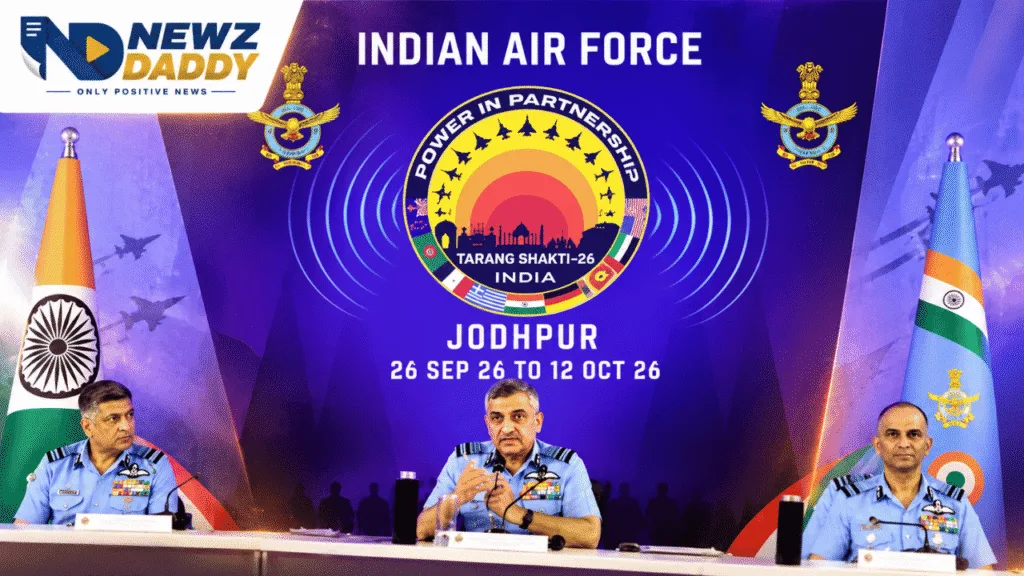
Air Marshal Ashutosh Dixit, Vice Chief of the Air Staff, briefed the media on the exercise on September 22. He explained the planned operations, participation by Friendly Foreign Air Forces, the range of missions and the major events scheduled during the exercise. The briefing gave a clearer picture of what the IAF plans to achieve when the exercise starts later this week.
Tarang Shakti 2026 will be held at Air Force Station Jodhpur and adjoining air bases from September 26 to October 12. Eight countries are expected to take part with air assets: Australia, Bangladesh, France, Germany, Greece, Sri Lanka, the United Arab Emirates and the United States. Another 32 countries are expected to attend as observers.
The exercise will cover a wide range of air operations. These include counter-air missions, air defence, combat operations, reconnaissance, airlift and air-to-air refuelling. The idea is to allow different air forces to plan and conduct missions in the same operational setting and learn how their aircraft, crews and support systems work together.
For India, the exercise also comes with a major new feature. US F-35A stealth fighters are expected to take part in a military exercise on Indian soil for the first time. The United States will also send KC-135 tanker aircraft. The F-35 has previously appeared in India at Aero India, but this will be its first participation in a military exercise in the country.
Other participating countries are also bringing important aircraft. France is expected to deploy Rafale fighters, A400M transport aircraft and an MRTT tanker. The UAE will participate with F-16 fighters and a Global 6000 aircraft. Australia will send a C-130J, Germany an A400M, Sri Lanka a KA-360ER surveillance aircraft and Bangladesh a C-130J.
The mix of aircraft means that Tarang Shakti will involve more than fighter operations. Transport aircraft, tankers and surveillance platforms are essential to modern air campaigns because they support fighters and help commanders maintain a wider picture of activity in the air.
The 2026 edition follows the first Tarang Shakti, held in 2024. That exercise was conducted in two phases at Sulur in Tamil Nadu and Jodhpur in Rajasthan.
Eleven countries took part with air assets during the 2024 exercise. Forty-five aircraft flew 76 missions, producing 867 sorties and more than 1,180 flying hours. The missions covered areas such as counter-air operations, air defence, close combat, reconnaissance, airlift and air-to-air refuelling.
The 2024 exercise was an important change in the way the IAF conducted multinational training. For many years, international air exercises involving India were mainly bilateral, with two air forces working together. Tarang Shakti brought several foreign air forces into one exercise framework.
Air Marshal Dixit said the IAF had earlier learned to operate with one foreign partner at a time, while Tarang Shakti changed that approach. The 2026 exercise is intended to build on the experience gained two years ago.
For the 2026 edition, invitations were sent to 65 friendly foreign countries. Eight have confirmed participation with aircraft, while 32 are expected to attend as observers. The IAF has also indicated that senior air force leaders from around 10 countries are expected to attend.
The exercise will also take place after a period in which air warfare has seen rapid changes. The IAF has said recent conflicts and military operations have shown the growing importance of precision weapons, integrated air defence, unmanned systems, intelligence and space-based capabilities.
Air Marshal Dixit said lessons from Operation Sindoor would also inform the exercise. He stressed that the exercise would not be a formal classroom on the operation. Instead, the experience gained during recent operations and the experience brought by foreign air forces would be considered during training.
That approach is relevant because modern air operations often involve several types of aircraft and systems working at the same time. Fighter aircraft may need information from surveillance platforms, support from tankers and coordination with ground-based air defence and other military assets.
Tarang Shakti allows participating forces to test these arrangements in a controlled training environment. It also allows crews to compare procedures and understand how other air forces plan and execute missions.
The exercise has a wider defence-industry angle as well. Foreign air forces taking part will operate alongside Indian aircraft and support systems, allowing visiting personnel to see equipment developed and produced in India.
The IAF has described the exercise as an opportunity to present the capabilities of India’s aerospace and defence sector to partner countries. Indian aircraft expected to participate include platforms such as the Rafale, Su-30MKI and other fighter and support aircraft.
The first Tarang Shakti also included activities linked to defence technology and professional exchanges. In September 2024, the IAF held a multinational symposium on Air Domain Awareness at Jodhpur, with delegates from 27 countries. Discussions covered airspace management, information sharing and technology.
The 2026 exercise is scheduled to run until October 12, with Indian Air Force Day falling on October 8 during the exercise period. Special engagements are planned around the occasion.
For the IAF, the coming weeks will therefore test more than individual aircraft. Tarang Shakti 2026 will bring together crews from several countries, different aircraft types and a broad set of air missions. The results will provide the participating forces with another opportunity to examine how well they can work together when operating in the same air campaign.
Must Read:
IAF Dronathon 2026 Tests New Drone Systems at Pokhran Range
Jaguar Conference Focuses on IAF Fleet Readiness