


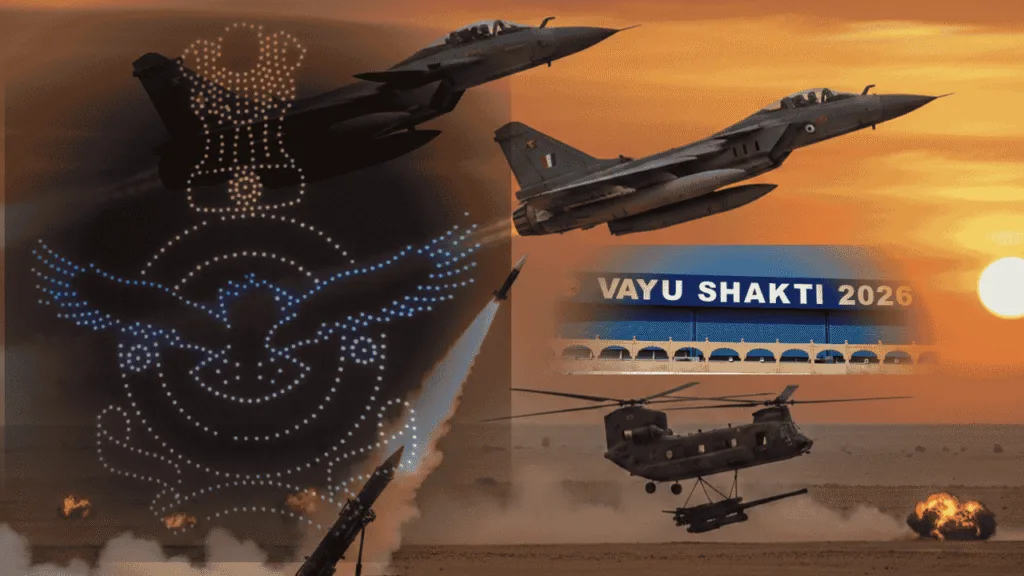
Vayushakthi 2026: A Proud Display of India’s Air Power
Vayushakthi 2026 Reveals A Fearless And Advanced Future For Our Brave Nation.
Synopsis of Vayushakthi 2026
- Precision Bombing: Rafale and Jaguar aircraft successfully destroyed simulated enemy runways and bunkers using advanced high-precision munitions.
- Indigenous Defence: The Indian-made Akash missile system demonstrated its effectiveness by intercepting and destroying aerial threats mid-air.
- Combat Logistics: Apache and Chinook helicopters showed their power by firing on targets and transporting heavy artillery and troops to forward positions.
- Air-Land Synergy: The exercise proved the seamless cooperation between the Air Force and the Army, essential for winning modern battles.
- Futuristic Technology: A massive drone swarm display highlighted India’s progress in unmanned combat systems and high-tech warfare.
- National Readiness: Held at Pokhran, the event confirmed the IAF’s status as a “force multiplier” capable of defending the nation in any environment.
The vast, golden sands of the Pokhran Field Firing Range recently became the stage for a breathtaking display of military might. Vayushakthi 2026 was not just a rehearsal; it was a vivid demonstration of the Indian Air Force’s (IAF) ability to strike with “relentless precision.” As an observer of global defence trends, it is clear that this exercise represents a massive leap in India’s aerial combat strategy and its move towards “Atmanirbharta” or self-reliance.
| Platform Name | Type | Key Role in Exercise | Top Speed / Range | Primary Weapons / Features |
| Dassault Rafale | Multi-role Fighter | Precision bombing & air superiority | Mach 1.8 / 3,700 km | Meteor missiles, SCALP-EG, Hammer bombs. |
| SEPECAT Jaguar | Strike Aircraft | Deep penetration & bunker busting | Mach 1.6 / 3,500 km | 30mm cannons, laser-guided bombs (DARIN III). |
| HAL Tejas | Light Combat Jet | Agile strike & indigenous showcase | Mach 1.8 / 1,850 km | Astra AAM, BrahMos-NG (future), multi-mode radar. |
| Boeing Apache | Attack Helicopter | Tank hunting & ground suppression | 284 km/h / 480 km | Hellfire missiles, 70mm rockets, 30mm chain gun. |
| Boeing Chinook | Heavy-Lift Heli | Artillery transport & troop insertion | 315 km/h / 741 km | Tandem rotors, triple-hook system for M777 guns. |
| Akash System | Surface-to-Air | Intercepting enemy aircraft/drones | Mach 2.5 / 25 km | Multi-target engagement, Rajendra 3D radar. |
Precision Strikes: The Tip of the Spear
The Vayushakthi 2026 exercise began with a literal roar as the Rafale and Jaguar jets tore through the sky. While the Rafale is often praised for its “omni-role” capabilities, seeing it in action at Pokhran highlighted its role as a “game-changer” in South Asian skies. These jets used advanced sensors to find and destroy simulated enemy runways.
Reports from leading defence journals suggest that the Rafale’s integration of the SCALP missile and HAMMER guided bombs allows it to hit targets from long distances, keeping pilots safe from enemy fire. The older but legendary Jaguar “Deep Penetration” aircraft followed up, proving that even classic airframes, when upgraded with modern navigation and attack systems (DARIN III), remain incredibly lethal against hardened bunkers.
A Shield Made in India
One of the most significant moments of the day at the Vayushakthi 2026 event was the successful deployment of the Akash Missile System. Unlike many systems bought from abroad, Akash is a home-grown hero. This surface-to-air missile system is designed to protect vital installations from “hostile aerial threats” like fighter jets, helicopters, and even drones.
According to recent updates from the Ministry of Defence, the Akash system is now 96% indigenous. At Vayushakthi, it proved its “detect and destroy” logic by intercepting fast-moving targets mid-air. Experts note that the system’s ability to engage multiple targets simultaneously makes it a cornerstone of India’s integrated air defence, ensuring that the nation’s skies remain un-pierced by intruders.
The Heavy Lifters: Vertical Battlefields
While the fighter jets grabbed the headlines, the “workhorses” of the IAF showed why they are the backbone of the army. The Boeing Apache and Chinook helicopters turned the desert into a frantic zone of activity. The Apache, often called a “flying tank,” used its Hellfire missiles and 30mm chain gun to clear the way for ground troops.
Meanwhile, the tandem-rotor Chinook demonstrated its incredible lifting power at the Vayushakthi 2026. In modern warfare, moving heavy artillery to high-altitude “forward zones” is a massive challenge. At Pokhran, the Chinook lifted M777 ultra-light howitzers as if they were toys, placing them exactly where the simulated “Army” needed them. Social media clips from the event showed these giant machines hovering in thick dust clouds, a testament to the skill of the pilots who operate in these “hot and high” conditions.

Drones: The Future is Here
The main difference between the Vayushakti 2024 and the Vayushakti 2026 was the drone display. As the sun dipped below the horizon, the focus shifted from brute force to high-tech grace. A spectacular drone show involving hundreds of unmanned aerial vehicles (UAVs) lit up the Pokhran sky. This wasn’t just for entertainment; it was a show of “network-centric warfare.” Modern journals frequently discuss “Swarm Technology,” where many small drones work together to confuse enemy radar or attack multiple points at once. By showcasing this, the IAF signalled that it is no longer just a traditional force but a futuristic one. These drones represent the shift towards “unmanned systems” that can carry out dangerous missions without risking human lives.
The Grand Finale
The main event on Friday will host President Droupadi Murmu and Defence Minister Rajnath Singh. Their presence underscores the national importance of this exercise. Vayushakthi 2026 is a message to the world: the Indian Air Force is ready, capable, and increasingly powered by its own technology. From the thundering engines of the Rafale to the silent, glowing path of a drone, India’s “Guardians of the Skies” have proven they are truly unstoppable.