


Women-led development will shape India’s powerful future
Women-Led Development Inspires India’s Emotional Journey to Viksit Bharat
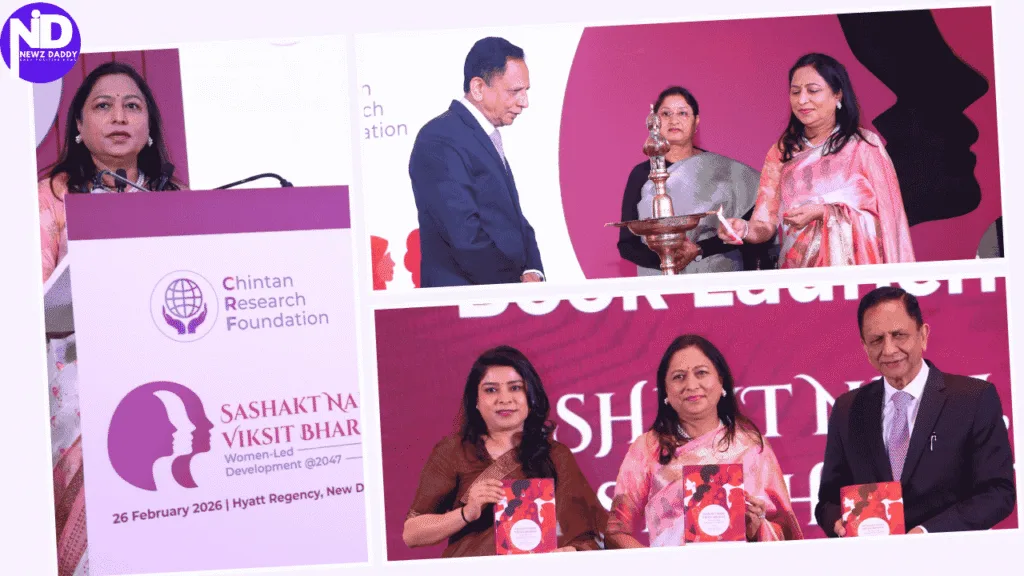
At the ‘Sashakt Nari, Viksit Bharat’ conference in New Delhi, the Chairperson of the Adani Foundation positioned women’s economic agency as central to the vision of Viksit Bharat 2047. She highlighted on-ground outcomes across agriculture, dairy, health and enterprise through initiatives led by the social welfare and development arm of the Adani Group. Her address underscored the convergence between grassroots practice and emerging national policy frameworks.
Speaking at the “Sashakt Nari, Viksit Bharat” conference organised by the Chintan Research Foundation (CRF), a New Delhi-based public policy think tank, Dr Priti Adani, Chairperson of the Adani Foundation, called for women to be recognised as central architects of India’s growth journey towards Viksit Bharat 2047.
India’s push for Viksit Bharat 2047 is part of a long-term national plan. The goal is to make India a fully developed country by the time it marks 100 years of Independence. Experts say this cannot happen unless women play a bigger role in the economy. Today, women make up nearly half of India’s population, but their share in the workforce is still much lower than that of men. Government data and global reports have shown that when more women work and earn, families become stronger, children get better education, and the whole economy grows faster.
Welcoming Union Minister for Women and Child Development, Smt. Annapurna Devi and Dr Adani acknowledged the policy momentum behind women-led development, while urging a shift from intent to sustained economic participation.
In recent years, the Government of India has launched many schemes to support women. These include financial support, skill training, and business loans. Programmes such as Stand Up India, Mudra Yojana, and National Rural Livelihood Mission have helped millions of women start small businesses. Experts say that moving women from small savings groups into full business ownership is the next big step. This helps women earn more and become decision-makers in their homes and communities.
Drawing on grassroots experience, she emphasised that empowerment begins with access. In rural communities where formal education levels are limited, women farmers supported by the Foundation, the social welfare and development arm of the Adani Group, have been introduced to simple agricultural mobile applications that guide irrigation, fertiliser use, seed selection and mandi price tracking. Improved access to information has translated into higher productivity, higher incomes and greater confidence.
This reflects a wider change happening across rural India. Mobile phones and internet access are helping farmers in new ways. Today, farmers can check weather forecasts, crop advice, and market prices from their phones. Government platforms and private apps are helping farmers avoid losses and earn better prices. Studies have shown that when women farmers use digital tools, they make better farming decisions and increase their income. This also improves food security for their families.
In the dairy sector, collective action has reshaped earning potential. Self-help group-led milk collection centres, facilitated by the Foundation, now include more than 3,500 women who collectively handle over 75 lakh litres of milk annually. Transparent pricing, quality testing and organised procurement have enhanced income stability and bargaining power.
India is the world’s largest milk producer, and women play a major role in this sector. In many villages, women take care of cattle, milk collection, and daily dairy work. Self-help groups have helped women sell milk together instead of alone. This gives them better prices and a steady income. Successful models like Amul have shown how women’s dairy cooperatives can transform village economies. These groups also help women gain respect and financial independence.
Dr Adani also referenced the Foundation’s flagship maternal and women’s health initiative, SuPoshan, through which trained local women volunteers have supported improved health outcomes for over 3.25 lakh women in the reproductive age group. Additionally, the Swabhimaan programme has enabled more than 4,500 women across 300 enterprise self-help groups to pursue sustainable livelihoods.
Women’s health has become a major focus area in India. Many rural women earlier did not get proper nutrition, health check-ups, or guidance. This affected both mothers and children. Health workers such as ASHA and Anganwadi staff have helped improve this situation. They provide advice on nutrition, pregnancy care, and child health. Studies show that when women are healthy, their families are healthier and more financially secure. Healthy women are also able to work and support their households better.
She underscored that empowerment is not about charity, but about expanding access to skills, finance, markets and leadership pathways.
This idea is strongly supported by economic research. Experts say giving women direct access to money, training, and markets leads to long-term change. Women invest more in their children’s health and education. Microfinance programmes across India have already helped millions of women start small businesses such as tailoring, food production, and handicrafts. Many of these women later grow into successful entrepreneurs.
Referring to the recent Union Budget’s Self-Help Entrepreneurs initiative, Dr Adani described it as an important policy step in enabling women to transition from micro-credit participants to enterprise owners with access to growth capital. She noted its alignment with the Foundation’s framework of Supporting Her Exponential Empowerment.
The Union Budget has placed a strong focus on women-led development. The government has increased support for women’s self-help groups and small entrepreneurs. These groups have already shown strong repayment records and business success. Experts believe that easier access to larger loans will help women expand their businesses and create jobs for others as well.
Across discussions on enterprise, governance and rural leadership, the message remained consistent: women’s economic participation is foundational to India’s long-term prosperity.
Global organisations such as the World Bank have said that India can grow much faster if more women join the workforce. Increasing women’s participation could add billions to the country’s economy. It also helps reduce poverty and inequality.
Concluding her address, Dr Adani urged institutions to dismantle structural barriers and widen access to opportunity. India’s next phase of development, she said, will be shaped in classrooms, training centres, village enterprises and digital marketplaces led by confident women.
Education and digital access are already opening new doors. More girls are going to school today than ever before. Women are also using online platforms to sell products, learn new skills, and run businesses from home. This digital shift is helping women become part of India’s modern economy.
Her closing words resonated with clarity: “Let her. And she will”.
This message reflects a wider belief that when women are given equal opportunity, they can drive powerful change. Across India, many women are already proving this through farming, business, education, and leadership. Their growing role is shaping not just their own future, but the future of the nation.
Must Read:
Dr Priti Adani Inspires India’s Future Leaders with Purpose
Dr. Priti Adani Honoured with Second Doctorate for Social Impact