


WPU Goa Transdisciplinary Education Targets AI Era Jobs
As AI Changes the Workplace, WPU Goa Puts Focus on Learning Across Disciplines
The rise of artificial intelligence is changing how people work, how companies hire and what skills employers value. Against this backdrop, leaders at World Peace University (WPU), Goa, say universities must prepare students for a working life that may involve several career changes rather than a single profession.
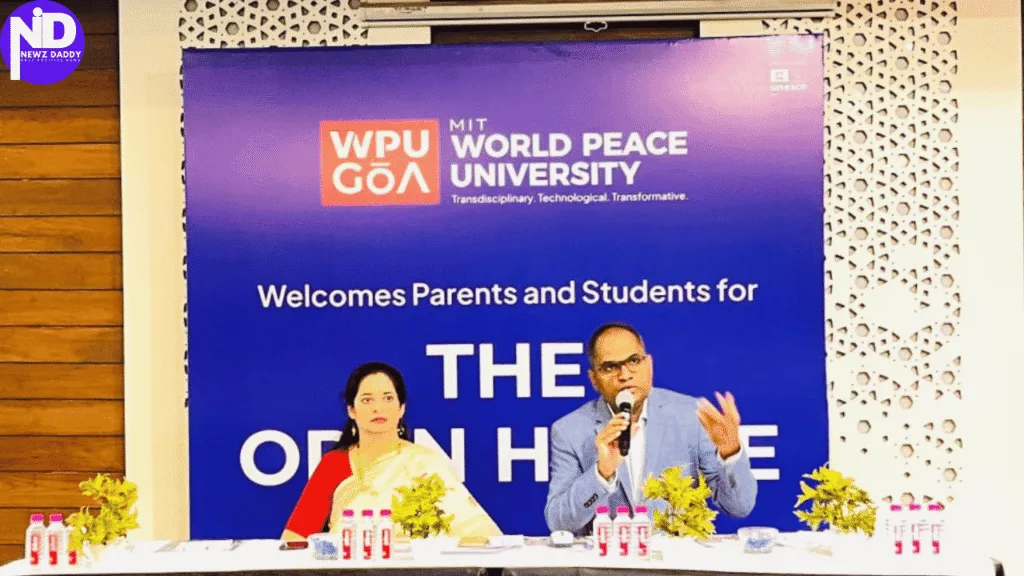
That message was at the centre of discussions during the WPU Goa Open House held on 20 June, where prospective students, parents and educators gathered to discuss how higher education is responding to rapid technological change.
The event came at a time when governments, businesses and educational institutions around the world are debating the impact of AI on jobs. Recent international studies have suggested that while artificial intelligence may automate some routine tasks, it is also expected to create demand for new skills, particularly those linked to problem-solving, communication, creativity and the ability to work across different fields.
University leaders argued that traditional academic models, built around narrow specialisation, may not be enough for a future in which industries are changing faster than ever before.
WPU Goa is being established around a transdisciplinary approach that encourages faculty and students to engage with perspectives beyond the boundaries of a single discipline. Through immersive learning, industry integration, global exposure, and active learning, the university aims to prepare graduates for a lifetime of learning, adaptation, and leadership, also opening the doors for excellent jobs in the private and public sector, where they can apply what they have learned,” said Vice Chancellor Professor Walter Leal.
The university is positioning itself around a transdisciplinary model, an approach that seeks to connect knowledge from different academic areas rather than treating subjects as separate fields. The concept has gained attention internationally as employers increasingly seek graduates who can understand complex problems from more than one perspective.
According to WPU Goa, students are encouraged to study beyond the limits of their chosen degree and examine how technology, business, design, psychology and other disciplines intersect. The institution describes itself as a transdisciplinary university and plans to offer learning experiences linked to industry exposure, community engagement and practical projects.
Dr Ashish Bharadwaj, Pro Vice Chancellor of WPU Goa, said universities must rethink their role in preparing students for an uncertain future.
“Universities can no longer assume that preparing students for their first job is enough,” said Dr Ashish Bharadwaj, Pro Vice Chancellor of WPU Goa. “The more important question is whether we are preparing students for the multiple changes, transitions and opportunities they will encounter throughout their lives. The future belongs not simply to specialists, but to individuals who can learn continuously, connect ideas across domains and respond to challenges that do not fit neatly into traditional categories.”
His comments reflect a wider debate taking place across higher education. Many employers now expect workers to update their skills regularly as technology changes. Jobs linked to data analysis, digital systems, artificial intelligence and sustainability have expanded rapidly over the past decade, while some routine administrative and technical tasks have become increasingly automated.
Education experts have pointed out that many children entering universities today could eventually work in occupations that do not yet exist. That reality has led institutions in several countries to review course structures and place greater emphasis on flexibility, teamwork and lifelong learning.
During the discussion, speakers examined how long-standing assumptions about higher education are being tested. Degree programmes have traditionally been designed around established professions such as engineering, management, medicine and law. Yet technological change is creating new career paths at a pace that often outstrips academic reform.
Participants heard that competition in the labour market increasingly comes from people who can combine knowledge from different fields. A software engineer with an understanding of psychology, a designer who understands business strategy, or a manager with strong technological knowledge may have advantages in sectors where collaboration across disciplines has become essential.
The conversation also addressed personal qualities that many employers now value alongside technical expertise. Curiosity, resilience, communication skills and the willingness to keep learning were described as important attributes for navigating future workplaces.
These themes align with broader trends in higher education. Around the world, universities are experimenting with interdisciplinary and transdisciplinary programmes that encourage students to tackle real-world problems involving multiple areas of knowledge. Issues such as climate change, public health, urban development and artificial intelligence often require contributions from scientists, economists, designers, policymakers and social researchers working together.
WPU Goa’s academic plans reflect this approach. The university currently offers B.Tech. in Computer Science and Engineering, Bachelor of Management Studies (Hons.), B.Des. in Integrated Product Design, B.Des. in Communication Design and B.Sc. (Hons.) in Psychology. The institution has also outlined plans for additional programmes in areas including economics, media, energy systems and semiconductor engineering in future years.
The university’s broader vision has been developing over several years. Reports surrounding the establishment of the Goa campus indicate that academic leaders and experts participated in extensive consultations while designing the institution’s educational framework. The campus is expected to begin academic operations for the 2026-27 academic year and has been promoted as a fully residential learning environment.
Another theme discussed during the Open House was employability. Parents and students often judge universities by graduate job outcomes, particularly at a time when concerns about automation and changing labour markets are growing.
Speakers argued that employability should not be viewed only as securing a first job after graduation. Instead, they said universities should help students develop the capacity to remain relevant throughout their careers, even as industries evolve and new technologies emerge.
That view reflects a growing shift in higher education policy discussions. Many experts now see learning as a continuous process rather than something completed at the end of a degree programme. Professional retraining, online learning, industry certifications and mid-career education are becoming increasingly common across many sectors.
For students considering university options, the debate goes beyond course selection. It raises broader questions about how education should prepare young people for a future that remains difficult to predict.
As artificial intelligence continues to reshape workplaces and industries, institutions such as WPU Goa are arguing that the strongest preparation may come from combining subject knowledge with adaptability, curiosity and the ability to understand problems from different angles. Whether that model becomes more widely adopted across higher education remains to be seen, but the discussion in Goa reflected a growing recognition that the future of work may require a different approach to learning than the one previous generations experienced.
Must Read:
International Law and Security Programme Opens at RRU
BIMSTEC Conference in Gandhinagar Sparks Hope for Stronger Ties