


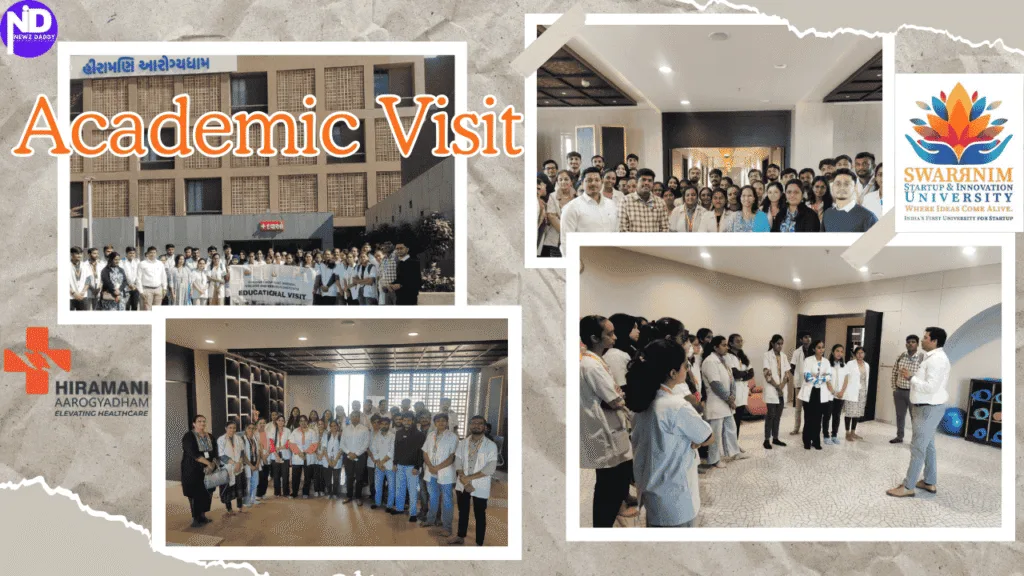
Academic Visit Sparks Ayurvedic Fire!
Students Felt Naturopathy Power in Epic Academic Visit Adventure!
Aarihant Ayurvedic Medical College & Research Institute Organises Academic Visit of Students to Hiramani Aarogyadham. Gandhinagar. Aarihant Ayurvedic Medical College & Research Institute, which is part of the Swarrnim Startup and Innovation University, recently concluded a two-day academic visit to Hiramani Aarogyadham. The event was organised at Swarrnim University’s Adalaj campus under the guidance of the Department of Swasthavritta and Yoga. The programme offered students hands-on exposure to key naturopathy and wellness practices.
Also Read:
Swarrnim students reflect on NEP 2020 and its impact through essay writing
Swarrnim Welcomes Future Engineers with a Heartwarming Orientation
In the BAMS second year, Swasthavritta and Yoga is designed to build skills in health protection, prevention, and lifestyle-based care, not only textbook learning. The national syllabus also includes Yoga and Naturopathy, showing that students are expected to understand these areas as part of modern Ayurveda training. This makes academic visits to the field useful because they help students link classroom ideas with real patient care and real equipment.
Some 89 second-year BAMS students, led by HOD Dr Sonali P Ladhi and four other faculty members, visited the centre in two batches on December 9-10. Such supervised academic visits match the course goal of learning by doing, through activities like field academic visits and health-institution visits that are built into the curriculum approach. Learning in batches also supports safer observation in therapy rooms, where space, privacy, and patient comfort matter.
Students observed therapies across mud treatment, hydrotherapy, physiotherapy, and yoga and meditation departments. Mud therapy is commonly used in naturopathy, and research reviews have reported that mud packs or mud baths were used in many studies, with a pooled finding of reduced pain in the analysed data. Hydrotherapy uses water at different temperatures and methods, and medical literature describes how hot water can relax muscles while cold water can stimulate circulation and help with inflammation control.
They also visited Ayurvedic therapy units, allopathic OPDs, radiology, pathology, blood bank and dialysis facilities located within the same premises. Seeing many departments in one campus helps students understand how different systems of care can sit side by side, which is often described as an “integrated” or “holistic” approach in hospitals offering more than one therapy stream. It also helps students learn why tests like radiology and pathology can support safe treatment planning, especially when patients have long-term illness or multiple problems.
Doctors at the centre, including Dr Nitesh and Dr Chinmay, guided students through various treatment rooms and demonstrated the therapeutic equipment used in clinical naturopathy. Guided demonstrations matter because safety and correct technique are key, especially in therapies that use temperature, pressure, or physical movement. In yoga too, clinical sources stress that practice should be learned with proper guidance, since poor technique or over-strain can cause harm, particularly for people with health risks.
The academic visit helped students understand the holistic healing systems in a better and more scientific way. For example, yoga is widely studied as a lifestyle support tool, and a 2024 review explains that yoga can help lower blood pressure by reducing stress and improving body balance systems. This type of evidence-linked learning supports a more science-aware view of traditional practices, which is important when students later speak to patients and other health professionals.
It also highlighted the practical application of natural therapies in managing chronic conditions. Whole-system naturopathic care is often discussed in research as a multi-modality approach used alongside standard care for long-term problems such as cardiovascular risk and pain conditions. At the same time, responsible training reinforces that such therapies should support, not replace, urgent medical care, and should be used with proper clinical judgement.
Students gained hands-on insight into naturopathy therapies like mud treatment, hydrotherapy, physiotherapy, and yoga, seeing how they apply in real settings. They learned the value of integrated care by touring Ayurvedic units alongside allopathic OPDs, radiology, pathology, blood bank, and dialysis facilities on one campus. Above all, the academic visit deepened their grasp of holistic healing as a scientific aid for chronic conditions, guided by experts like Dr Nitesh and Dr Chinmay.
Key Therapy Insights
Mud therapy drew from naturopathy’s use of earth to ease pain and inflammation, as shown in student observations of packs and baths. Hydrotherapy highlighted water’s role in relaxing muscles with heat or boosting circulation with cold, key for daily wellness. Yoga and meditation sessions stressed stress reduction and blood pressure control, linking ancient practice to modern evidence.
Holistic Systems Understanding
Exposure to multiple departments showed how natural therapies complement tests and urgent care like dialysis. This built skills in Swasthavritta and Yoga curriculum goals, such as prevention and lifestyle care through field academic visits. Students now better see practical uses for long-term health issues without replacing core medicine.
Also Read:
Swarrnim Institute of Law Constitution Day Sparks Awareness
Fresh Start With The Orientation Programme At Swarrnim University