


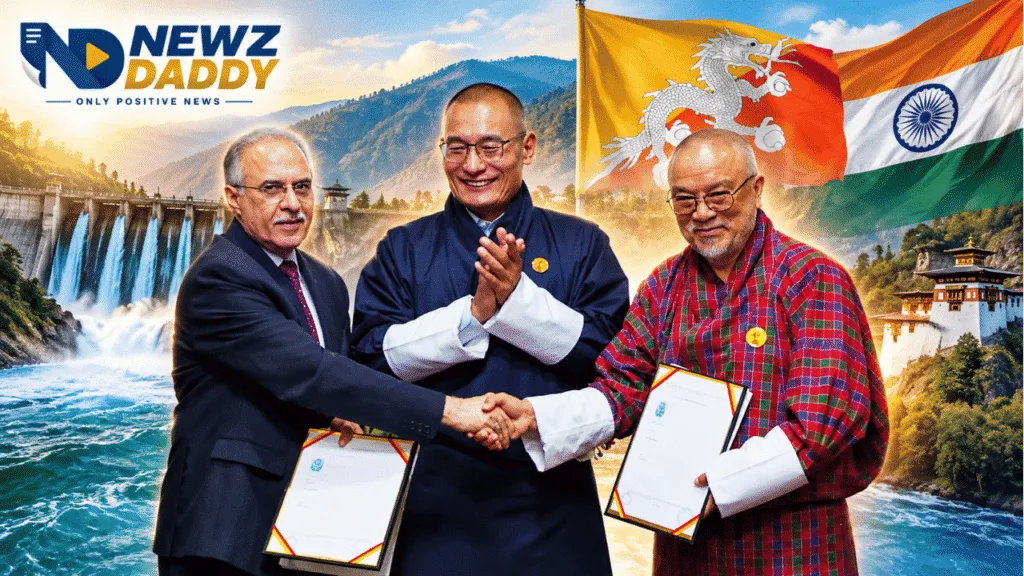
Chamkharchhu: Adani Power Signs 770 MW Bhutan Hydro Pact
Adani Power, Bhutan’s DGPC sign pact for 770 MW Chamkharchhu-I hydropower project
Construction is expected to begin in the first half of 2027, with the project targeted for completion within six years of groundbreaking
Adani Power and Bhutan’s state-owned Druk Green Power Corporation Ltd. (DGPC) have signed an agreement to develop the 770 MW Chamkharchhu-I Hydroelectric Project in Bhutan, adding another large power project to the growing energy partnership between the two countries.
The Shareholders Agreement was signed on October 6, 2026, in the presence of Bhutanese Prime Minister Lyonchen Dasho Tshering Tobgay. Bhutan’s Finance Minister and Minister of Energy and Natural Resources, along with officials from Druk Holding & Investments Limited, Bhutan Power Corporation Limited, DGPC and Adani Power, also attended the ceremony.
The project will be built on the Chamkharchhu River in Zhemgang District in central Bhutan. It is planned as a peaking run-of-river hydropower project and will operate under a Build, Own, Operate and Transfer model.
Adani Power will hold 49% of the project company, while DGPC will hold the larger 51% share. The concession will run for 30 years from the commercial operation date.
Construction is expected to start during the first half of 2027. The partners have set a target of commissioning the project within six years of groundbreaking.
The Chamkharchhu-I agreement is the second major hydropower project being developed by Adani Power and DGPC. In September 2025, the two companies signed agreements for the 570 MW Wangchhu Hydroelectric Project.
The two projects sit within a much larger plan. In May 2025, the Adani Group and DGPC signed a memorandum of understanding covering the development of up to 5,000 MW of hydropower projects in Bhutan. The programme includes hydropower and pumped-storage projects to be taken forward in phases.
For Bhutan, the timing of new hydropower projects is important because the country depends heavily on electricity generated from its rivers. Hydropower provides most of its domestic electricity, but generation can fall during the dry winter months when river flows are lower.
India already plays a major role in Bhutan’s electricity trade. According to India’s Ministry of External Affairs, the two countries have jointly developed five major hydropower projects with a combined capacity of 3,156 MW. These include Chukha, Kurichhu, Tala, Mangdechhu and Punatsangchhu-II. Punatsangchhu-II, with a capacity of 1,020 MW, was completed in August 2025. A 1,200 MW Punatsangchhu-I project remains under construction.
The electricity relationship works in both directions. Bhutan exports surplus hydropower to India, while India has also supported electricity supplies to Bhutan during periods when the Himalayan country faces shortages in the lean season. The two governments have been working to expand power trading and grid links as part of their wider energy partnership.
Chamkharchhu-I has been planned with this seasonal pattern in mind. According to the project partners, electricity from the plant is expected to help Bhutan meet peak winter demand. During periods of higher water availability in summer, surplus electricity could be exported to India.
Anil Sardana, Managing Director of Adani Power Ltd., said:
“We are delighted to strengthen our partnership with the Royal Government of Bhutan and DGPC through the Chamkharchhu Hydroelectric Project. Hydropower will play a pivotal role in accelerating South Asia’s energy transition, and this project will contribute significantly to enhancing energy security, reducing carbon intensity, and advancing shared sustainability goals. While the project is expected to help meet Bhutan’s peak winter electricity requirements, it will also enable the export of surplus green power to India during the summer months, creating long-term value for both nations,”
DGPC Managing Director Dasho Chhewang Rinzin said:
“This partnership marks another significant milestone in Bhutan’s hydropower development journey and further strengthens the long-standing energy partnership between Bhutan and India. The 770 MW Chamkharchhu-I Hydropower Project will contribute to strengthening Bhutan’s energy security, particularly during the winter months, while creating opportunities to optimise and export surplus clean energy to India. Beyond the project itself, this collaboration reflects our shared commitment to developing Bhutan’s renewable energy resources through strong partnerships and responsible, efficient project delivery. We look forward to working closely with Adani Power to realise this important project and to advancing further opportunities under the broader hydropower development partnership,”
The wider India-Bhutan hydropower relationship goes back several decades. India’s Ministry of External Affairs describes hydropower as a central part of bilateral cooperation. Bhutan has a large river-fed power resource, although only a portion of its estimated potential has been developed.
Bhutan is also seeking to expand beyond hydropower. Its energy plans include greater use of solar power, with the National Solar Energy Roadmap targeting 5,000 MW of solar capacity by 2040. The government has also been opening parts of the renewable energy sector to private investment.
That shift matters because hydropower output can vary with water availability. Bhutan’s energy authorities have been looking at solar and other sources alongside hydro to improve supply through the year. The country’s Department of Energy also maintains plant-level electricity generation data covering hydropower stations dating back to 1986.
The Chamkharchhu-I project therefore adds another major plant to a power relationship that has long linked Bhutan’s rivers with India’s electricity market. Both Adani Power and DGPC remain engaged in discussions on other projects under the 5,000 MW programme.
For Bhutan, the immediate test will be turning the agreement into construction and then reliable generation. For India, the project could add another source of electricity from a neighbouring country with which it already has established power-trading links.
The next major milestone is expected in 2027, when construction of the 770 MW Chamkharchhu-I project is scheduled to begin.