


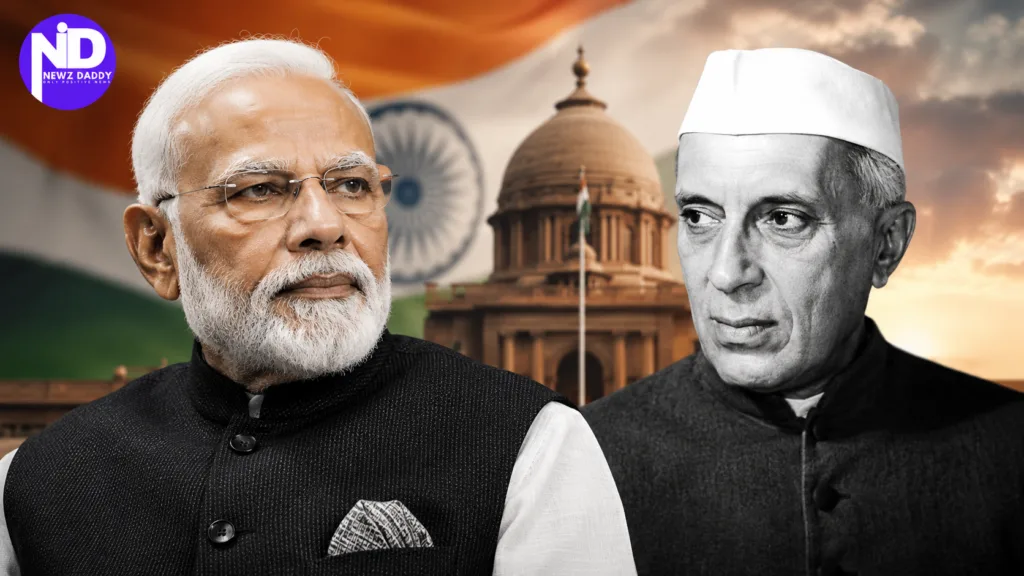
PM Modi Surpasses Nehru to Become India’s Longest-Serving Elected Prime Minister
Narendra Modi Has Achieved A Major Political Milestone By Becoming India’s Longest-Serving Elected Prime Minister
A Historic Moment in Indian Politics
Prime Minister Narendra Modi has achieved a major political milestone by becoming India’s longest-serving elected Prime Minister. On 10 June 2026, he completed 4,399 consecutive days in office, surpassing the record previously held by India’s first Prime Minister, Jawaharlal Nehru.
The achievement has sparked discussion across the political spectrum. Supporters describe it as a sign of public trust and political stability, while critics argue that the true measure of a leader should be governance outcomes rather than time spent in office.
Regardless of political views, the development marks an important moment in India’s democratic history.
What Exactly Happened?
Narendra Modi first took office as Prime Minister on 26 May 2014 after the Bharatiya Janata Party (BJP) won a majority in the Lok Sabha.
He was re-elected in 2019 and again in 2024, becoming one of the few Indian leaders to win three consecutive national elections.
By completing 4,399 consecutive days as Prime Minister, Modi moved ahead of Jawaharlal Nehru’s record for the longest uninterrupted tenure by an elected Prime Minister.
The milestone was celebrated by BJP leaders and party workers across the country. Messages of congratulations also came from several international leaders and members of the Indian diaspora.
Understanding the Difference Between Nehru’s Record and Modi’s Record
The comparison between Nehru and Modi requires some context.
Jawaharlal Nehru served as Prime Minister from 15 August 1947 until his death on 27 May 1964. His tenure lasted nearly 17 years.
Narendra Modi has now surpassed Nehru’s record for consecutive service as an elected Prime Minister.
However, political historians note that the two leaders governed under very different circumstances.
Nehru led a newly independent nation facing enormous challenges such as Partition, refugee rehabilitation, institution-building, and economic planning.
Modi leads a much larger and more developed India in an era shaped by globalisation, digital technology, social media, geopolitical competition, and rapid economic change.
Because of these differences, many analysts believe the two leaders are difficult to compare directly.
How Did Modi Reach This Milestone?
Several factors have contributed to Modi’s long tenure.
Strong Electoral Success
The BJP has emerged as the dominant force in national politics during the past decade.
Under Modi’s leadership, the party won:
- Lok Sabha Election 2014
- Lok Sabha Election 2019
- Lok Sabha Election 2024
Winning three consecutive national elections is rare in Indian politics and has helped Modi maintain his position at the centre of national decision-making.
Personal Popularity
Political analysts often point to Modi’s personal popularity as one of the key reasons behind the BJP’s electoral success.
His supporters view him as a decisive leader who communicates directly with citizens through public rallies, radio programmes, social media, and government campaigns.
The BJP’s nationwide organisational network has also played a major role.
The party has expanded its presence in several states and built a strong election machinery that remains active throughout the year rather than only during election campaigns.
Welfare and Development Programmes
Government schemes aimed at housing, sanitation, digital services, financial inclusion, cooking gas connections, and infrastructure development have helped the BJP build support among different sections of society.
Supporters argue that these programmes have improved the lives of millions of citizens.
Why Is This Milestone Politically Important?
The achievement is important because it reflects a period of unusual political continuity in a country known for coalition politics and changing electoral trends.
For decades, Indian politics have often witnessed unstable governments, coalition arrangements, and frequent political shifts.
Modi’s long tenure represents one of the most stable periods of national leadership since independence.
The milestone also strengthens the BJP’s narrative that it remains the country’s most influential political force.
For party supporters, the record serves as evidence of sustained public support across multiple elections.
What Does the Opposition Say?
Opposition parties have responded differently.
Some opposition leaders have acknowledged the significance of the record while emphasising that democratic accountability remains more important than longevity.
Critics argue that a long tenure alone should not determine a leader’s legacy.
They point to issues such as unemployment, inflation, social tensions, and economic challenges that they believe deserve greater attention.
Congress leaders have often argued that historical comparisons should consider broader indicators such as institution-building, economic growth, social development, and constitutional values.
As a result, the debate has shifted from the number of days in office to the impact of governance.
Supporters’ View: Why Many See the Record as Significant
Supporters of the Prime Minister present several arguments.
They say:
- Political stability has improved decision-making.
- India’s global profile has grown significantly.
- Infrastructure development has accelerated.
- Digital governance has expanded rapidly.
- Welfare delivery has become more targeted through technology.
- India has emerged as a major voice in international forums.
Many BJP supporters also view the record as proof that voters have repeatedly endorsed Modi’s leadership through democratic elections.
Critics’ View: Concerns and Questions
Critics present a different perspective.
They argue that:
- Economic inequality remains a challenge.
- Youth unemployment continues to be a concern.
- Inflation affects many households.
- Democratic institutions must remain strong regardless of who governs.
- Long political dominance can reduce the strength of opposition politics.
These concerns continue to be part of the broader political debate surrounding the Modi government.
What Does This Mean for Ordinary Citizens?
For most citizens, the record itself does not immediately change daily life.
However, it reflects a period of political continuity that can influence government policies, economic planning, investment decisions, and international relations.
Supporters believe continuity allows long-term projects to move forward without major disruption.
Others argue that strong democratic competition is equally important for ensuring accountability.
Ultimately, voters will continue to judge governments based on issues that affect everyday life, including jobs, prices, education, healthcare, and public services.
How Does This Affect BJP and Congress?
For BJP
The milestone provides a powerful political message.
The party is likely to use the achievement to reinforce its image as India’s dominant national force.
It may also become a central theme in future political campaigns and public outreach programmes.
For Congress and Other Opposition Parties
The development creates a new challenge.
Opposition parties, particularly Congress, must now respond not only to the BJP’s current policies but also to a growing narrative centred on Modi’s historical place in Indian politics.
This could encourage opposition parties to focus more on governance issues, economic concerns, and alternative policy proposals.
Modi and Nehru: A Debate That Will Continue
The comparison between Narendra Modi and Jawaharlal Nehru is likely to continue for years.
Both leaders have shaped India during very different periods of history.
Nehru is remembered for helping build the foundations of modern India after independence.
Modi is associated with an era marked by digital transformation, infrastructure expansion, welfare delivery reforms, and a stronger global presence.
Historians, political scientists, and voters will continue debating their respective contributions.
What Happens Next?
The record is unlikely to have an immediate effect on government policy. However, it adds another chapter to Modi’s political legacy and may influence future political discussions.
Attention will now turn to how the government handles key challenges such as economic growth, employment generation, inflation management, national security, and India’s role in global affairs.
As India moves towards future elections, voters will ultimately decide how this period of leadership is remembered.
Narendra Modi becoming India’s longest-serving elected Prime Minister is more than a personal milestone. It is a significant event in the country’s political history.
For supporters, it reflects public trust, political stability, and strong leadership. For critics, it is an opportunity to evaluate the government’s overall record and examine unresolved challenges.
The milestone has already become part of a larger conversation about leadership, democracy, governance, and India’s future direction.
While opinions differ, one fact is clear: Narendra Modi’s place in India’s political history has become even more significant, and the debate over his legacy is likely to continue for many years.