


Ahmedabad Leads Water Security India Emotional Shift
Adani Foundation, Centre for Environment Education convene dialogue on water security and inclusive stewardship
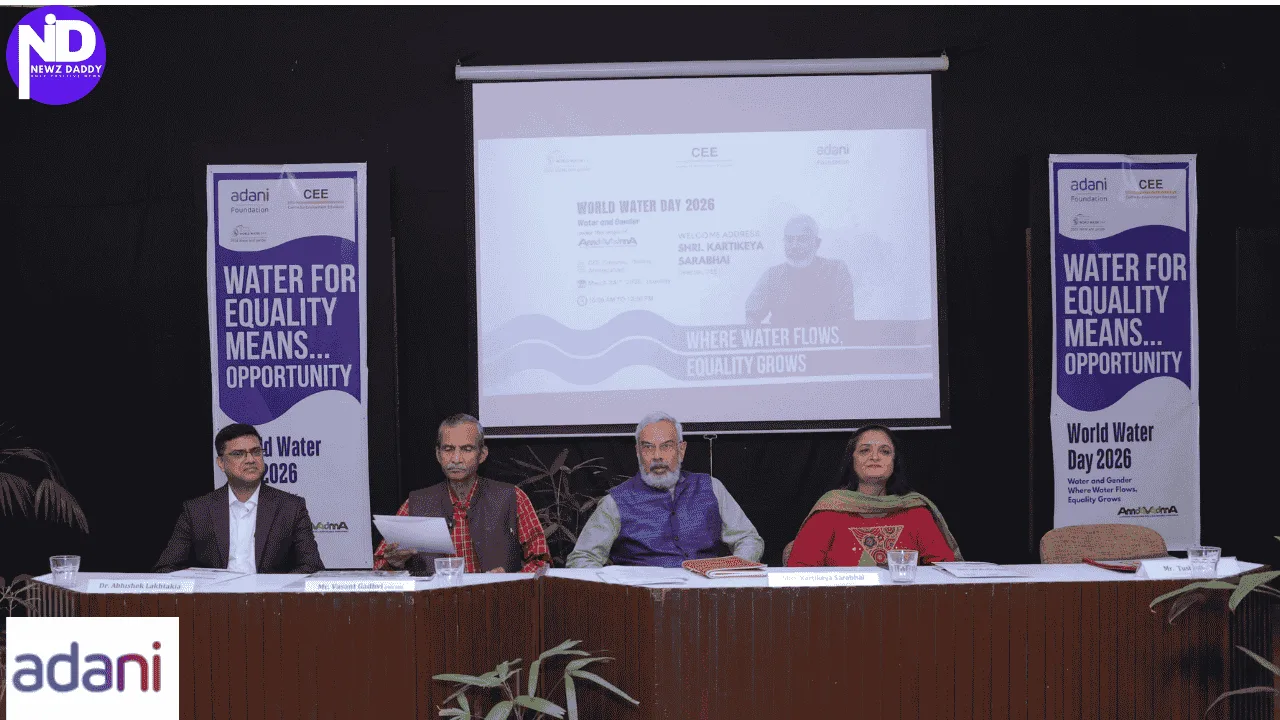
The Adani Foundation, the social welfare and development arm of the Adani Group, in partnership with the Centre for Environment Education (CEE), a nationally recognised environmental education organisation, convened a multi-stakeholder dialogue on water security at the CEE campus in Ahmedabad to mark World Water Day 2026.
The event brought together policymakers, industry representatives, corporate social responsibility (CSR) leaders and development practitioners to discuss solutions to India’s water challenges. Such gatherings are becoming more common across India, as experts warn that water stress is no longer a future problem but a present reality. Studies from global agencies show that many Indian cities could face severe groundwater shortages if action is delayed.
Mr Kartikeya Sarabhai, Director, CEE, said: “Water will remain one of the defining challenges of our time. We must move beyond the illusion of abundance and recognise the disproportionate burden water scarcity places on women in rural India. The way forward lies in combining traditional knowledge with youth-led action. A Viksit Bharat must begin with valuing every drop.”
His point reflects findings seen across rural India, where women often walk long distances daily to collect water. Reports from development groups show that in some regions, women spend several hours each day on this task. This affects education, health, and opportunities for income. Many experts now believe that involving women in water planning leads to better outcomes, as they understand local needs deeply.
Mr Vasant Gadhavi, Director, Adani Foundation, who attended as Chief Guest, said: “Water security cannot be addressed through policy alone. Communities must drive it. World Water Day is a moment to reflect on the urgency of groundwater depletion and climate variability, but also to act. At the Adani Foundation, we focus on enabling local ownership of water resources so that conservation becomes a sustained, collective movement.”
This idea of community ownership has been widely supported by successful projects in states like Maharashtra and Rajasthan. Villages that manage their own water systems often see better results, including improved crop yield and reduced migration. Experts say that when people feel responsible for water, they protect it more carefully.
Aligned with the United Nations’ theme for World Water Day 2026, “Water and Gender,” the dialogue highlighted the link between water access and gender equity and the need for coordinated and scalable interventions. Global reports have shown that better water access can improve girls’ school attendance and reduce health risks, especially in low-income areas.
India supports nearly one-fifth of the global population with limited freshwater availability, making water security a key development priority. According to widely cited research, India has only about 4 per cent of the world’s freshwater resources. This gap creates pressure on rivers, lakes and underground water. Rapid urban growth and climate change are making the situation even more complex.
Participants said water access remains critical to livelihoods, agriculture and long-term economic resilience. Agriculture alone uses a large share of India’s water, and inefficient irrigation methods often lead to wastage. Experts are now promoting drip irrigation, rainwater harvesting and crop planning as ways to save water without reducing output.
The Foundation said it continues to expand community-led water management programmes in water-stressed regions, integrating conservation, access and governance. Similar programmes across India have shown that small steps, like building check dams and restoring ponds, can bring big changes over time.
As part of these efforts, 16.28 billion litres of additional water storage capacity have been created across India. The initiatives span Kutch in Gujarat, parts of Rajasthan and Vidarbha in Maharashtra, with a focus on watershed development, rainwater harvesting and community-led water governance. In many of these areas, farmers have reported better crop cycles and improved groundwater levels after such interventions.
The event included technical sessions on urban water systems, water, sanitation and hygiene (WASH) interventions and community-led governance models. Cities, in particular, face rising demand and ageing infrastructure. Experts often highlight the need for recycling wastewater and reducing leaks to ensure a long-term supply.
A panel discussion examined partnerships between government, industry and civil society to scale water solutions. Across the world, such partnerships are seen as key to solving complex problems. Governments bring policy support, companies provide funding and innovation, and communities ensure long-term success.
Dignitaries at the event included Mr Gadhavi, Mr Sarabhai, Dr Abhishek Lakhtakia, Chief Executive Officer (CEO), Adani Foundation, and Mr Vinay Kumar Jain, Head – Environment, Mundra Petrochemicals Ltd.
The dialogue concluded with a call for coordinated action, with participants emphasising the role of collaboration and innovation in ensuring sustainable water access. Experts agree that no single solution can solve the water crisis. It will require steady effort, local action and shared responsibility to secure water for future generations.