


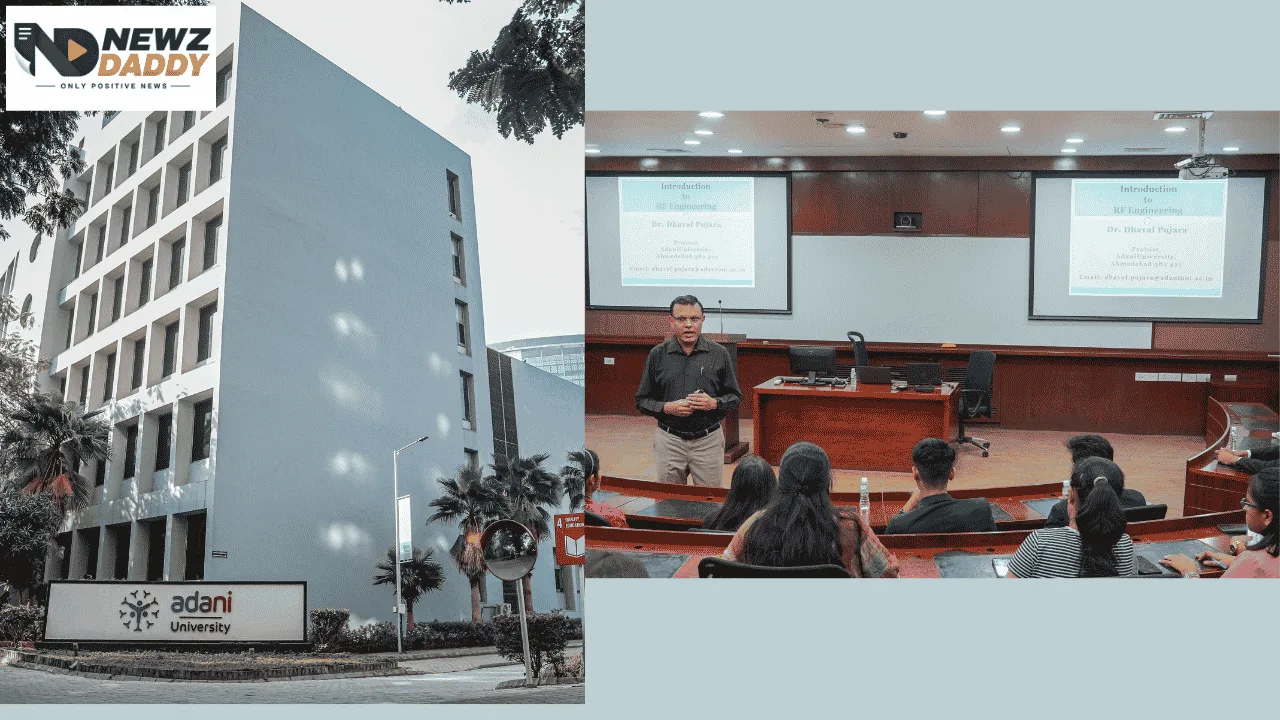
Adani University AI Curriculum Adds New AI Courses for Students
Adani University Recasts Courses as AI Changes Skills Needed in the Workplace
As artificial intelligence becomes part of daily work in industries ranging from manufacturing and finance to transport and healthcare, universities across India are changing the way they teach students. Ahmedabad-based Adani University has become one of the latest institutions to redesign its academic programmes to prepare graduates for jobs that are expected to rely heavily on AI tools and data-driven decision-making in the years ahead.
The university has announced a major revision of its Engineering, Science and Management curricula for the 2026 to 2027 academic year. The changes affect classroom teaching, internships, practical training and elective subjects across several programmes.
A central part of the redesign is the introduction of a compulsory course titled “AI for Engineers” for Engineering and Science students. The course will introduce students to the basics of artificial intelligence, prompt engineering and ethical use of AI systems. University officials said AI topics will no longer remain limited to computer science departments and will instead be woven into different areas of study.
The move reflects a wider shift taking place in higher education in India and abroad. Universities are increasingly treating AI as a basic workplace skill in the same way that computer literacy became essential during the internet era. Employers in sectors such as infrastructure, logistics, energy and construction are already using machine learning tools for forecasting, maintenance planning, design and operational management.
India’s technical education sector has also been moving in this direction. The All India Council for Technical Education has supported the introduction of AI and data science concepts across multiple engineering disciplines rather than limiting them to specialist courses in computing. Experts say graduates entering the workforce over the next decade are likely to work alongside AI systems regardless of their field of study.
The Faculty of Management Sciences at Adani University has also revised its MBA in Infrastructure Management programme. The updated syllabus adds subjects linked to Artificial Intelligence, analytics, Environmental, Social and Governance standards, commonly known as ESG, and Indian Knowledge Systems.
Infrastructure management has traditionally focused on project execution, finance and operations. The addition of AI and analytics reflects growing use of digital technologies in transport networks, power systems, ports and urban development projects. ESG reporting has also become more important as companies face increasing scrutiny from investors, regulators and communities over environmental performance and governance standards.
Students enrolled in the MBA programme will continue to receive industry exposure through internships and capstone projects while also being able to choose sector-specific areas of study.
University officials said the revised courses were prepared after consultations with academics and industry representatives and after reviewing programmes offered by institutions in India and overseas.
The redesign has been aligned with the National Education Policy 2020, which encourages multidisciplinary learning, practical education and greater flexibility for students to move across fields of study. Since its approval by the Union Cabinet in 2020, the policy has encouraged universities to create broader academic structures that combine technical knowledge with communication skills, ethics and practical training.
One of the more distinctive features of the new curriculum is the inclusion of Indian Knowledge Systems, often referred to as IKS. Students will study the subject through a compulsory credit-based course as well as through links with individual disciplines.
The National Education Policy places particular importance on exposing students to India’s intellectual traditions, scientific history and philosophical ideas alongside modern scientific education. Several universities across the country have recently introduced similar courses as part of their compliance with the policy framework.
Practical learning has received greater emphasis in the revised structure. Students will complete three separate internships during their studies. These include a community service internship after the first year, a professional development placement after the second year and an industry internship after the third year.
Many employers have argued that graduates often leave university with theoretical knowledge but limited workplace experience. By spreading internships across multiple years, institutions hope students will gain a clearer understanding of professional environments before graduation.
Adani University is also expanding opportunities for students to customise their studies through online courses, interdisciplinary electives and Minor Degrees that can be taken alongside major programmes. Areas available for additional study include Robotics, VLSI Design and Financial Data Analytics.
The university has partnered with e-Yantra, an initiative developed by IIT Bombay, to introduce project-based courses focused on hardware development and software programming. Studio Learning modules will also be introduced in selected programmes, so students begin practical problem-solving exercises during their first year rather than waiting until later stages of their degree.
Student wellbeing forms another part of the curriculum changes. A credit-based course on Yoga, Health and Hygiene has been introduced, and students will have access to counselling support services at all hours.
Adani University, which offers undergraduate, postgraduate and doctoral programmes in engineering, infrastructure and management fields, has already expanded its presence in areas such as Artificial Intelligence and Machine Learning through dedicated academic programmes. The institution has also announced plans for research facilities and centres focused on AI, robotics and advanced manufacturing technologies.
For universities across India, the challenge is no longer whether artificial intelligence will influence careers, but how quickly students can be prepared for workplaces where human judgement and machine intelligence increasingly operate side by side.