

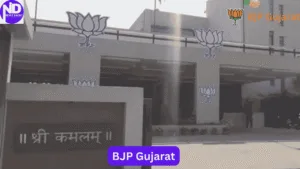
The Bharatiya Janata Party in Gujarat, often called BJP Gujarat, has been one of the most dominant political forces in the state for decades. It has shaped Gujarat’s political direction, controlled the state government for long stretches, and built a strong organisational network at the booth, district, and state levels.
The BJP’s rise in Gujarat is closely linked to the growth of Narendra Modi as a state leader before he became Prime Minister. Shri Narendra Modi served as Chief Minister of Gujarat from 2001 to 2014, and his long tenure helped turn the BJP into the state’s principal governing party. After Shri Narendra Modi moved to national politics, the party continued its control through leaders such as Anandiben Patel, Vijay Rupani, and Bhupendra Patel.
BJP Gujarat has built its political strength by combining organisational discipline, strong cadre activity, and a development-focused public message. The party presents Gujarat as a model of stability, infrastructure growth, industrial expansion, and administrative continuity. Its messaging often stresses delivery, state pride, and a close connection between governance and economic growth.
Electorally, the party has remained powerful since 2000. In the 2017 Assembly election, the BJP won 99 seats in the 182-member house and formed the government again. In 2022, it won 156 seats, the largest majority in Gujarat’s history, showing how deeply rooted the party remains in the state. Even in local body polls, the BJP has usually performed strongly, including in the 2026 civic and panchayat elections, where it led across many municipal and rural bodies.
The party’s strength is also visible in its response to leadership changes. When Anandiben Patel resigned in 2016, the BJP quickly reorganised under Vijay Rupani. When Bhupendra Patel replaced Rupani in 2021, the transition was equally swift and showed the party’s preference for internal control and calm succession management. This ability to change leadership without losing its governing position has helped the BJP in Gujarat to project stability.
At the same time, the party faces challenges. Anti-incumbency, local dissatisfaction, and competition from the Congress and Aam Aadmi Party have forced it to keep refreshing its leadership and organisation. The BJP has responded by bringing in new faces, increasing attention to local elections, and adjusting its cabinet structure to match changing political pressures.
Overall, BJP Gujarat is not just a state unit of a national party. It is one of the BJP’s strongest regional power centres and a major reason the party has maintained such a commanding position in Indian politics. Its record in Gujarat continues to shape both state politics and the broader national image of the BJP.