


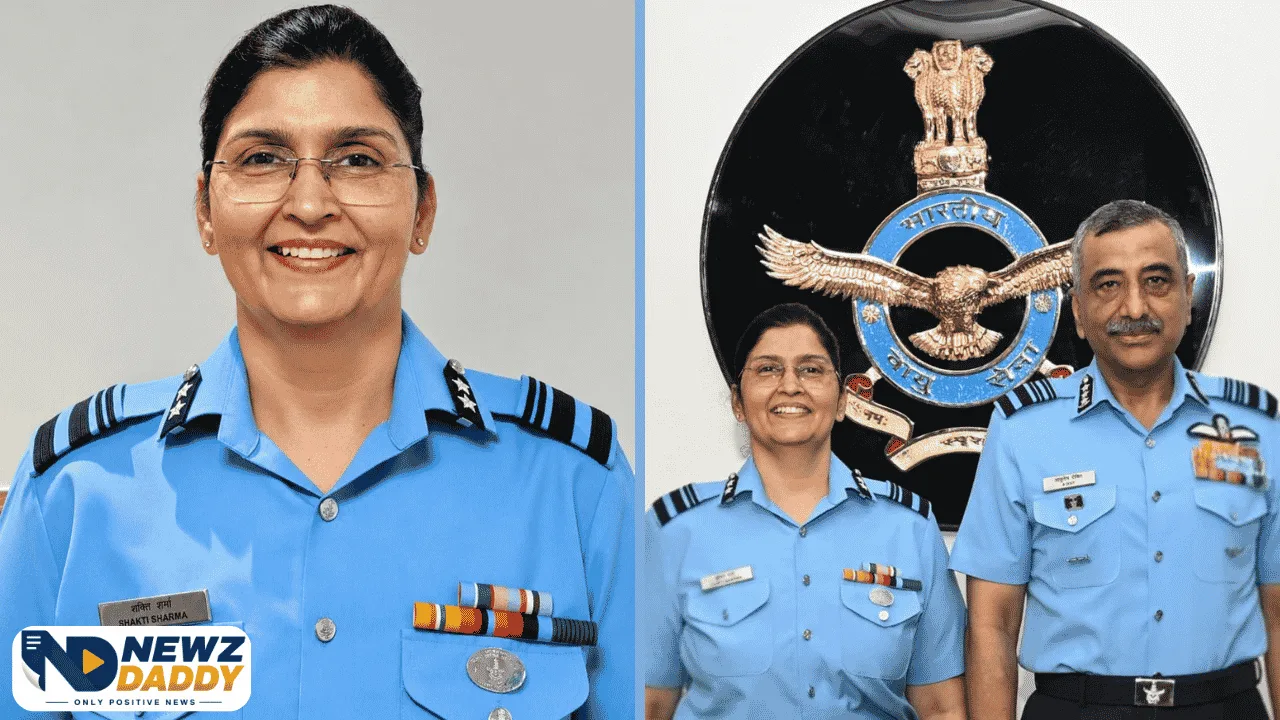
Shakti Sharma Reaches Air Vice Marshal Rank in Indian Air Force
Shakti Sharma Becomes First Non-Medical Woman Officer to Reach Air Vice Marshal Rank
Air Vice Marshal Shakti Sharma has become the first woman officer from a non-medical branch of the Indian Defence Forces to reach the rank of Air Vice Marshal, or its equivalent. She took charge as Assistant Chief of the Air Staff (Education) at Air Headquarters on 1 September 2026.
The appointment places Sharma at a senior level in the Indian Air Force’s education branch after more than three decades of service. She joined the IAF on 18 June 1994, when she was commissioned into the Education Branch.
Air Vice Marshal Shakti’s career has taken her through training establishments, field stations, Command Headquarters and Air Headquarters. Her latest appointment also brings her professional experience in military education to the senior leadership of the service.
The distinction is important because women had reached two-star and higher ranks in India’s armed forces before Sharma, but those earlier cases included officers from the medical services. Air Marshal Padma Bandopadhyay became the first woman in the Indian Air Force to reach Air Vice Marshal in 2002. She later became the first woman Air Marshal in the IAF.
Air Vice Marshal Shakti Sharma’s promotion marks the first time a woman from a non-medical stream in the Army, Navy or Air Force has reached the two-star level.
Sharma’s route to the top ranks has been closely linked with education and professional training.
During her service, she worked at several types of IAF establishments. Her assignments included field and command organisations as well as Air Headquarters. She was also involved in efforts to build stronger links between the armed forces and universities.
One such effort was the establishment of IAF Chairs of Excellence at the Indian Institute of Technology Kanpur and Savitribai Phule Pune University.
At Pune University, the IAF and the university’s Department of Defence and Strategic Studies signed agreements in February 2020 to establish the Marshal of the Indian Air Force Arjan Singh Chair of Excellence and a Resident Scholar Programme for Air Force officers. Sharma was among the IAF officers present at the signing ceremony.
The Chair was intended to support academic work related to defence and strategic studies and create opportunities for closer work between military officers and university researchers.
At IIT Kanpur, an IAF Chair of Excellence has also been associated with aerospace research and training, including areas such as aircraft structural integrity and aircraft health monitoring.
These programmes show the wider role of the Education Branch. Military education is tied to professional training, research and the preparation of officers for increasingly technical and specialised roles.
Sharma had already broken another barrier before reaching Air Vice Marshal.
In August 2015, she became the first woman principal of Sainik School Kapurthala. The school’s official records show that Group Captain Shakti Sharma served as principal from 7 August 2015 until 29 May 2017.
At the time, her appointment was reported as a first for women officers in the Sainik School system. She became the first woman officer from the Army, Navy or Air Force to command a Sainik School.
The Kapurthala school, located in Punjab, prepares school students through a mix of academic education, discipline and military-oriented training. During Sharma’s tenure, students also took part in activities linked to awareness about careers in the armed forces.
Her time at the school also gave her experience in running an educational institution and working directly with young people preparing for possible careers in the military. Sharma’s promotion comes after several changes in the way women are recruited, trained and employed by India’s armed forces.
The Indian Air Force has opened all its branches and streams to women officers. The service began inducting women into fighter pilot training on an experimental basis in 2015, and the policy was made permanent in 2022. Women are also serving in other operational roles.
Women’s entry into the National Defence Academy has added another change. The first women cadets began training at the NDA in July 2022 after the Supreme Court opened the academy to women candidates.
According to a Ministry of Defence backgrounder issued in March 2026, the number of women officers in the three services had grown to around 11,000. The same government account noted that women were holding senior leadership and operational positions, including Lieutenant General rank, fighter pilot roles and command appointments.
The rise of women into senior positions has taken place over several decades. Major General Gertrude Alice Ram of the Military Nursing Service became the first woman to hold a flag rank in the armed forces in 1976. Medical officers later reached higher ranks, including Air Marshal Padma Bandopadhyay and Lieutenant General Punita Arora.
Air Marshal Sadhna Saxena Nair, also from the IAF medical branch, became the second woman Air Marshal in 2023. Sharma’s case is different because her career has been in the non-medical Education Branch.
As Assistant Chief of the Air Staff (Education), Sharma will work at Air Headquarters on matters connected with education and training in the Indian Air Force.
Her appointment also reflects the career path available to officers in specialist branches. The senior ranks of a modern air force require expertise in areas that go beyond flying and combat operations, including training, technology, research, administration and professional development.
For Shakti Sharma, the new position comes 32 years after she entered the IAF.
Shakti Sharma’s career has included several firsts along the way, from becoming the first woman officer to lead a Sainik School to becoming the first woman from a non-medical branch of the Indian Defence Forces to reach the Air Vice Marshal rank.
The Indian Air Force described her achievement with the words, “Touch the Sky with Glory”. For women entering the armed forces today, Sharma’s career provides a clear example of how a specialist branch can lead to the highest levels of military service.