


Samudra Pradakshina Becomes India’s Biggest Defence Story
Rajnath Singh Honours All-Women Tri-Services Sailing Crew After Historic 314 Day Voyage Around the World
Defence Minister Rajnath Singh has honoured the nine women officers who completed India’s first all-women tri-services sailing expedition around the world. The crew returned after spending 314 days at sea on board the Indian Army Sailing Vessel (IASV) Triveni, covering nearly 25,500 nautical miles across four oceans.
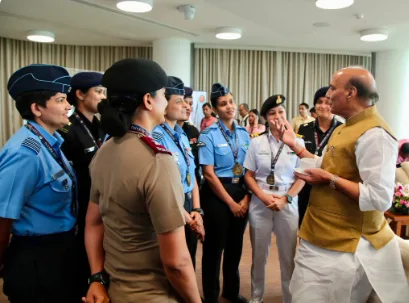
During a meeting in New Delhi on 30 July 2026, Singh congratulated the officers from the Indian Army, Indian Navy and Indian Air Force. He described the expedition, named Samudra Pradakshina, as an important example of cooperation between the three armed services and a milestone for women serving in India’s military.
The officers shared details of the demanding journey, explaining that long periods at sea, changing weather conditions and the mental and physical demands of ocean sailing tested the team throughout the mission. They said their determination to represent India successfully helped them overcome those challenges.
Responding to the crew, Rajnath Singh said their achievement had strengthened his own belief in the power of determination. He said, “You have proven that physical capability, mental toughness, and leadership qualities are not bound by gender. Every daughter in India can look at you and believe that she, too, can cross oceans and conquer the world.”
He also called the expedition an example of successful cooperation among the Army, Navy and Air Force, noting that officers from all three services sailed together under one mission and one national flag.
The voyage began on 11 September 2025, when Rajnath Singh joined the flag-off ceremony through video conferencing. The mission officially concluded on 22 July 2026, when the Defence Minister virtually welcomed the vessel back to Mumbai. The interaction in New Delhi marked the formal recognition of the crew’s achievement.
According to the Ministry of Defence, the success of the mission came after almost two years of preparation. The programme included extensive sailing practice, survival drills, navigation exercises and technical training. A round-the-clock shore-based support system also monitored the crew throughout the expedition and assisted with logistics, weather information and operational planning.
The expedition met the internationally accepted conditions for a complete circumnavigation of the globe. The crew crossed every line of longitude, crossed the Equator twice, sailed across the International Date Line and rounded the world’s three famous southern capes: Cape Leeuwin in Australia, Cape Horn at the southern tip of South America and the Cape of Good Hope in South Africa.
One of the hardest stages of the voyage came while sailing through the Drake Passage, the stretch of water between South America and Antarctica. The area is widely regarded by sailors as one of the roughest sea routes because of powerful winds, large waves, and rapidly changing weather. The successful passage through the Drake Passage and the rounding of Cape Horn earned the crew membership of the respected international fraternity of Cape Horners. Membership is reserved for sailors who complete one of the world’s most demanding ocean passages.
Ocean circumnavigation is considered among the highest achievements in offshore sailing. Only a limited number of Indian military crews have completed such missions. The Indian Navy has previously organised successful global sailing expeditions, including Navika Sagar Parikrama, which became India’s first all women naval circumnavigation. Completed in 2018, that mission was led by an all-women naval crew on board INSV Tarini and marked a significant moment in the country’s maritime history. Samudra Pradakshina builds on that progress by bringing together officers from all three armed services for the first time.
The expedition also carried a wider diplomatic purpose. During visits to ports in several countries, the IASV Triveni crew represented India through cultural programmes, meetings with local authorities and interactions with naval organisations. Such visits are a regular part of defence diplomacy and help strengthen military relationships, encourage professional exchanges and improve goodwill between friendly nations.
Rajnath Singh said the officers also demonstrated India’s engineering capability, indigenous technology and maritime skills during these international visits. He told the crew, “You conveyed a message to the world that India is second to none in any field.”
Senior military and government officials attended the interaction in New Delhi. Those present included Chief of the Army Staff General Dhiraj Seth, Defence Secretary Rajesh Kumar Singh, Vice Chief of the Air Staff Air Marshal Ashutosh Dixit and Vice Chief of the Naval Staff Vice Admiral Ajay Kochhar, along with other senior officers from the three services.
The expedition reflects a wider effort by the Indian armed forces to increase opportunities for women in operational roles. Over the past decade, women have taken on responsibilities in fighter aviation, frontline warships, military police, permanent commissions and specialised operational assignments. More women officers are also joining leadership positions in technical and combat support branches.
Military sailing expeditions are designed to develop leadership, teamwork, endurance, navigation skills and decision-making under difficult conditions. They also provide experience in handling emergencies far from land, where crews must depend on their own judgement and training.
For the nine officers of IASV Triveni, Samudra Pradakshina now stands as one of India’s most significant military sailing achievements. Beyond the distance travelled, the voyage demonstrated how personnel from different services can work together during a demanding mission while adding another milestone to the growing role of women in the country’s armed forces.