


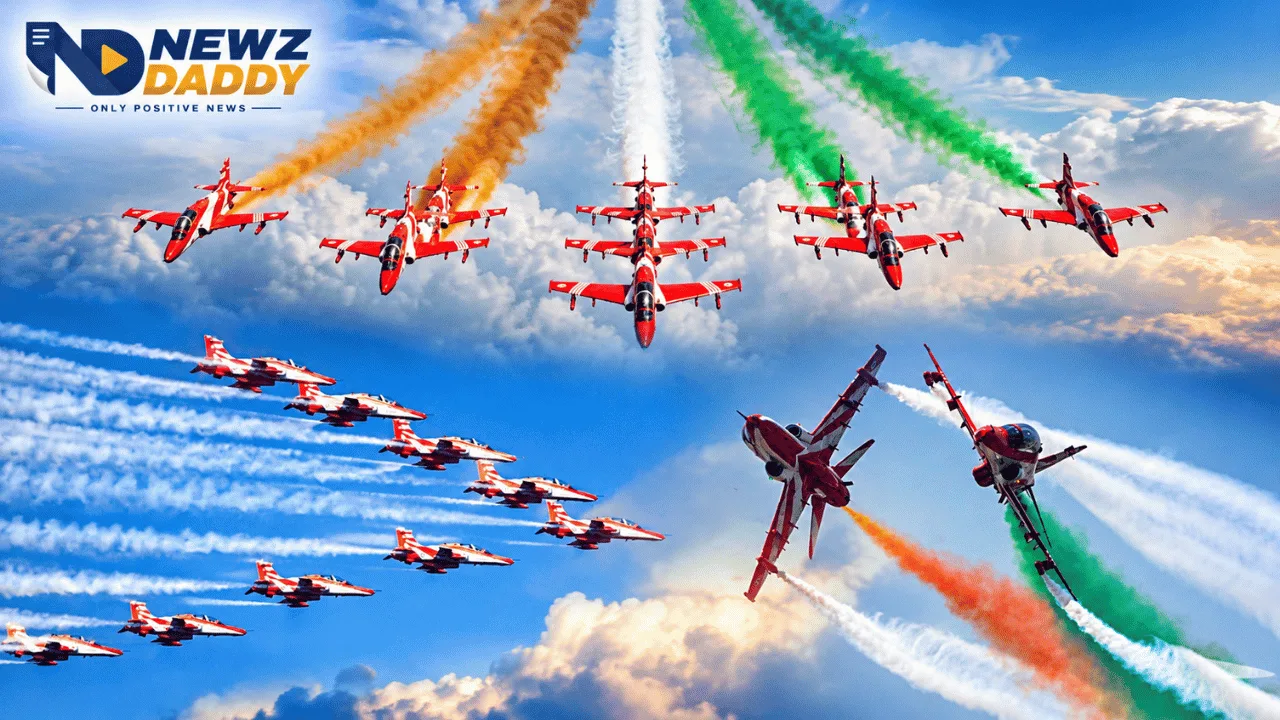
Suryakiran Team to Fly Nine Jets Over Bhavnagar on Nov 1
Suryakiran Aerobatic Team to Perform Nine-Jet Display Over Bhavnagar on November 1
The Indian Air Force’s Suryakiran Aerobatic Team will perform a nine-aircraft aerial display over Bortalav in Bhavnagar on Sunday, November 1, 2026, giving residents an opportunity to watch one of the country’s best-known flying teams in action.
The show is scheduled to begin at 10.30 am. Flying nine Hawk Mk 132 aircraft, the team will perform a series of aerobatic manoeuvres, including loops, barrel rolls, inverted flying and its signature DNA manoeuvre. Coloured smoke trails in saffron, white and green will mark the aircraft’s movements across the sky.
The display brings the Indian Air Force’s public flying programme to Bhavnagar, a city with a long history of trade, maritime activity and royal patronage. The event will take place at Bortalav, also known as Gaurishankar Lake, where the aircraft will demonstrate close formation flying and the pilots’ ability to carry out complex manoeuvres in a controlled setting.
The Suryakiran Aerobatic Team, commonly known as SKAT, was formed in 1996 at Air Force Station Bidar in Karnataka. It marks 30 years of service in 2026. Over the years, the team has performed at air shows and public events in India and abroad, earning a reputation for its nine-aircraft formations.
The team’s history began with the Kiran Mk II aircraft. It later moved to the Hawk Mk 132, which it has flown since 2015. The Hawk is a jet trainer manufactured in India under licence by Hindustan Aeronautics Limited (HAL).
The aircraft used by Suryakiran are specially prepared for aerobatic displays. Flying in close formation requires pilots to maintain precise positions while carrying out manoeuvres at speed. The team’s performances depend on extensive training, clear communication and close coordination between pilots.
The DNA manoeuvre is among the team’s recognised formations. The display also includes loops, barrel rolls and inverted flying, where aircraft fly upside down. The nine aircraft move together through a series of planned movements, with pilots relying on their training and judgement to maintain safe distances.
The coloured smoke trails add a visual element to the display. The Hawk Mk 132 aircraft have been fitted with smoke systems that allow them to produce coloured trails in the national flag’s saffron, white and green. The smoke makes the aircraft’s movements easier to follow from the ground.
The team has performed more than 850 displays, according to the Indian Air Force’s announcement for the Bhavnagar event. Its performances have taken place across India and at international air shows, including events in China, Sri Lanka, Myanmar, Thailand, Singapore and the United Arab Emirates.
Suryakiran is often described as an ambassador for the Indian Air Force. Public displays give people a chance to see the work of military pilots outside their usual operational role. They also help introduce young people to aviation and careers in the armed forces.
The team is commanded by Group Captain Ajay Dasarathi. Wing Commander Tejeshwar Singh serves as the Flight Commander, while Wing Commander Abhimanyu Tyagi is the Senior Engineering Officer. Tyagi oversees aircraft maintenance and leads the technical team.
The team has 18 officers, including 13 pilots, three engineering officers, one commentator and one medical officer. Around 180 technical personnel support the squadron. Their work includes preparing aircraft, checking equipment and ensuring that the jets are ready for each performance.
The technical staff play a key role in the team’s operations. Aerobatic flying places demanding requirements on aircraft and pilots, making regular maintenance and detailed checks essential before every display.
Bhavnagar has a history that dates back to the eighteenth century, when it was founded by Maharaja Bhavsinhji Gohil. The city developed as an important trading centre, with maritime links across the Arabian Sea. Its port and commercial activity helped shape the growth of the wider Saurashtra region.
The air show will add a military aviation event to the city’s public calendar. For residents, it offers a chance to watch a team whose performances are usually seen at major air shows and national events.
The Indian Air Force has used public displays to explain its flying skills and introduce its work to people across the country. Suryakiran’s formation flying also gives viewers a closer look at the training, discipline and technical support needed for such performances.
The Bhavnagar display comes as the team marks three decades since its formation. Its record of more than 850 performances reflects the continued use of aerobatic displays as part of the Indian Air Force’s public engagement programme.
For the people of Bhavnagar, the November 1 event will bring nine Hawk Mk 132 aircraft over Bortalav in a display of precision flying. The performance is expected to draw attention to the Indian Air Force’s flying skills and the work of the pilots and technical personnel who prepare each show.