


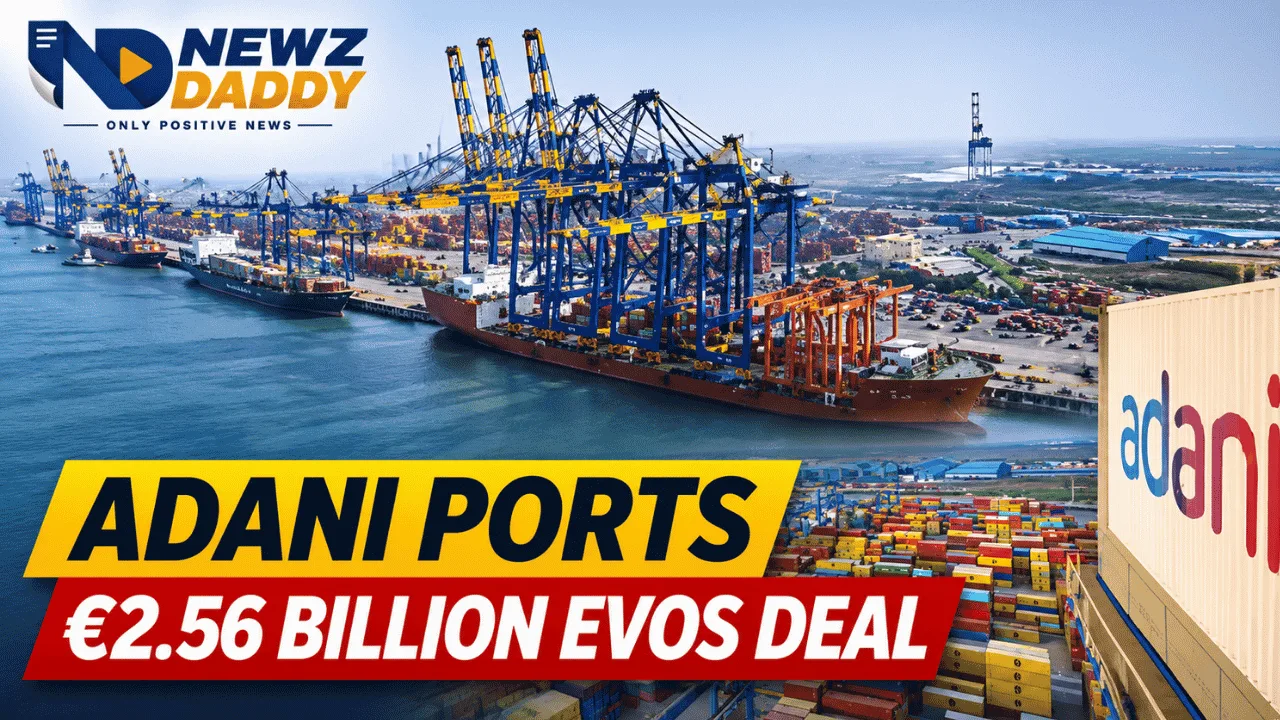
Adani Ports Evos Deal Adds Eight Terminals Across Europe
Adani Ports to Acquire European Liquid Storage Operator Evos for €2.56 Billion
Adani Ports and Special Economic Zone Limited (APSEZ) has agreed to acquire the Netherlands-based Evos B.V. for an enterprise value of €2.56 billion, giving the Indian port operator control of eight liquid storage terminals across five European countries. The all-cash transaction, announced on 5 November 2026 in Ahmedabad, will give APSEZ a larger presence in Europe’s energy storage and transport business.
Evos is Europe’s second-largest independent liquid storage operator. The proposed acquisition covers its entire 100% shareholding and will be funded through debt. APSEZ has agreed to an equity value of €1.18 billion for the company. The enterprise value represents 11.7 times Evos’ earnings before interest, tax, depreciation and amortisation (EBITDA) for calendar year 2025.
The Evos deal is subject to regulatory approvals and consultation with employee representative bodies, known as works councils. These processes are due to begin immediately. APSEZ has selected Evos following a competitive bidding process.
The financial performance of Evos provides an idea of the scale of the business being acquired. During calendar year 2025, the company recorded revenue of €392 million and EBITDA of €219 million, giving it an EBITDA margin of 56%. Its storage facilities handled 37 million metric tonnes (MMT) of products during the year.
Evos deal has a total storage capacity of 6.3 million cubic metres. Its eight terminals are spread across the Netherlands, Germany, Belgium, Spain and Malta. These facilities are located near major industrial centres, shipping routes and energy markets, giving customers access to storage and transport services in several parts of Europe.
The terminal network includes 452 storage tanks and 63 vessel and barge berths. Evos also has pipeline connections to important transport and industrial facilities, including Schiphol Airport and the Central Europe Pipeline System. Its terminals serve the Amsterdam-Rotterdam-Antwerp (ARA) region, Hamburg and the Mediterranean.
The ARA region is one of Europe’s main centres for oil trading, refining, chemical production and fuel distribution. Its ports connect European industrial markets with international suppliers. Storage terminals in this region allow energy companies and traders to hold products, move them between ships and pipelines, and supply customers according to market demand.
Evos deal handles a range of conventional fuels, including petrol, gasoil, marine fuels and aviation fuel. Its facilities also store products linked to the shift towards alternative energy sources, such as sustainable aviation fuel (SAF), biofuels, methanol and bioethanol. This gives APSEZ access to businesses serving both traditional energy markets and newer fuel sectors.
A key feature of Evos’ business is its high level of contracted storage activity. Its average commercial occupancy stood at 99% during the reported period. The company has long-standing relationships with major international energy companies, industrial and chemical businesses, and commodity traders.
A substantial part of its income comes from take-or-pay contracts. Under these agreements, customers pay for reserved capacity even when they do not use the full amount. Some contracts are also linked to the Consumer Price Index (CPI), allowing charges to be adjusted in line with inflation. These arrangements provide greater visibility over future income. Evos is also an investment-grade rated issuer.
For APSEZ, the purchase will add a European business with a higher operating margin than its existing international ports division. Evos reported a 56% EBITDA margin in CY25, compared with APSEZ’s International Ports margin of 44.8% in the first half of FY27. The difference is expected to support the combined company’s operating margins, although the final results will depend on the cost of financing and the performance of the acquired business.
The transaction also comes as APSEZ expands its operations outside India. The company has been building its international portfolio through investments in Sri Lanka, Tanzania, Australia and Israel. Its recent expansion includes the Colombo West International Terminal in Sri Lanka and NQXT Australia, which APSEZ completed acquiring in December 2025.
In March 2026, APSEZ reported that its ports had crossed 500 million tonnes of cargo handled. The company has set a target of handling one billion tonnes annually by 2030. With the Evos acquisition, its global network is expected to cover 28 ports and terminals in 10 countries.
The financial position of APSEZ will also be watched as it takes on debt to fund the purchase. The company’s cash balance stood at ₹12,502 crore as of 30 September 2026. Its first-half FY27 international ports business recorded revenue of ₹3,586 crore and EBITDA of ₹1,608 crore. Cargo volumes rose to 47 MMT, compared with 17 MMT during the corresponding period of FY26.
Growth at the Colombo West International Terminal, operations in Tanzania and the contribution from NQXT Australia supported this performance.
The proposed purchase will increase the group’s borrowing requirements. Based on APSEZ’s FY26 financial figures and Evos’ CY25 results, the combined company’s pro forma net debt-to-EBITDA ratio is estimated at 2.76 times. APSEZ expects this figure to come down to around 2.5 times by FY27.
MUFG is the sole underwriter and has committed financing of up to €2.8 billion for the proposed transaction. Linklaters and Cyril Amarchand Mangaldas are advising APSEZ on international and domestic legal matters respectively.
Commenting on the agreement, Karan Adani, Managing Director of APSEZ, said:
“Evos marks an important milestone in APSEZ’s trajectory towards handling 1 billion tons of cargo and building a truly global, integrated transport platform. We are delighted to welcome Evos into our portfolio, giving us significant presence across key global liquid storage and energy hubs. We look forward to partnering with Europe, supporting its sustainable energy transition and creating enduring value while maintaining the financial prudence that underpins our growth.”
The acquisition will place APSEZ in a larger role in Europe’s liquid storage market and give it access to established customers and industrial locations. The next steps will involve regulatory clearances and employee consultation in the countries where Evos operates. Until those requirements are completed and the transaction closes, the proposed change in ownership remains subject to approval.
For APSEZ, the financial test will be whether Evos can maintain its high storage occupancy and earnings while the Indian company manages the additional debt. The deal also gives the group a direct presence in European energy markets at a time when the region is developing new fuel supply chains.