

Sarang Team to Fly Over Vadodara from November 12 to 15
IAF Sarang Helicopter Team to Perform in Vadodara for 11 Squadron’s 75th Anniversary
Vadodara, November 11, 2026: Residents of Vadodara will get an opportunity to watch the Indian Air Force’s (IAF) Sarang Helicopter Display Team perform aerial manoeuvres from November 12 to 15. The four-day programme will mark the Platinum Jubilee, or 75th anniversary, of 11 Squadron of the Indian Air Force.
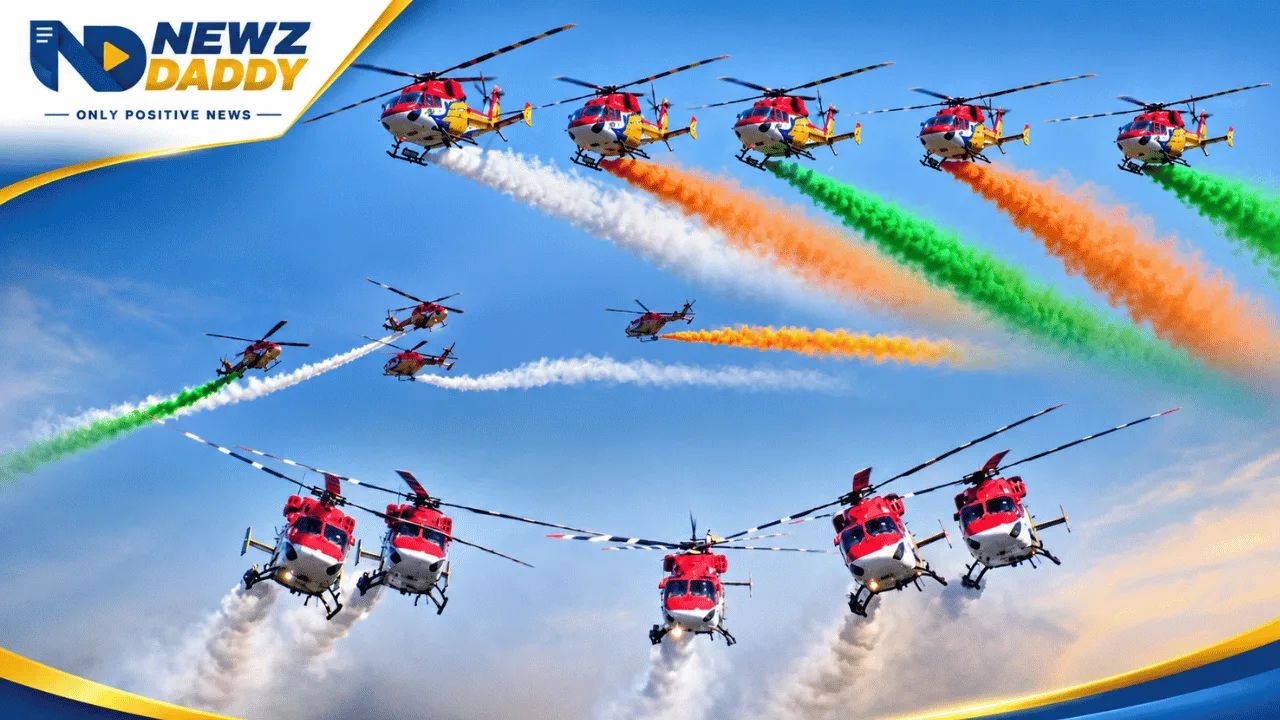
The displays will take place over Vadodara Airfield. The Sarang team will fly five Advanced Light Helicopters (ALH) Dhruv, an aircraft designed and manufactured in India. Its performances will include close-formation flying, in which pilots must maintain carefully controlled distances and positions while carrying out coordinated movements in the air.
The event is expected to draw school students, aviation enthusiasts, serving Air Force personnel and veterans. For Vadodara residents, it will offer a chance to see a specialised military helicopter team at work while marking an important anniversary in the history of an IAF squadron.
The Sarang team was formed in 2003 and made its first international public appearance at the Asian Aerospace Air Show in Singapore in 2004. Since then, it has represented India at several international aviation events, including air shows in Russia, Germany, the United Kingdom, the United Arab Emirates, Bahrain and Egypt.
Its participation in the Singapore Air Show in February 2026 and the El Alamein International Air Show in Egypt in September 2026 has kept the team active on the international aviation circuit. At the Egypt event, the team was scheduled to perform from September 8 to 10. The Indian Ministry of Defence described Sarang as the world’s only five-helicopter display team.
The name Sarang comes from the Sanskrit word for peacock. The helicopters carry colourful paint schemes inspired by India’s national bird. The design has become a recognisable feature of the team at air shows in India and abroad.
The five-helicopter formation requires careful flying. Unlike fixed-wing aircraft, helicopters depend on rotating blades to remain airborne and change direction. Pilots must control their speed, height and position while keeping a safe distance from the other aircraft. Even small changes in movement can affect the formation.
The team has developed several recognised manoeuvres over the years. These include the Dolphin Leap, Single Cross and Double Cross. During its September 2026 visit to Egypt, Sarang also planned to perform a Spot Stall Turn, a newer addition to its display programme. Such performances require regular practice and close coordination between pilots and ground crews.
The aircraft used by the Sarang team is the Advanced Light Helicopter Dhruv, developed by Hindustan Aeronautics Limited (HAL), headquartered in Bengaluru. The Dhruv programme represents India’s effort to develop helicopters for its own military and civilian requirements.
The helicopter has several uses beyond aerial displays. Its operational roles include passenger transport, search and rescue, medical evacuation, movement of troops, cargo transport and support during emergencies. The Indian Army, Indian Navy, Indian Air Force and Indian Coast Guard have all operated versions of the Dhruv.
The Sarang team has also taken part in humanitarian assistance and disaster relief work. Its aircraft and personnel have supported relief operations during the Uttarakhand floods in 2013, Cyclone Ockhi in 2017 and the Kerala floods in 2018. These operations show the wider work carried out by military helicopter units during natural disasters, when aircraft can help reach places that are difficult to access by road.
The Vadodara programme also brings attention to the history of 11 Squadron, which is completing 75 years in 2026. The squadron, known as the Charging Rhinos, was raised in 1951. Its early aircraft included Dakota transport planes. Over the decades, it operated different aircraft as the Indian Air Force changed and updated its transport fleet.
One of the major developments in the squadron’s recent history came in September 2023, when it became the first IAF squadron to receive the Airbus C-295 transport aircraft. The aircraft was formally inducted into the Air Force in the presence of Defence Minister Rajnath Singh at Hindan Air Force Station in Uttar Pradesh.
India signed a contract worth Rs 21,935 crore with Airbus Defence and Space in September 2021 for 56 C-295 aircraft. Under the agreement, 16 aircraft were to be delivered directly from Spain, while the remaining 40 were assigned for manufacture in India by Tata Advanced Systems Limited at its Vadodara facility. The programme also marked an important step in bringing military aircraft manufacturing into India’s private industrial sector.
The association of 11 Squadron with Vadodara makes the city an important location in this aircraft programme. The arrival of the C-295 has added a new chapter to the squadron’s transport aviation history, which began with the Dakota aircraft more than seven decades ago.
For school students attending the Sarang team displays, the event could offer an early introduction to military aviation. Watching helicopter pilots perform coordinated manoeuvres may encourage young people to learn more about aircraft, engineering, flight operations and careers in the armed forces.
The programme also allows serving personnel and former members of the Indian Air Force to mark the squadron’s 75-year record. Veterans who have served in different aircraft and locations will have an occasion to reconnect with the unit’s history.
With the Sarang team arriving for the four-day programme, Vadodara will host an aviation event that brings together the history of 11 Squadron and the work of one of the Indian Air Force’s best-known display teams. The performances from November 12 to 15 will form part of the city’s celebrations marking 75 years of the squadron.