


Adani University MBA Infrastructure Management Begins New Journey
Adani University Opens MBA Infrastructure Management Batch for 2026-28 as India Expands Focus on Infrastructure Skills
Adani University has admitted 120 students to its MBA in Infrastructure Management programme for the 2026-28 academic session, marking one of the largest intakes since the course was introduced and reflecting growing interest in careers linked to India’s expanding infrastructure sector.
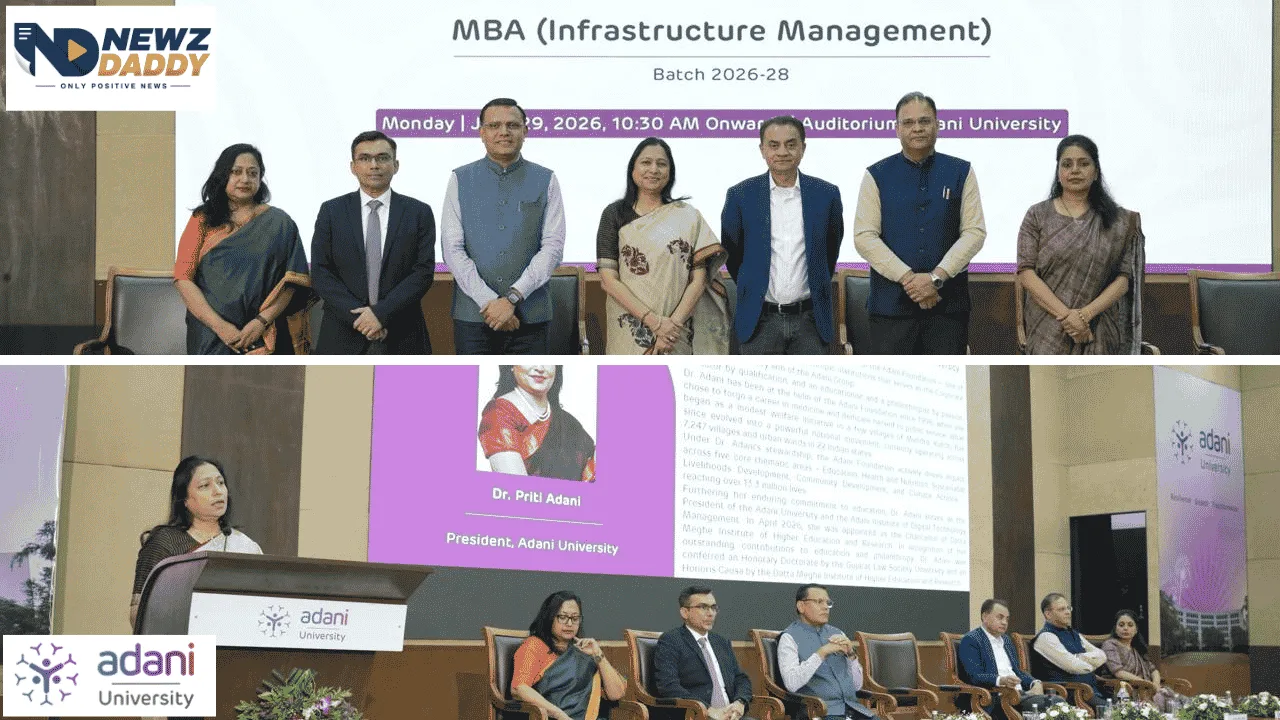
The new students formally began their two-year postgraduate studies during an induction programme held at the university campus in Ahmedabad. The event was attended by university leaders, faculty members and parents, along with guests from academia and industry.
Addressing the incoming class, Adani University President Dr Priti G. Adani spoke about the wider role infrastructure plays in everyday life and economic development.
Dr Adani said, “Infrastructure is much more than roads, airports, ports, energy systems or smart cities. It is about improving lives, connecting communities, strengthening the economy and contributing to nation-building.”
India has placed infrastructure development at the centre of its economic plans during the past decade, with major public and private investments flowing into transport networks, renewable energy projects, logistics parks, airports, urban housing and digital connectivity. The country’s National Infrastructure Pipeline, launched to support long-term economic growth, has identified projects worth trillions of rupees across sectors including energy, railways, roads and urban development.
This growing investment has increased demand for managers who understand both business operations and the technical challenges involved in delivering large projects.
During her address, Dr Adani encouraged students to make full use of opportunities available through academic learning and industry engagement. She stressed that personal values would remain important alongside professional success.
She told students that integrity, compassion and commitment to excellence would influence their careers as strongly as technical and managerial abilities.
The MBA in Infrastructure Management programme has been designed around the needs of sectors such as transport, energy, logistics, urban infrastructure and real estate. Alongside classroom learning, students are expected to take part in industry visits, field assignments and practical projects linked to infrastructure businesses.
University officials said the programme combines academic study with industry exposure and includes artificial intelligence tools and digital learning methods that are increasingly becoming part of business education worldwide.
Artificial intelligence is now being used across infrastructure planning and operations, including traffic management, energy forecasting, construction monitoring and predictive maintenance of assets such as bridges, ports and power networks. Business schools across India have started incorporating AI-based learning modules to prepare students for these changes.
The induction ceremony began with a traditional lamp-lighting event, a practice followed by many Indian educational institutions to mark the beginning of a new academic journey.
Speakers at the event discussed how infrastructure industries are being reshaped by technological change, environmental targets and the growth of renewable energy projects. They encouraged students to prepare for careers that may look very different from those available only a decade ago.
Among those present were Guest of Honour Prof. Arun Kumar Sharma, Provost Prof. (Dr.) Dhaval Pujara, Registrar; Prof. Amish Vyas, Dean of the Faculty of Management Sciences; Prof. Sandip Solanki; Prof. Baishali Mitra and Dr Namita Pragya.
Faculty members, students and parents also attended the programme.
Adani University, based in Ahmedabad, has developed several courses linked to infrastructure, engineering and management. Its Faculty of Management Sciences offers specialised programmes focused on sectors that traditionally receive limited attention in conventional business schools.
The MBA in Infrastructure Management remains one of the university’s flagship management programmes and has attracted students from different parts of India seeking careers in project management, transport, logistics, energy and urban development.
Industry specialists have repeatedly pointed to a shortage of managers with sector-specific knowledge in infrastructure projects, particularly as India increases spending on highways, renewable energy, airports, data centres and industrial corridors.
Large projects often require professionals who can work across engineering, finance, regulation, environmental compliance and stakeholder management. Universities and business schools have increasingly responded by introducing specialised courses rather than relying entirely on traditional general management degrees.
The 2026-28 batch arrives at a time when India’s infrastructure sector is undergoing rapid change driven by digital technologies, automation and sustainability targets. Renewable energy expansion, electric mobility projects and smart city developments are expected to create new roles that did not exist when many current industry leaders entered the workforce.
By welcoming the latest group of students, Adani University signalled its intention to continue building expertise in a field that is expected to remain central to India’s economic growth plans for many years.
For the students entering the programme this week, the next two years will offer an early look at an industry that is helping shape how people travel, work, communicate and access services across the country.
Must Read:
Adani University AI Curriculum Adds New AI Courses for Students
Adani University Partners with MIT World Peace University