



APSEZ Results Show Overseas Ports Gaining a Bigger Role
Adani Ports raises FY27 revenue target as quarterly profit grows 18%
APSEZ increases its annual revenue and EBITDA forecasts by ₹1,000 crore each, while raising planned investment by ₹3,000 crore as overseas ports, logistics and marine services expand.
Adani Ports and Special Economic Zone Limited (APSEZ) has raised its full-year revenue and operating profit targets after reporting 24% revenue growth and an 18% rise in net profit for the second quarter of FY27.
The Ahmedabad-based company reported consolidated revenue of ₹11,340 crore for the quarter ended September 30, 2026, against ₹9,167 crore in the same period last year. Earnings before interest, tax, depreciation and amortisation (EBITDA) rose 23% to ₹6,807 crore, while profit after tax (PAT) increased to ₹3,682 crore from ₹3,120 crore.
The results, announced on October 28, reflect higher earnings across its domestic ports, overseas ports, logistics and marine businesses.
APSEZ has raised its FY27 revenue guidance by ₹1,000 crore to ₹44,000 crore-₹46,000 crore. Its EBITDA target has also increased by ₹1,000 crore to ₹26,000 crore-₹27,000 crore.
The company has raised its planned capital expenditure for FY27 by ₹3,000 crore to ₹15,000 crore-₹17,000 crore.
The higher investment comes as APSEZ works towards its FY31 targets of ₹91,500 crore in revenue and ₹52,000 crore in EBITDA.
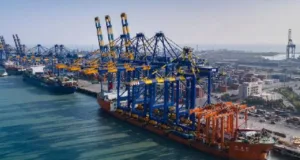
Domestic ports continued to account for the largest share of the company’s business. Revenue from this segment rose 13% year-on-year to ₹7,177 crore, while EBITDA increased 11% to ₹5,201 crore.
The segment’s EBITDA margin stood at 72.5%, reflecting its strong contribution to the company’s earnings.
APSEZ handled 118 million metric tonnes (MMT) of cargo during the quarter. Its share of India’s total cargo and container traffic stood at 27.3% and 44.4%, respectively. The company’s domestic port capacity was 671 MMT.
During the quarter, APSEZ secured a 30-year concession for Paradip Port’s CQ-I and CQ-II dry bulk berths in Odisha. The agreement adds 18 MMT of mechanised capacity and gives the company a larger role in handling dry bulk cargo on India’s east coast.
The company also began export-import (EXIM) operations at Vizhinjam Port in Kerala.
International ports recorded the fastest revenue growth among APSEZ’s major businesses.
Revenue increased 71% to ₹1,839 crore, while EBITDA rose more than threefold to ₹878 crore. The segment’s EBITDA margin reached 47.7%.
International port volumes rose to 24 MMT in Q2 FY27 from 10 MMT a year earlier.
The growth came mainly from the expansion of Colombo West International Terminal (CWIT) in Sri Lanka, operations in Tanzania and contributions from NQXT Australia.
CWIT handled two million twenty-foot equivalent units (TEUs) within its first 18 months of operations. APSEZ inaugurated the terminal’s second phase during the quarter, doubling its capacity from 1.6 million TEUs to 3.2 million TEUs.
The expanded terminal aims to handle nearly 25% of the Port of Colombo’s targeted capacity of 13 million TEUs by 2028.
Tanzania also recorded its highest quarterly volume, at 265,518 TEUs. Its monthly volume reached a record 91,625 TEUs in July 2026.
APSEZ’s logistics business reported a 21% rise in revenue to ₹1,273 crore. Its performance improved after the first quarter, which had been affected by the West Asia crisis.
Container volumes rose to 167,453 TEUs in Q2 FY27 from 145,310 TEUs in Q1 FY27. Trucking revenue increased 28% year-on-year, while revenue from integrated freight network (IFN) services more than doubled to ₹289 crore.
The company is developing a logistics network that connects ports with industrial centres and consumer markets across India.
The marine business reported 57% revenue growth to ₹1,007 crore. EBITDA rose 32% to ₹447 crore.
The company’s fleet grew to 138 vessels in Q2 FY27 from 127 in the year-ago quarter. Higher income from offshore services and its entry into subsea services also contributed to growth.
APSEZ spent ₹10,521 crore on capital investment during the first half of FY27. Its operating cash flow stood at ₹13,327 crore, while free cash flow was ₹2,806 crore.
Gross debt was ₹57,717 crore and cash reserves stood at ₹12,502 crore at the end of September.
The company’s net debt-to-EBITDA ratio remained at 1.8 times, despite capital expenditure of ₹30,346 crore over the past two years.
Ashwani Gupta, Whole-time Director and CEO of APSEZ, said:
“APSEZ’s ability to execute at scale with financial prudence enables us to pursue ambitious growth while leveraging balance-sheet strength and compounding cash flows. Against this backdrop, Q2FY27 was another stellar quarter. Domestic Ports continue to anchor our earnings, while International Ports, Logistics and Marine are emerging as powerful growth engines. Reflecting strong H1 performance, we are upgrading our FY27 guidance across revenue, EBITDA and capex.
As we accelerate investments toward our Ambition 2031 objectives, our balance sheet remains exceptionally strong. We have deployed ₹30,346 Cr of capex over the past two years, including higher-than-planned investments in H1, while maintaining net debt-to-EBITDA at just 1.8x, underscoring the strength of our business model and capital discipline.”
The company’s credit ratings have also improved. S&P Global Ratings upgraded APSEZ’s long-term issuer credit rating and senior unsecured notes rating to BBB from BBB-, with a stable outlook. Japan Credit Rating Agency assigned it an A- rating with a stable outlook in January 2026.
CARE Ratings and ICRA Limited reaffirmed APSEZ’s domestic AAA ratings.
The company’s average debt maturity stood at 4.9 years on September 30, 2026, compared with 5.2 years a year earlier.
For the first half of FY27, revenue rose 21% to ₹22,161 crore, EBITDA increased 21% to ₹13,347 crore, and net profit grew 14% to ₹7,332 crore.
APSEZ’s higher annual targets now depend on continued growth across its ports, logistics and marine operations, along with its ability to fund an expanding investment programme while keeping debt levels within its stated limits.