


EDII Lecture: Local Enterprise Gets Focus in Ahmedabad Now
EDII’s 8th V.G. Patel Lecture Puts Local Enterprise at the Centre of India’s Growth Debate
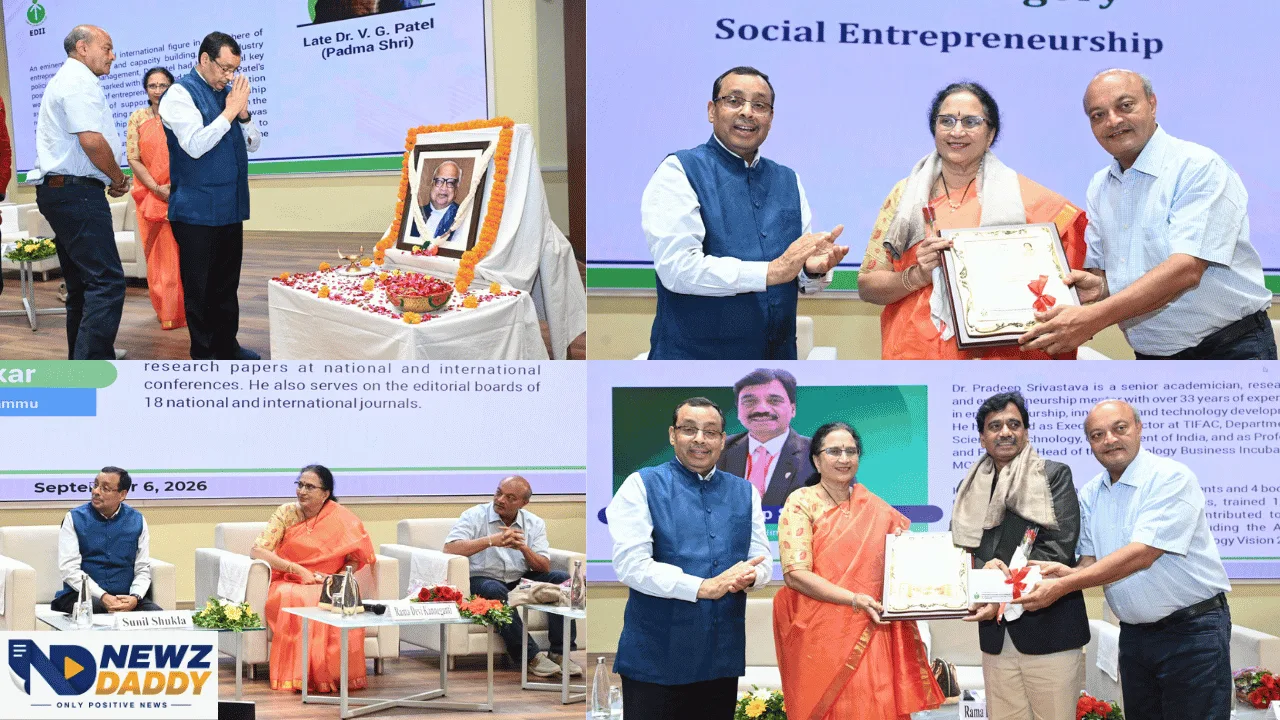
The role of small businesses, women entrepreneurs and local enterprise in India’s next phase of economic growth came into focus at the eighth Dr V.G. Patel Memorial Lecture held by the Entrepreneurship Development Institute of India (EDII) in Ahmedabad on September 6.
Rama Devi Kanneganti, President of the Association of Lady Entrepreneurs of India (ALEAP), delivered the lecture on “From Local Strength to National Prosperity”. Mahesh Savani, Chairperson of the P. P. Savani Group, attended as the distinguished guest.
The event also included the Dr V.G. Patel National Award for Entrepreneurship Trainer/Educator/Mentor 2026. EDII said the 2026 awards received 532 applications from 302 institutions across 18 countries and 25 Indian states. Kanneganti was recognised under the Social Entrepreneurship category.
The subject of the lecture comes at a time when entrepreneurship has become a major part of India’s economic policy. Government figures show that more than 55,200 startups were recognised during 2025-26, the highest number in a single year since the Startup India programme began. By March 31, 2026, the total number of recognised startups had crossed 2.23 lakh, with more than 23.36 lakh direct jobs recorded.
From local markets to national customers
Kanneganti argued that India’s large domestic market, expanding digital economy, young population and growing startup base provide a strong base for future growth.
“India today stands at a very important point in its economic journey. With a strong domestic market, rapid growth in the digital economy, a vibrant startup ecosystem and a young population, we have the foundations to create the next phase of growth. Our domestic market itself is a tremendous strength. At the same time, initiatives such as Make in India, Startup India and Digital India are creating new opportunities for entrepreneurs to innovate, formalise and scale. Digital platforms are enabling even small businesses from villages and towns to access customers across the country and increasingly global markets. India’s economy is already around $3.9 trillion, and the country is moving towards becoming the world’s third-largest economy. If we sustain strong growth and combine our domestic strength with manufacturing, digitalisation, innovation and exports, the opportunity ahead is enormous. Projections and long-term aspirations indicate the possibility of India moving towards a $10–12 trillion economy over the next decade or so.”
Her remarks point to an important change in the way local businesses can reach customers. A small producer no longer has to depend only on buyers in the same town. Online marketplaces, digital payments and social media can give small firms access to customers in other parts of India.
The wider startup numbers support the scale of this change. The government reported that recognised startups are now present in every state and Union territory. Maharashtra, Karnataka, Uttar Pradesh, Delhi and Gujarat were among the leading regions by the number of recognised startups and direct employment as of March 2026.
India’s formal startup system has also expanded sharply since Startup India was launched on January 16, 2016. The government says more than 1.07 lakh recognised startups had at least one woman director or partner by March 2026.
Remembering V.G. Patel
The annual lecture is linked to the work of Dr V.G. Patel, the founder of EDII and one of the early figures to argue that entrepreneurship could be taught through education and training.
Patel died on April 4, 2019. EDII began the annual memorial lecture series that year. The first lecture was held in 2019, followed by the second in 2020 and subsequent lectures each year. The seventh lecture in 2025 focused on moving people from “Job Seekers to Job Creators”.
EDII was established in Ahmedabad in 1983 as a national resource institute for entrepreneurship. Patel’s work helped give entrepreneurship education a formal place in India’s development efforts. The institute continues to run programmes in entrepreneurship education, training, research and support for new enterprises.
Dr Sunil Shukla, Director General of EDII, used the occasion to recall Patel’s contribution and discuss the wider role of entrepreneurship in India’s economy.
“Entrepreneurship has come a long way and has been recognised as an engine of growth. The country is progressively instituting measures to create a conducive start-up ecosystem through amiable policy machinery and the amalgamation of government, industry and academia. In all this, EDII shoulders the vast responsibility of nurturing entrepreneurs and their inventive spirit through outcome-oriented initiatives with the support of academia, Government and Corporates.”
The institute’s award programme also reflects Patel’s belief in the importance of people who train and mentor entrepreneurs. EDII introduced the Dr V.G. Patel Memorial Award for Entrepreneurship Trainer/Educator/Mentor in 2020. The award recognises people working in entrepreneurship education, training and mentoring.
A wider role for entrepreneurs
Mahesh Savani also spoke about the responsibilities that come with business success. He said entrepreneurs should consider how their work can contribute to society.
“Entrepreneurship brings the best out of a person. It helps create wealth, which can be constructively used for the progress of society. Every entrepreneur must be conscious about giving back to society. A continuous cycle of impact can easily be created if every successful entrepreneur mindfully decides to care for society in his or her own way. Even a small effort, over a period of time, leads to a mega impact. So, I would say, an entrepreneur must keep innovating to excel and must also simultaneously watch out for gaps in society where he/she can contribute meaningfully. Only such an approach can create a permanent legacy. I congratulate EDII for creating entrepreneurs with the right values and ethics.”
The discussion at EDII therefore went beyond the number of startups being created. It also raised a practical question for India’s next stage of growth: how can businesses that begin in towns, villages and local markets grow while creating jobs and wider social benefits?
For EDII, that question is closely connected with the legacy of V.G. Patel. The institute’s memorial lecture has now completed eight editions, with each year using entrepreneurship as a way to examine a different part of India’s economic and social development. This year’s focus placed local enterprise, digital access, manufacturing, exports and women-led entrepreneurship within that continuing discussion.