


GLS University Entrepreneurial Blueprint Brings Industry Insights
GLS University Brings Industry Experience to Campus Through Entrepreneurship Session with OMC Power Chairman
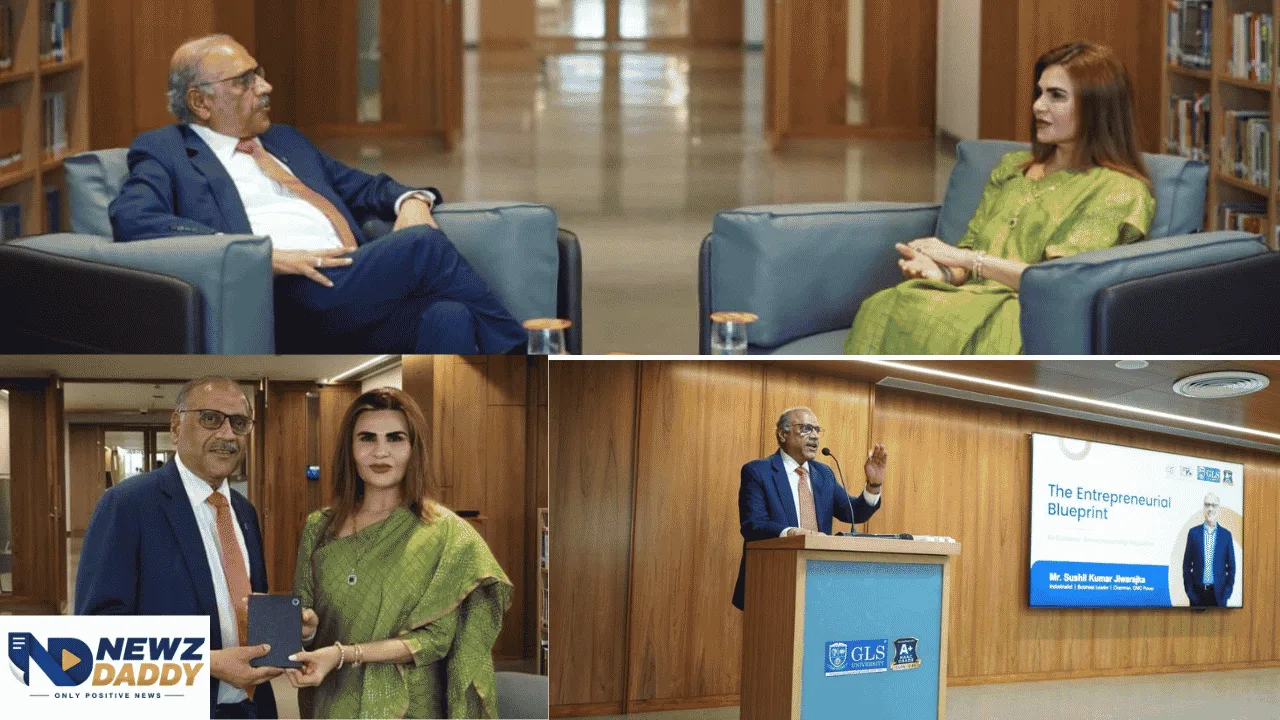
Students at GLS University in Ahmedabad had an opportunity to hear directly from one of India’s senior business leaders when industrialist Sushil Kumar Jiwarajka, Chairman of OMC Power, visited the campus for an interaction titled The Entrepreneurial Blueprint.
The programme focused on entrepreneurship, business leadership and the changing needs of modern industry. Students and faculty members gathered to discuss how companies are built, how business decisions are made and what skills young people need if they wish to start ventures of their own.
Jiwarajka, who has spent several decades working in technology, telecommunications and energy businesses, spoke about the realities of creating and growing enterprises in competitive markets. He discussed the pressures faced by business founders, the need to make difficult decisions and the importance of adjusting to changing economic conditions.
India has seen a rapid rise in entrepreneurial activity during the past decade. Government initiatives such as Startup India, launched in 2016, have encouraged young founders to build companies in sectors ranging from technology and health care to renewable energy and manufacturing. According to official figures, India is now home to one of the world’s largest startup ecosystems, with thousands of recognised startups operating across the country.
Against this backdrop, universities have increasingly begun inviting founders, investors and industry executives to interact with students outside traditional classroom settings. Higher education institutions argue that such discussions help bridge the gap between academic learning and business realities.
During the session, Jiwarajka spoke about the uncertainty that often accompanies entrepreneurship. He said business leaders must learn to respond to changing market conditions and unexpected setbacks rather than expect a predictable path to success.
He also discussed the role of continuous learning and the need for business founders to remain open to new ideas and technologies. Students were encouraged to look beyond conventional career choices and consider opportunities in problem solving, enterprise creation and leadership.
The conversation carried additional significance because of Jiwarajka’s experience in the energy sector, an industry undergoing major changes worldwide as countries move towards cleaner power sources.
OMC Power, the company he chairs, works in distributed renewable energy and decentralised power systems, particularly in areas where reliable electricity access has historically been limited. The company has developed solar-powered mini-grid projects and energy solutions for telecom infrastructure and rural communities in India and parts of Africa. Industry experts view such technologies as an important part of improving electricity access in remote regions while reducing dependence on fossil fuels.
Jiwarajka has also held leadership and board positions across several sectors, including telecommunications, electronics and technology services, during a professional career spanning many years. He has served on the boards of numerous Indian companies and has remained involved in corporate governance and business advisory roles.
A separate part of the engagement was recorded as part of the Decoded with Chandni Kapadia podcast series hosted by Dr Chandni Kapadia, Executive Director of GLS University. Through the conversational format, Jiwarajka reflected on experiences that shaped his professional life and discussed the decisions that influenced his leadership journey.
Podcast-based learning has become increasingly common across universities in India and abroad, allowing students to revisit discussions and hear extended conversations that may not fit within formal events or lectures.
Kapadia, who has worked in education, law, branding and international business, has been associated with several initiatives aimed at strengthening industry participation in higher education and expanding global collaborations for students. She currently serves as Executive Director of GLS University and has led several programmes focused on entrepreneurship and leadership development.
GLS University itself has increased its emphasis on innovation and entrepreneurship in recent years through startup competitions, research conferences and business events involving industry experts and entrepreneurs. Several of these programmes have focused on helping students understand business planning, investment readiness and market opportunities.
Educational institutions across Gujarat have expanded similar initiatives as the state continues to strengthen its position in manufacturing, financial services, renewable energy and technology sectors. Ahmedabad and Gandhinagar, in particular, have become important centres for startups, incubators and innovation programmes supported by universities, private organisations and government agencies.
For students attending the event, the value of the discussion lay less in business theory and more in hearing first-hand accounts from someone who has spent years making decisions in boardrooms and competitive markets.
As Indian universities place greater attention on employability and entrepreneurship, interactions with experienced business leaders are becoming a regular feature of campus life. Institutions increasingly see these conversations as a way to expose students to the practical challenges of leadership, risk management and enterprise building before they enter the workplace.
The session at GLS University reflected this wider shift in higher education, where classroom learning is being supplemented by direct engagement with industry voices and real-world business experiences.