

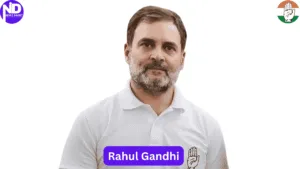
Rahul Gandhi is one of the most prominent faces of the Indian National Congress and a central figure in contemporary Indian politics. Born on 19 June 1970 in New Delhi, he belongs to the Nehru-Gandhi family, one of India’s most influential political families.
He is the son of former Prime Minister Rajiv Gandhi and Sonia Gandhi, and the grandson of Indira Gandhi. His family background has shaped both his political identity and the public attention around his career, with supporters viewing him as a continuation of a long political legacy and critics often focusing on dynastic politics.
Rahul Gandhi studied at St. Stephen’s College, Delhi, and later completed his education abroad, including at Rollins College in the United States and Trinity College, Cambridge. Before entering politics, he worked outside India for a period, which gave him a broader professional experience before he returned to public life. He entered electoral politics in 2004 and was elected to the Lok Sabha from Amethi, a seat that became strongly associated with his political career.
Over the years, he has held several key roles in the Congress Party. He became the party’s vice president in 2013 and later took over as president in 2017, leading the party through a difficult period marked by electoral setbacks and internal rebuilding. In the 2024 Lok Sabha elections, he played a leading role in Congress campaigning and in the wider INDIA alliance effort.
In Parliament, Rahul Gandhi has often positioned himself as a vocal critic of the ruling government. His speeches and public campaigns have focused on unemployment, inflation, social justice, caste census demands, and concerns about democratic institutions. He has also used mass outreach campaigns such as the Bharat Jodo Yatra and Bharat Jodo Nyay Yatra to connect with voters across regions and present himself as a more direct, ground-level political communicator.
His political style has changed over time. Earlier, he was often seen as reserved and cautious, but in recent years, he has become more assertive and visible in national debates. Supporters credit him with persistent opposition to the BJP and with helping Congress recover some political ground in 2024, while critics argue that he has struggled with consistency, organisation, and mass appeal.
As of 2026, Rahul Gandhi serves as the Leader of the Opposition in the Lok Sabha, giving him a major constitutional role and a stronger platform in national politics. His current position makes him one of the most important opposition leaders in India and a key figure in debates over the country’s political direction.