


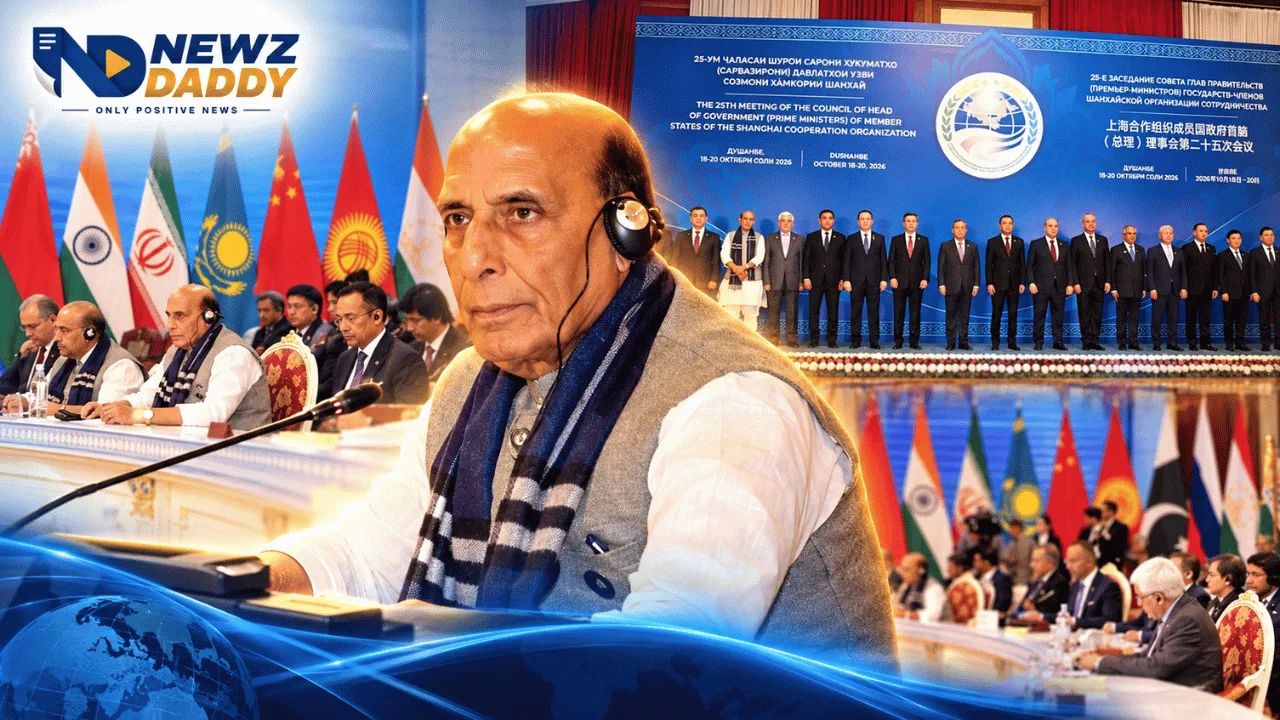
Rajnath Singh Backs SCO Trade Plan for 2026-2030 in Dushanbe
Rajnath Singh Urges SCO Nations to Act Together Against Terrorism at Dushanbe Meeting
India calls for stronger regional security, fair trade links and economic cooperation as Shanghai Cooperation Organisation members adopt a five-year trade action plan.
Defence Minister Rajnath Singh has urged members of the Shanghai Cooperation Organisation (SCO) to take joint action against terrorism, including those who finance, support or provide safe havens to terrorist groups. Speaking at the organisation’s meeting in Dushanbe, Tajikistan, he also called for fair trade rules, better transport links and economic policies that benefit ordinary people.
Rajnath Singh addressed the Council of Heads of Government meeting on 20 October, where member states reviewed economic and trade cooperation. His speech placed security and regional development at the centre of India’s approach to the 10-member organisation.
“Terrorism results in the loss of innocent lives and disrupts investment & commerce. It radicalises societies and deprives youth of the opportunities they rightfully deserve. There can be no justification for terrorism, no double standards in addressing it, and no place for those who finance, support, or provide safe havens to terrorists,” said Raksha Mantri.
The meeting brought together senior representatives from countries including India, China, Russia, Pakistan, Iran and the Central Asian republics. Belarus is also an SCO member. India and Pakistan joined the organisation in 2017, while Iran became a member in 2023 and Belarus in 2024.
Rajnath Singh referred to the SCO summit held in Bishkek in August and September 2026, where Prime Minister Narendra Modi called for practical steps on security, connectivity and economic opportunities.
India wants member states to address terrorism consistently, regardless of where attacks take place or who supports those responsible. Singh argued that terrorism harms public safety and weakens economic activity by discouraging investment and disrupting trade.
Turning these calls into action will require cooperation between governments and security agencies. The SCO already has a Regional Anti-Terrorist Structure, based in Tashkent, which supports cooperation against terrorism, separatism and extremism.
Rajnath Singh also welcomed decisions taken at the Bishkek summit to establish a Universal Centre in Tashkent and an Anti-Drug Centre in Dushanbe as permanent SCO bodies. He said their success would depend on coordination and the timely completion of their work.
Economic cooperation formed another major part of Singh’s address. He urged member states to respond to geopolitical tensions, trade disruptions, supply chain problems, energy and food security concerns, and gaps in access to technology.
India supports the adoption of an Action Plan for the Multilateral Trade and Economic Cooperation Programme for 2026-2030. The plan is intended to guide cooperation among member states over the next five years.
Rajnath Singh said the SCO should work through consensus and respect the equal rights of its members. He cautioned that creating more institutions would not automatically lead to better results. New bodies, he said, should meet clearly defined needs and avoid repeating work already being done elsewhere.
Transport links are another area where India wants progress. Singh referred to the International North-South Transport Corridor (INSTC) and Iran’s Chabahar Port as routes that could improve access between India, Central Asia and wider markets.
The INSTC is a planned multi-mode trade route using ships, roads and railways. It is designed to connect India with Iran, the Caspian region, Russia and markets further north and west. Chabahar Port, on Iran’s coast along the Gulf of Oman, offers India a route towards Afghanistan and Central Asia that does not pass through Pakistan.
These routes could help businesses move goods between regions. Their practical value, however, depends on transport infrastructure, customs procedures, political conditions and reliable links between different modes of transport.
Rajnath Singh said connectivity projects must respect the sovereignty and territorial integrity of every country involved. He also called for simpler customs procedures, digital documents, better logistics and compatible digital systems to reduce the cost of trade.
Rajnath Singh referred to a symposium on financing infrastructure projects in Central Asia held in Mumbai earlier in October. He thanked Central Asian countries and other SCO partners for taking part. He also acknowledged the first SCO Asian Economic Dialogue.
He said the organisation should judge its progress by the opportunities it creates for young people, entrepreneurs, farmers and small businesses.
India’s experience with Digital Public Infrastructure was another subject in his address. Singh said digital systems had changed public service delivery and improved financial inclusion. He also referred to India’s start-up sector and its focus on women-led development.
He mentioned the International Solar Alliance, the Coalition for Disaster Resilient Infrastructure, Mission LiFE and the Global Biofuel Alliance. These initiatives cover clean energy, climate-resilient infrastructure, responsible consumption and cleaner fuels.
Their inclusion reflected India’s call for SCO cooperation to extend beyond traditional trade and security matters. For businesses and communities, the practical test will be whether such cooperation improves access to services, markets, finance and technology.
Singh invited member states to attend the first SCO Civilisational Dialogue Forum, which India plans to host later this year.
The meeting reviewed progress in multilateral economic and trade cooperation, including transport, finance, the digital economy and social development.
Delegation heads adopted a joint communiqué covering the meeting’s decisions. It included the SCO budget for 2027, financial and administrative matters, and the action plan for multilateral trade and economic cooperation for 2026-2030.
The Council of Heads of Government is one of the SCO’s main forums for economic and practical cooperation. The organisation’s broader work also covers security, transport, energy, agriculture and cultural exchanges.
For India, the Dushanbe meeting offered an opportunity to press for consistent action against terrorism while seeking better access to Central Asian markets. The next test will be whether member states turn their shared commitments into working arrangements that improve security and make regional trade easier.
Must Read:
Rajnath Singh Represents India at SCO Meeting in Tajikistan