


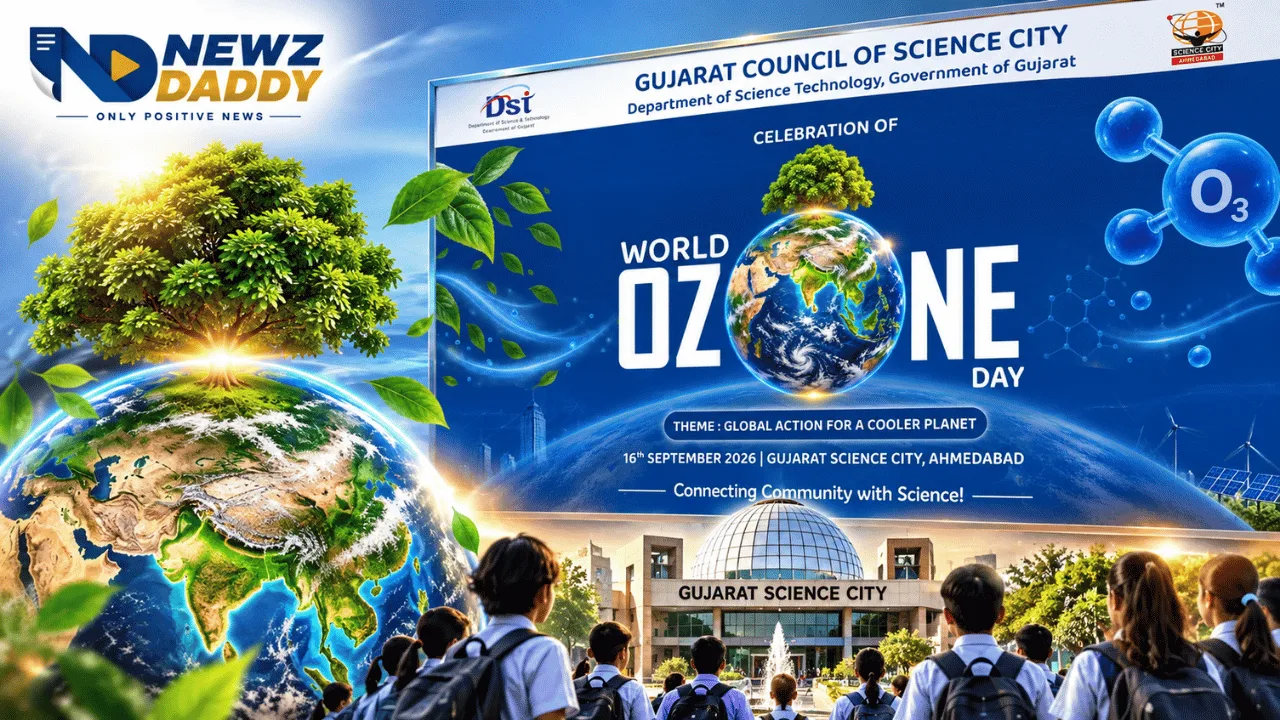
World Ozone Day 2026: Ahmedabad Science City Plans Student Event
Ahmedabad Science City to Mark World Ozone Day with 1,000 Students
Around 1,000 students from schools and colleges are expected to gather at Gujarat Science City in Ahmedabad on September 16 for a World Ozone Day programme focused on the protection of the ozone layer and the link between ozone protection, climate change and cooling.
The event will be held at the Children Activity Centre from 11 am to 6 pm. Gujarat Council of Science City, which works under the Department of Science and Technology, Government of Gujarat, has listed the World Ozone Day programme in its 2026 event calendar.
The United Nations Environment Programme has chosen “Global Action for a Cooler Planet” as the theme for World Ozone Day 2026. This year also marks 10 years since the adoption of the Kigali Amendment to the Montreal Protocol, which calls for a gradual reduction in the use of hydrofluorocarbons, or HFCs. These gases are widely used in cooling equipment and can contribute strongly to global warming.
At Gujarat Science City, the programme will begin with registration at 11 am, followed by a welcome and introductory session. A popular science lecture titled “Action for Ozone Protection & Cooler Planet” will explain the role of the ozone layer, the damage caused by ozone-depleting substances and the steps being taken to protect it.
Students will also watch a film on ozone protection and take part in an interactive “Explore Ozone” puzzle game carrying the message “Save Ozone: Save Life.” The programme will include visits to Science City’s scientific galleries, allowing students to connect classroom lessons with working exhibits and demonstrations.
The timing of this year’s programme is significant. The ozone layer absorbs much of the sun’s harmful ultraviolet radiation, helping reduce the risk of skin cancer and cataracts and protecting plants, crops and ecosystems. Scientists began raising concerns about ozone loss in the late 1970s. The discovery of a major ozone hole over Antarctica in the mid-1980s led to international action.
Governments adopted the Vienna Convention for the Protection of the Ozone Layer in 1985, followed by the Montreal Protocol in 1987. The treaty has since become one of the main international agreements dealing with ozone-depleting chemicals.
Recent scientific assessments show that these measures have produced measurable results. The 2022 Scientific Assessment of Ozone Depletion, prepared for the Montreal Protocol, found that nearly 99% of banned ozone-depleting substances had been phased out. If countries continue to follow the protocol, the global average ozone layer is expected to return to 1980 levels around 2040. The expected recovery date is around 2045 for the Arctic and 2066 for the Antarctic.
The ozone issue is also closely linked with climate change. The same scientific assessment found that action under the Montreal Protocol has avoided an estimated 0.5 to 1 degree Celsius of warming by the middle of this century compared with a scenario in which ozone-depleting substances continued to increase. The Kigali Amendment adds a climate goal by reducing HFCs, which do not damage the ozone layer but can have a high global warming effect.
The 2026 international campaign therefore places cooling at the centre of World Ozone Day. UNEP says the Kigali Amendment, adopted in 2016, is intended to support a shift towards more climate-friendly cooling while improving energy efficiency. The issue has practical importance in countries such as India, where air conditioners and refrigeration are increasingly important for homes, businesses, food storage and other services.
India has its own institutional system for carrying out obligations under the Montreal Protocol. The Ministry of Environment, Forest and Climate Change is responsible for ozone-layer protection and implementation of the protocol in the country. Its Ozone Cell works on the phase-out of ozone-depleting substances and provides support for implementation of India’s commitments.
For students attending the Ahmedabad programme, the subject will be presented through several forms of learning rather than through a lecture alone. The planned film, puzzle activity and gallery visits are intended to explain environmental science in ways that can be followed by young visitors.
This approach fits the wider work of Gujarat Science City. The centre was established by the Government of Gujarat and registered as the Gujarat Council of Science City in 1999. It operates under the Department of Science and Technology and uses exhibitions, working models, laboratories, virtual reality activities and live demonstrations to explain science and technology.
Its facilities include the Hall of Science, Hall of Space, Energy Education Park, Life Science Park, Astronomy and Space Science Gallery, Robotics Gallery, Aquatic Gallery, Nature Park and Climate Change Learning Lab. The Science City website also lists regular outreach programmes and activities for students and teachers.
The September 16 programme will run from 11 am to 6 pm at the Children Activity Centre, Gujarat Science City, Ahmedabad. With ozone recovery showing progress but requiring continued international action, the programme will give participating students a chance to examine how a global environmental agreement affects science, technology, health and climate policy.
The event is scheduled for World Ozone Day, September 16, 2026, the date observed each year to mark the signing of the Montreal Protocol and to keep public attention on the protection of the ozone layer.