


Rashtriya Raksha University NMHC MoU Gives Gujarat New Role
Rashtriya Raksha University and National Maritime Heritage Complex Join Hands to Strengthen Maritime Education and Heritage Research
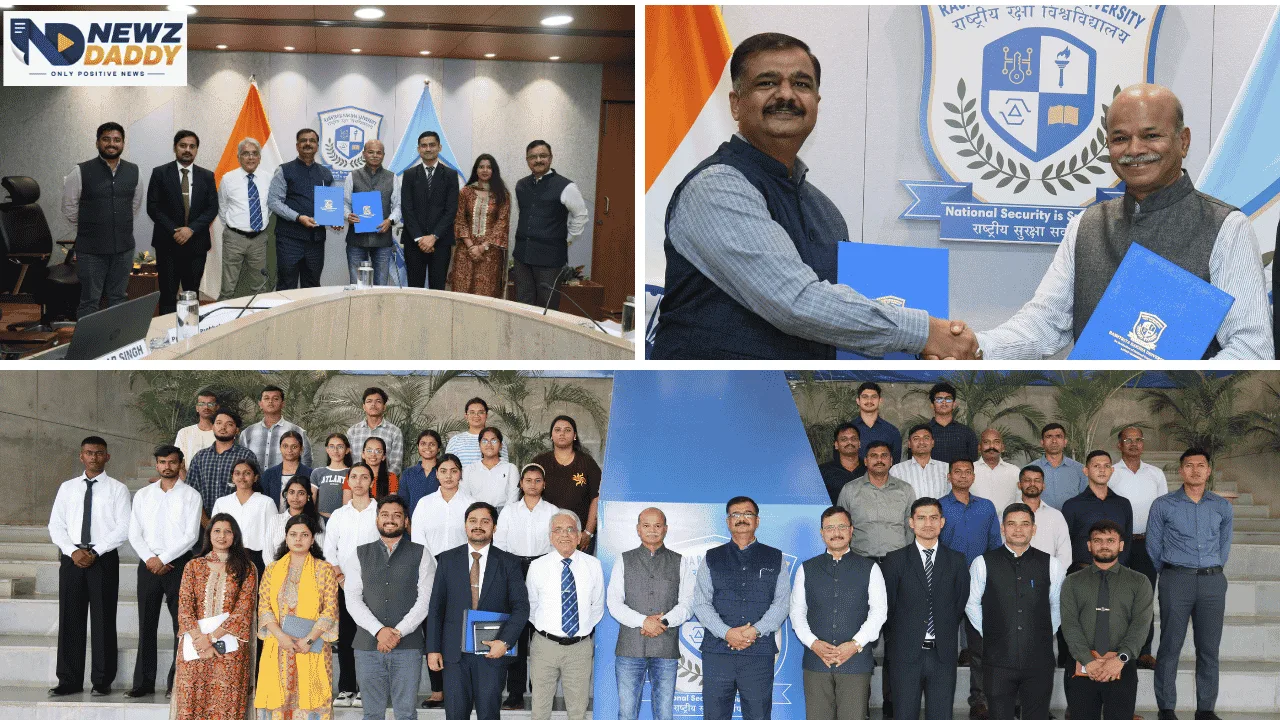
Rashtriya Raksha University (RRU) in Gandhinagar and the National Maritime Heritage Complex (NMHC) at Lothal have signed a Memorandum of Understanding (MoU) to expand cooperation in maritime education, research, training, heritage studies and professional capacity building. The agreement was exchanged on 14 July 2026 at the RRU campus and brings together two institutions working in different parts of India’s maritime sector.
The partnership links the School of Integrated Coastal and Maritime Security Studies (SICMSS) at RRU with the National Maritime Heritage Complex, a flagship project of the Ministry of Ports, Shipping and Waterways, Government of India. Both organisations plan to work together in areas that connect India’s maritime history with present-day coastal security, governance and policy.
The MoU was exchanged in the presence of senior representatives from both institutions. Prof. (Dr.) Kalpesh H. Wandra, Pro Vice Chancellor of Rashtriya Raksha University, exchanged the agreement on behalf of the university with Prof. (Dr.) Vasant Shinde, Chief of Galleries and Advisor at the National Maritime Heritage Complex, Lothal.
The agreement comes at a time when India is placing greater attention on its maritime sector. The country has a coastline of more than 7,500 kilometres, supports 12 major ports and many non-major ports, and depends heavily on sea routes for international trade. Maritime security, coastal management, port development and marine heritage have therefore become important areas for education, research and public policy.
The National Maritime Heritage Complex under development at Lothal in Gujarat is one of the Government of India’s major cultural and maritime projects. Lothal was one of the most important cities of the Indus Valley Civilisation and is widely recognised for its ancient dockyard, regarded by many historians as one of the world’s earliest known tidal dock facilities. The complex aims to present India’s long maritime tradition through museums, galleries, research facilities and public exhibitions.
Rashtriya Raksha University, established as an Institution of National Importance under an Act of Parliament, focuses on national security, policing, criminal justice, strategic studies and related disciplines. Through SICMSS, the university has expanded its academic work into coastal and maritime security, recognising the growing need for trained professionals in these fields.
Speaking during the exchange ceremony, Prof. (Dr.) Kalpesh H. Wandra said the partnership reflects Rashtriya Raksha University’s continued commitment to developing a strong academic and professional foundation for maritime security and governance.
He stated, “The partnership reflects Rashtriya Raksha University’s continued commitment to developing a strong academic and professional foundation for maritime security and governance. He stated that the collaboration with NMHC would enable students, researchers and practitioners to understand India’s maritime journey holistically, connecting civilisational knowledge with contemporary security and policy requirements.”
His remarks underline an effort to combine historical understanding with modern security challenges. Universities are increasingly encouraging students to study issues such as maritime law, coastal surveillance, marine governance, port security and international shipping alongside historical developments.
Prof. (Dr.) Vasant Shinde said NMHC represents India’s long maritime tradition and its connections with the wider world.
He observed, “NMHC, Lothal, represents India’s maritime civilisational legacy and its global maritime outlook. He noted that the collaboration with RRU would help connect maritime archaeology, heritage interpretation and museum-based knowledge with modern maritime education, research and public awareness. He further emphasised that such partnerships are important for taking India’s maritime history to students, scholars, policymakers and the wider public.”
The National Maritime Heritage Complex is expected to become an important centre for preserving archaeological discoveries, maritime artefacts and historical records while helping visitors understand India’s role in ancient and modern sea trade. Academic partnerships can support this work through research projects, student visits, training programmes and public engagement activities.
Mr Manish Kumar Singh, Director of the School of Integrated Coastal and Maritime Security Studies at RRU, said the agreement creates opportunities for practical and interdisciplinary work between maritime heritage and maritime security studies.
He stated, “The MoU provides an important platform for advancing practical and interdisciplinary engagement between maritime heritage and maritime security studies. He highlighted that SICMSS looks forward to working closely with NMHC involving coastal States and Union Territories, maritime institutions, museums, industry and international partners.”
Such cooperation reflects a wider trend in higher education, where universities increasingly work with government agencies, museums, research organisations and industry to provide students with practical learning opportunities alongside classroom teaching.
The agreement may support joint research projects, academic events, training programmes, seminars, workshops and student exchanges. It can also encourage studies covering maritime archaeology, coastal resilience, maritime governance, museum interpretation and heritage conservation. These subjects have gained greater attention as governments seek to protect cultural heritage while strengthening economic and strategic interests linked to the sea.
For Gujarat, the collaboration carries added importance. The state has a long coastline, several commercial ports and historic trading centres that have connected India with regions across Asia, Africa and the Middle East for centuries. Lothal itself remains one of the country’s most significant archaeological sites and continues to attract researchers interested in ancient trade, engineering and urban planning.
The exchange of the MoU marks another step in efforts to connect academic learning with India’s maritime heritage and present-day maritime priorities. By combining expertise in security studies, archaeology, history and public education, Rashtriya Raksha University and the National Maritime Heritage Complex aim to encourage informed research, strengthen professional training and increase public understanding of India’s maritime legacy for future generations.
Must Read:
Police Image and Best Practices in Policing Discussed at RRU