


RRU Pasighat VC Roundtable: 16 VCs Meet in Arunachal
16 North-East Vice-Chancellors Meet in Pasighat to Discuss the Future of Higher Education
Pema Khandu opens two-day RRU Pasighat roundtable covering AI, research, border studies and university partnerships
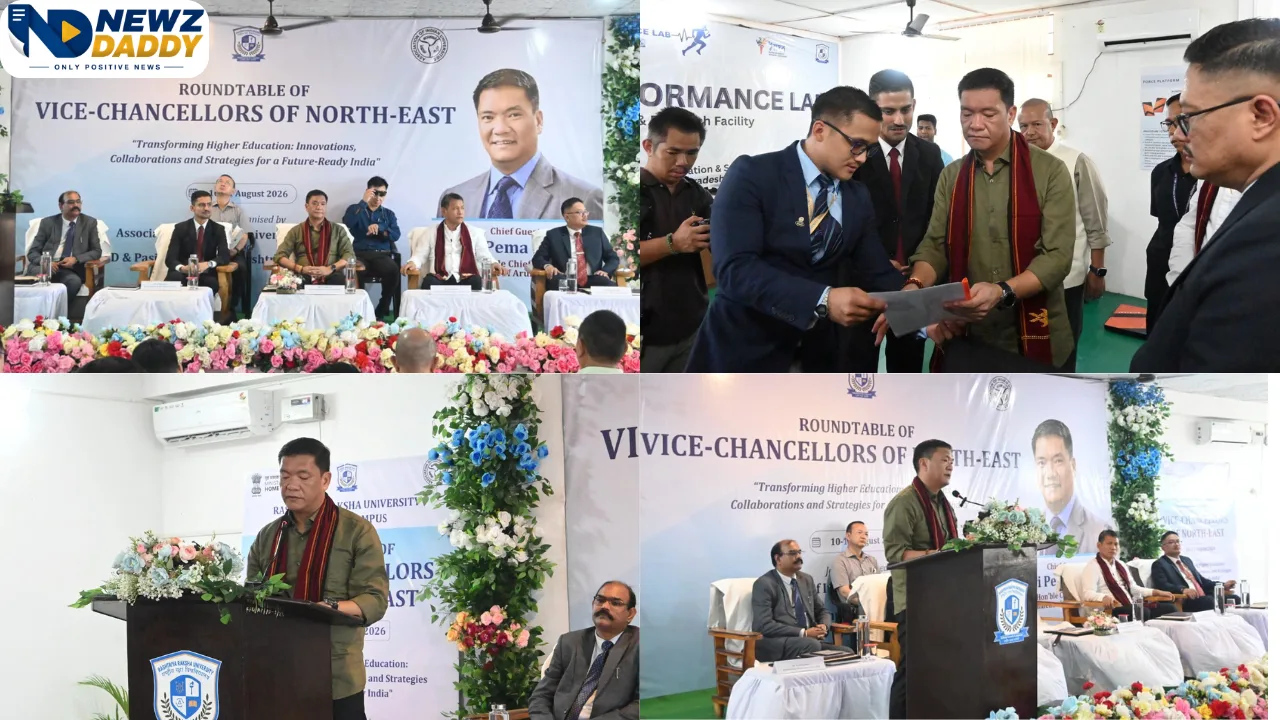
Sixteen Vice-Chancellors from universities across North-East India have gathered at Rashtriya Raksha University’s Pasighat Campus for a two-day meeting on the changing needs of higher education, with research, artificial intelligence, university partnerships and development in border areas among the main subjects under discussion.
Chief Minister of Arunachal Pradesh Pema Khandu opened the roundtable on Monday. The event, organised by Rashtriya Raksha University (RRU), Pasighat Campus, in collaboration with EDLD and the Association of Indian Universities (AIU), New Delhi, is being held under the theme, “Transforming Higher Education: Innovations, Collaborations and Strategies for a Future-Ready India.”
The meeting comes as Indian universities are dealing with rapid changes in teaching, research and technology. AI has become a major subject in discussions among university leaders. At an Association of Indian Universities national conference earlier this year, more than 300 Vice-Chancellors discussed AI-based learning, changes in classroom teaching, internationalisation, entrepreneurship and the use of traditional knowledge in higher education.
For the North-East, the Pasighat meeting carries another layer of importance. The region includes several frontier states, and Arunachal Pradesh shares an international border with China. Khandu has asked universities to pay greater attention to research linked to border communities and the problems they face.
Speaking at the inaugural session, Khandu said universities have a responsibility to prepare young people who are skilled, responsible, ethical and aware of their duties towards society. He referred to Prime Minister Narendra Modi’s Viksit Bharat vision and called for more university research on border-area development.
The areas he mentioned include livelihoods, connectivity, sustainable development, technology and the social and economic progress of people living in frontier regions. He also called for universities to work together by sharing expertise, resources and academic knowledge.
The Chief Minister welcomed the 16 Vice-Chancellors to Pasighat and said he expected the discussions to lead to practical academic and research partnerships.
The presence of university leaders from across the region also gives the meeting a chance to address an issue that is often difficult for individual institutions: building research projects that cross university and state boundaries. Joint studies, faculty exchanges, student programmes and shared research projects could allow institutions to combine resources and work on problems that affect more than one state.
The discussions at Pasighat will cover the growing use of AI in universities. One session will examine “Digital Transformation & AI Integration”, while another will focus on “Building AI-Ready Universities: A Roadmap for Academic Leaders”. A further discussion will look at how universities should deal with AI in areas ranging from administration to teaching and research.
Other subjects include globalisation and internationalisation, the role of Indian Knowledge Systems in university education, innovation and entrepreneurship, startup activity, and the financial and institutional sustainability of higher education institutions.
The proposed regulatory changes under the Viksit Bharat Shiksha Adhishthan Bill, 2025, are also on the agenda. The Bill was introduced in the Lok Sabha in December 2025 and proposes a new higher education regulatory structure that would replace the University Grants Commission, the All India Council for Technical Education and the National Council for Teacher Education with a single commission and three councils covering regulation, standards and accreditation. The Bill is currently under consideration by a Joint Parliamentary Committee.
RRU’s Pasighat Campus has a particular reason to focus on the connection between higher education and security-related research. Rashtriya Raksha University is an Institution of National Importance under the Ministry of Home Affairs and specialises in areas including national security, police administration, internal security, criminology, cyber security and forensic science. Its Pasighat Campus offers programmes linked to police administration, security management, cyber security, digital forensics, physical education and sports sciences.
The university describes the Pasighat campus as its first off-campus centre. Its academic work has included police administration, internal security, physical education and related fields, with field visits and internships forming part of its approach to professional education.
That background makes the focus on border studies particularly relevant. Research carried out in Arunachal Pradesh can address questions that have a direct bearing on communities in frontier areas, including access to services, employment, transport, technology and local development. Such research can also give policymakers better information when planning programmes for remote areas.
The roundtable is being attended by several senior Arunachal Pradesh officials and elected representatives. Those present include Rural Development and Panchayati Raj Minister Ojing Tasing; Mutchu Mithi, MLA and Advisor to the Chief Minister on Home and Education; Kaling Moyong, President of BJP Arunachal Pradesh; MLAs Ninong Ering, Tapi Darang, Oken Tayeng and Oni Panyang; Education Commissioner Amjad Tak, IAS; East Siang Deputy Commissioner Sonalika Jiwani, IAS; and East Siang Superintendent of Police Pankaj Lamba, IPS.
RRU representatives at the inaugural session included Dr Amarendra Pani, Joint Director (Research), Association of Indian Universities; Dr Avinash Kharel, Dean, Campuses, RRU; and Dr M. Sanjeev Singh, Director, RRU Pasighat Campus.
The two-day meeting is expected to move beyond discussion towards cooperation between participating universities. The practical test will be whether the participating institutions develop joint research, student and faculty exchanges, academic programmes and other projects after the meeting ends.
For Pasighat and the wider North-East, that outcome could matter more than the meeting itself. Universities are being asked to respond to new technology while also addressing local questions of development, governance, security and employment. The success of the roundtable will ultimately depend on how much of that discussion turns into work that reaches classrooms, researchers and communities across the region.
Must Read:
Rashtriya Raksha University Enters Strategic Partnership with University of Kashmir