


Dabur Chyawanprash Campaign Pushes Year-Round Immunity Now
Dabur Chyawanprash Targets Younger Consumers With New Campaign on Everyday Immunity
Dabur India Ltd has launched a new advertising campaign for Dabur Chyawanprash, seeking to encourage younger consumers to include the traditional Ayurvedic preparation in their daily routines rather than treating it mainly as a winter product.
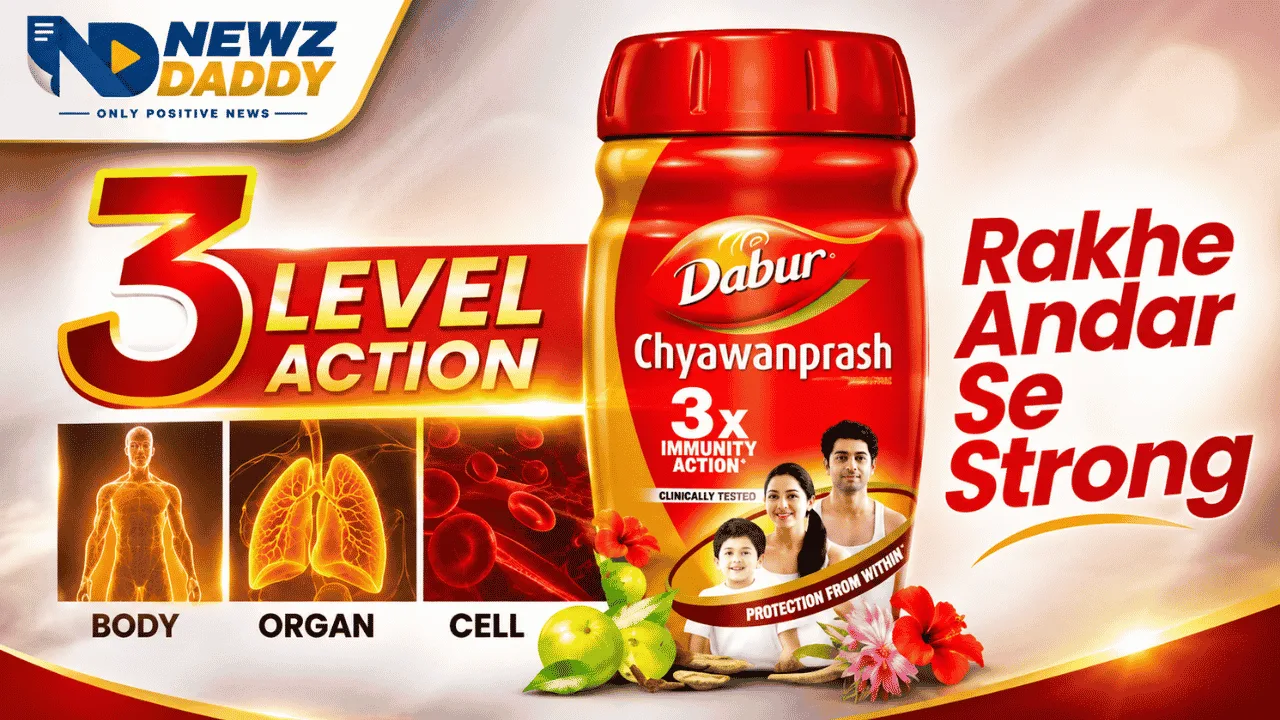
Titled “Triple Action On. Rakhe Andar Se Strong.”, the campaign explains the brand’s health proposition through three levels of the human body: the body itself, internal organs and individual cells. The film aims to explain how Dabur Chyawanprash is intended to support the body’s natural defences, using computer-generated visuals to present processes that cannot normally be seen.
The campaign comes at a time when younger Indian consumers are paying closer attention to their health habits. Regular exercise, food choices, sleep patterns and nutritional supplements have become common subjects of discussion among people who want to maintain their health throughout the year. Dabur is seeking to make its long-established Chyawanprash brand relevant to this changing consumer behaviour.
Sriram Padmanabhan, Director, Dabur India Ltd, said, “Almost every Indian family knows Dabur Chyawanprash. Far fewer know how it actually works. For generations, people have trusted this powerful blend of Ayurvedic ingredients — and with this campaign, we are finally showing them the science behind that trust. ‘Triple Action On’ makes protection across the body, organs and cells visible and easy to grasp. Today’s consumers don’t just want to be told something is good for them; they want to understand why. This campaign gives them that answer, and a reason to make Chyawanprash part of every day, not just every winter.”
Chyawanprash has a long history in India’s traditional system of medicine. It is generally prepared using amla, also known as Indian gooseberry, along with several herbs, spices and other ingredients. Classical Ayurvedic texts, including the Charaka Samhita, describe the preparation as a rasayana, a category of formulations associated with maintaining strength and general well-being.
Amla forms the main fruit base of the preparation. Other commonly used ingredients include giloy, pippali, ashwagandha, cardamom, cinnamon and clove. Traditional preparation involves boiling herbs and amla, extracting the pulp and combining it with other ingredients to produce a thick paste.
The number and quantities of ingredients can differ between manufacturers. A research paper published in the journal Biomolecules in 2019 examined the traditional preparation process and the herbs used in Chyawanprash. It also discussed the need for further scientific work to understand the formulation’s health effects.
Dabur has been associated with packaged Chyawanprash for more than seven decades. The company introduced its branded Chyawanprash in 1949, becoming the first Indian company to sell the traditional preparation under a brand name, according to its corporate history.
Dabur itself traces its beginnings to 1884, when Dr S K Burman started an Ayurvedic medicines business in Calcutta, now Kolkata. The company established research laboratories in 1919 to develop manufacturing methods and quality checks for Ayurvedic medicines. Over the years, it expanded into several consumer product categories, including healthcare, personal care, oral care and food products.
The Chyawanprash business has remained an important part of its healthcare portfolio. Its traditional association with winter consumption has also influenced how many households use the product. The latest campaign seeks to change this buying habit by presenting regular consumption as a daily health choice.
Binit Kumar, Marketing Head- Health Supplements, Dabur India Ltd, said, “Everyone has grown up with Dabur Chyawanprash. Our challenge was to make it matter to a generation that tracks its steps, its sleep and its protein — and to remind them that the most important part of being healthy is the part nobody sees. We built the film around one familiar neighbourhood moment and let it open the door to a fresh look at a brand people thought they already knew.”
The campaign’s message also raises an important question about the scientific evidence behind traditional health products. Although Chyawanprash has been examined in several scientific studies, the available clinical evidence does not establish all the health claims commonly associated with it.
A review published in the Journal of Ethnopharmacology in 2016 examined research on Chyawanprash and its possible therapeutic benefits. The researchers called for larger, better-designed clinical trials, with longer follow-up periods, before firm conclusions could be reached about its use as an immunity booster.
A separate review published in Biomolecules in 2019 also examined its ingredients, preparation methods and possible biological effects. The researchers noted that further scientific investigation was needed to establish its therapeutic value.
This distinction matters as consumers increasingly expect health products to provide clear information about their ingredients and claimed benefits. Traditional use and laboratory findings can offer useful starting points for research, but they do not automatically establish that a product prevents infections or protects every organ and cell in the human body.
The Advertising Standards Council of India requires advertisements to support claims that can be measured or independently checked. Its advertising code also requires companies to provide evidence when asked to substantiate such claims.
The new campaign has been conceptualised by McCann India, part of Omnicom Advertising India. Its television and digital film follows a father and daughter returning home after playing tennis and completing a shopping trip.
An unexpected conversation with a neighbour changes the direction of their discussion towards internal health. The film then uses visual effects to take viewers inside the human body, presenting the three levels described in the campaign: body, organs and cells.
It ends with the line, “Triple Action On. Rakhe Andar Se Strong.”
For Dabur, the campaign represents another attempt to connect a product introduced in 1949 with consumers’ expectations in 2026. Its success will depend on whether the message can persuade younger households to consider Chyawanprash year-round and whether the company’s health claims meet the growing demand for scientific evidence.
For consumers, the campaign also provides an opportunity to look more closely at the ingredients, nutritional information and evidence behind the health products they choose. Regular exercise, a balanced diet and appropriate medical care remain essential parts of maintaining good health, regardless of the supplements included in a daily routine.