


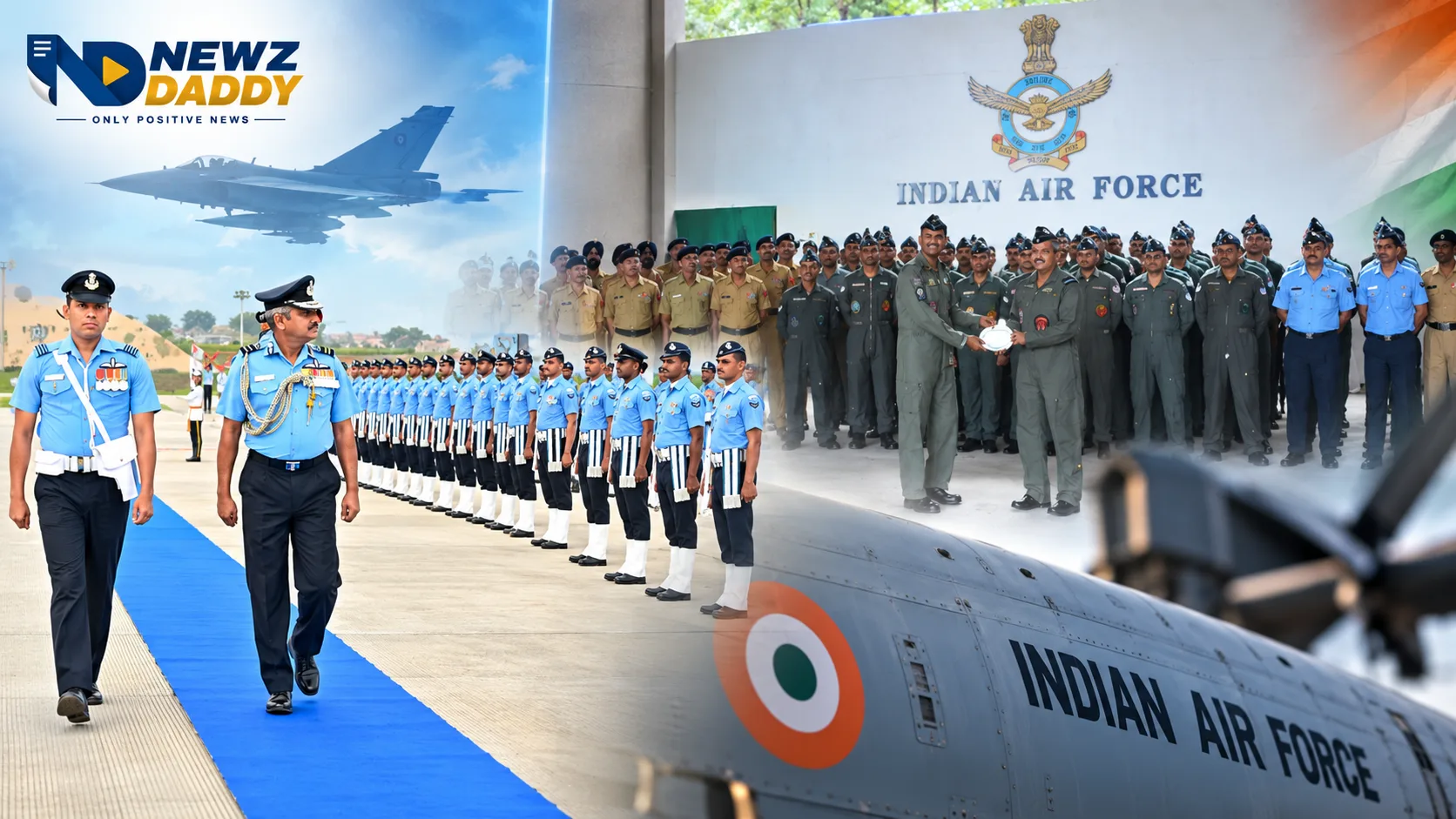
PV Shivanand Reviews Air Bases Across Saurashtra Sector
PV Shivanand’s Saurashtra Visit Explained As SWAC Checks Air Defence And Operational Readiness
Air Marshal PV Shivanand, Air Officer Commanding-in-Chief of the Indian Air Force’s South Western Air Command, has carried out an operational review of air bases in the Saurashtra sector, with attention on air defence, air operations and the readiness of personnel.
The review comes about two months after Air Marshal Shivanand took charge of South Western Air Command, headquartered in Gandhinagar. He assumed the appointment on 1 July 2026, succeeding Air Marshal Tejinder Singh, who moved to the post of Chief of Integrated Defence Staff to the Chairman Chiefs of Staff Committee.
During his visit to the Saurashtra sector, Air Marshal Shivanand received a ceremonial Guard of Honour on arrival. He then reviewed facilities linked to air defence and air operations and met personnel serving at the station.
A key part of the visit was his sortie on a maritime strike aircraft. The flight brought attention to the maritime role of the South Western Air Command, whose area of responsibility covers Gujarat and the Saurashtra region as well as large parts of Rajasthan.
The western coastline gives this responsibility added importance. Gujarat has a long coastline along the Arabian Sea, with major ports, industrial areas and important maritime routes. Air power forms one part of the wider security system used to watch and protect these approaches.
The sortie also gave the senior commander direct exposure to the operation of a maritime strike platform. The Indian Air Force operates alongside the Indian Navy in maintaining security over India’s maritime areas, with aircraft providing surveillance, reconnaissance and strike capabilities when required.
The South Western Air Command is one of the Indian Air Force’s five operational commands. It was raised at Jodhpur in July 1980 and later moved its headquarters to Gandhinagar in May 1998. Its geographical responsibility extends through Rajasthan and Gujarat, including Saurashtra and Kutch.
This makes the command an important part of India’s western air defence structure. Air bases in the region support different operational requirements, including fighter operations, air defence, transport and maritime tasks.
Air Marshal Shivanand’s appointment also brings extensive operational experience to the command. He was commissioned into the fighter stream of the Indian Air Force in December 1988. Before taking charge of South Western Air Command, he served as Senior Air Staff Officer at Headquarters Central Air Command.
According to the Ministry of Defence, he has more than 2,800 hours of flying experience on the MiG-21 and IL-76 AWACS platforms. His earlier assignments included command of two frontline IAF squadrons and a premier airbase in the Eastern Sector. He has also served at Headquarters South Western Air Command and Air Headquarters, with experience in air operations, air defence, airborne sensors and networking.
His career has also included a diplomatic assignment as Defence and Air Attaché at the Embassy of India in Washington DC, with concurrent accreditation to Canada.
The Saurashtra review therefore comes at an early stage of his tenure as AOC-in-C. Visits of this kind allow senior commanders to assess facilities and speak directly with personnel responsible for day-to-day operations.
During his interaction with station personnel, Air Marshal Shivanand stressed the need for 24 x 7 operational vigilance. He also placed emphasis on professional standards, demanding training, and physical and mental resilience.
The focus on continuous readiness reflects the nature of air operations. Aircraft and air defence systems can be called upon at short notice, while crews and ground teams must remain prepared to respond at any hour. Training is therefore a regular part of maintaining operational capability.
The reference to physical and mental resilience also points to the human side of military readiness. Pilots, engineers, technicians, air traffic personnel and other station staff work in roles where concentration and discipline are essential. Their ability to operate under pressure is closely linked to the reliability of the wider system.
The review also comes as the Indian Air Force continues to strengthen its surveillance, networking and air defence capabilities. Air Marshal Shivanand’s previous appointments included work involving airborne sensors and networking, areas that have become increasingly important as modern air operations depend on faster information sharing and coordination.
For Gujarat and the Saurashtra region, the maritime element carries particular weight because of the state’s position on India’s western seaboard. Air bases in and around the region form part of a wider military network covering the country’s western approaches.
The details released about the review do not disclose specific operational assessments, aircraft numbers, deployment plans or locations beyond the Saurashtra sector. That limits what can be concluded about individual bases from the visit.
What is clear is that the review placed three areas at the centre of attention: the condition of operational facilities, the ability of personnel to remain ready around the clock, and the continued importance of maritime air capability.
For South Western Air Command, the review provides an early indication of the priorities set by its new commander. For the Saurashtra sector, it underlines the continuing role of its air bases in India’s wider air defence and maritime security arrangements.
Also Read:
Shakti Sharma Reaches Air Vice Marshal Rank in Indian Air Force
Squash Championship 2026 Begins in Chandigarh With UK, Sri Lanka