

ISAM Conference to Link Military Aviation with Space Medicine
ISAM’s 65th annual conference to examine medical challenges from military aviation to human spaceflight
Bengaluru will host the two-day meeting on 26 and 27 November, bringing together around 250 delegates, including military doctors, aviation specialists and aerospace scientists.
India’s growing space programme and expanding aviation sector will form the focus of the 65th Annual Conference of the Indian Society of Aerospace Medicine (ISAM), scheduled for 26 and 27 November 2026 at the Institute of Aerospace Medicine (IAM) in Bengaluru.
The meeting will bring together around 250 delegates from military and civil aviation, the Indian Air Force (IAF), the Defence Research and Development Organisation (DRDO) and the aerospace industry. Medical experts and scientists from India and abroad are also expected to attend.
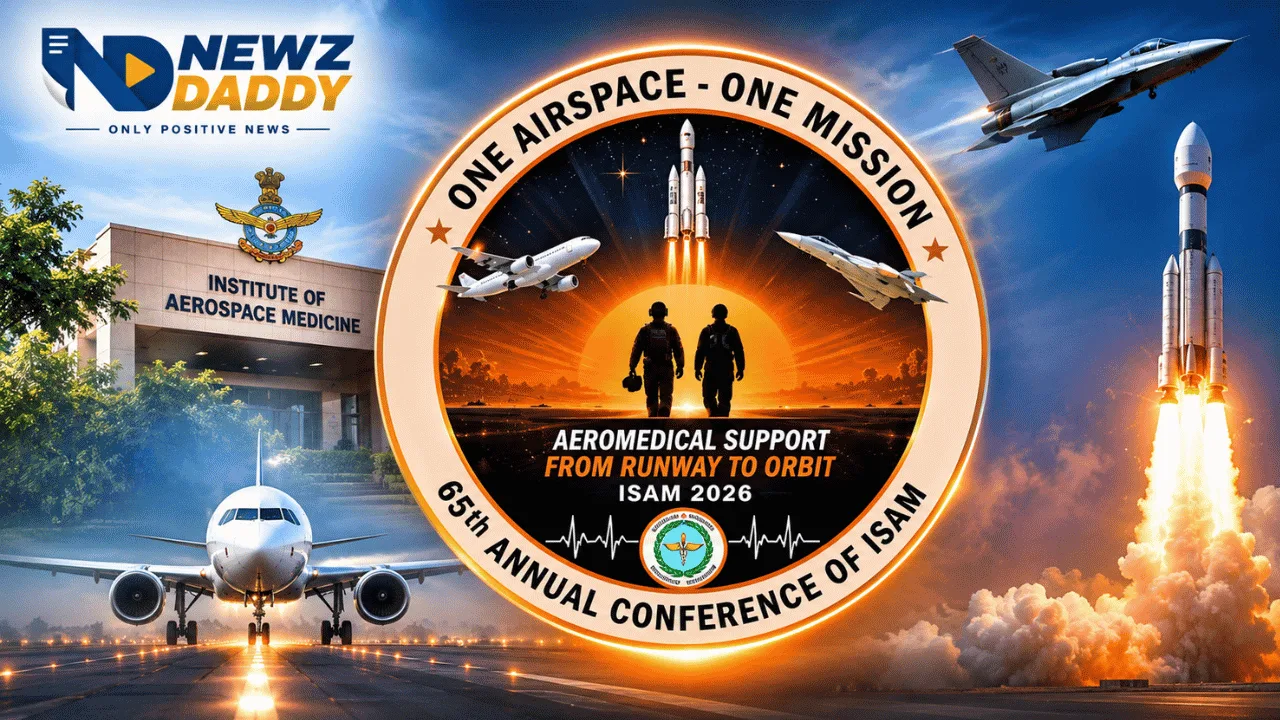
The conference will examine how medical services can support people working in different flying environments, from military aircraft and passenger planes to spacecraft. Its central theme is ‘One Airspace – One Mission: Aeromedical Support from Runway to Orbit’.
The meeting comes as India continues work on its human spaceflight programme and develops aircraft through domestic research and manufacturing. Both areas require careful study of how the human body responds to flight, changes in pressure, acceleration and other conditions associated with aviation and space travel.
The Indian Society of Aerospace Medicine was established in 1952. It has held an annual scientific conference since 1954. Its work covers medical issues linked to flying, including the health and safety of pilots and other aircrew.
The Institute of Aerospace Medicine, which is hosting this year’s meeting, has an important role in India’s military aviation medical services. It also supports the medical work linked to the Indian Space Research Organisation’s (ISRO) Gaganyaan programme.
The link between IAM and Gaganyaan goes back several years. Under an agreement signed between the Indian Air Force and ISRO in May 2019, IAM was named the lead agency for medical support to the human spaceflight programme. This arrangement places military medical expertise at the centre of India’s preparations for sending astronauts into space.
Gaganyaan is India’s first human spaceflight programme. ISRO is developing the systems needed to carry Indian astronauts into low Earth orbit and bring them safely back to Earth. Medical planning forms an important part of this work because the human body faces different conditions during spaceflight.
In August 2026, the Union government reported progress on several parts of the programme, including the human-rated launch vehicle, crew and service module systems, life-support equipment, crew escape systems and ground facilities. ISRO has also worked with the Sree Chitra Tirunal Institute for Medical Sciences and Technology on space medicine research. Areas covered by this cooperation include human physiology, behavioural health, radiation medicine, biomedical support and medical care during space missions.
For doctors working in this field, spaceflight creates problems that are different from those faced during ordinary air travel. Astronauts experience microgravity, which changes how fluids move through the body and affects muscles and bones. They may also face radiation exposure, sleep disruption and changes in balance. Medical teams must study these effects before, during and after a mission.
Aerospace medicine also has a direct role in aviation safety. Pilots flying military aircraft can experience high acceleration forces, which may affect blood flow to the brain and cause loss of consciousness. At high altitudes, a shortage of oxygen can affect judgement and physical performance. Medical checks, fitness assessments and training help reduce these risks.
Civil aviation has its own medical requirements. Pilots and other flight crew must meet health standards that allow them to perform their duties safely. The needs of a passenger aircraft crew differ from those of a fighter pilot or an astronaut, but all require medical systems suited to their working conditions.
The conference will also address the relationship between medical research and aircraft development. The Centre for Military Airworthiness and Certification (CEMILAC), which operates under DRDO, checks whether military aircraft and their equipment meet safety and performance requirements before they enter service. Its work covers aircraft, helicopters, unmanned aerial vehicles and other airborne systems. Medical specialists contribute by studying how aircraft design, cockpit conditions and life-support equipment affect the people who operate them.
Air Chief Marshal Ashutosh Dixit, Chief of the Air Staff, will inaugurate the Bengaluru conference in the presence of military and civil dignitaries from India and abroad.
Several senior figures from the defence and aviation sectors will take part in the programme. Shri APVS Prasad, Chief Executive of CEMILAC, will deliver the Air Marshal Subroto Mukerjee Memorial Oration. The late Air Marshal Subroto Mukerjee was India’s first Chief of the Air Staff after independence and served as the first patron of ISAM. The Society introduced the memorial oration in 1971.
Retired Air Vice Marshal Anupam Agarwal, Principal Consultant (Aerospace Medicine) at the Airports Authority of India, will deliver the Air Vice Marshal Srinagesh Memorial Oration. Air Vice Marshal MM Srinagesh is remembered for his contribution to developing aviation medicine in India.
The JHF Manekshaw Panel will include views from retired Wing Commander Surender Sodhi and retired Colonel K. N. Rao.
Another addition to this year’s programme is the launch of the Cosmonaut Rakesh Sharma Lecture Series. It will honour Wing Commander Rakesh Sharma (Retd), who became the first Indian to travel into space on 3 April 1984. He spent seven days, 21 hours and 40 minutes aboard the Soviet Salyut 7 space station as part of a joint Indian-Soviet mission.
The first lecture in the series will be delivered by Pawan Kumar Chandana, Chief Executive Officer of Skyroot Aerospace. Chandana co-founded the Hyderabad-based private space company in 2018 with Naga Bharath Daka. His participation brings the private space industry into discussions about India’s future in space research and technology.
The scientific programme will include more than 100 research papers. Experts will present their work through panels, symposia, podium presentations and poster sessions. A scientific exhibition will also display aeromedical equipment and biomedical devices used in the field.
The research presentations will give doctors, engineers and scientists an opportunity to discuss current medical problems and examine areas where further work is needed. The participation of military and civil aviation specialists may also help improve communication between organisations that follow different medical and operational requirements.
For India, the timing of the conference is relevant. The country is preparing for its first crewed Gaganyaan mission, targeted for 2027, while its aviation industry continues to work on indigenous aircraft and related systems. Each development places demands on the medical teams responsible for human safety during flight.
The discussions in Bengaluru will therefore bring attention to a field that has a direct bearing on the future of Indian aviation and human spaceflight. The research presented at the meeting will add to the scientific work needed to keep pilots, aircrew and future astronauts medically fit for their duties.
Must Read:
Bagheera AT1: Adani Fires Four Anti-Tank Missiles at Pokhran