


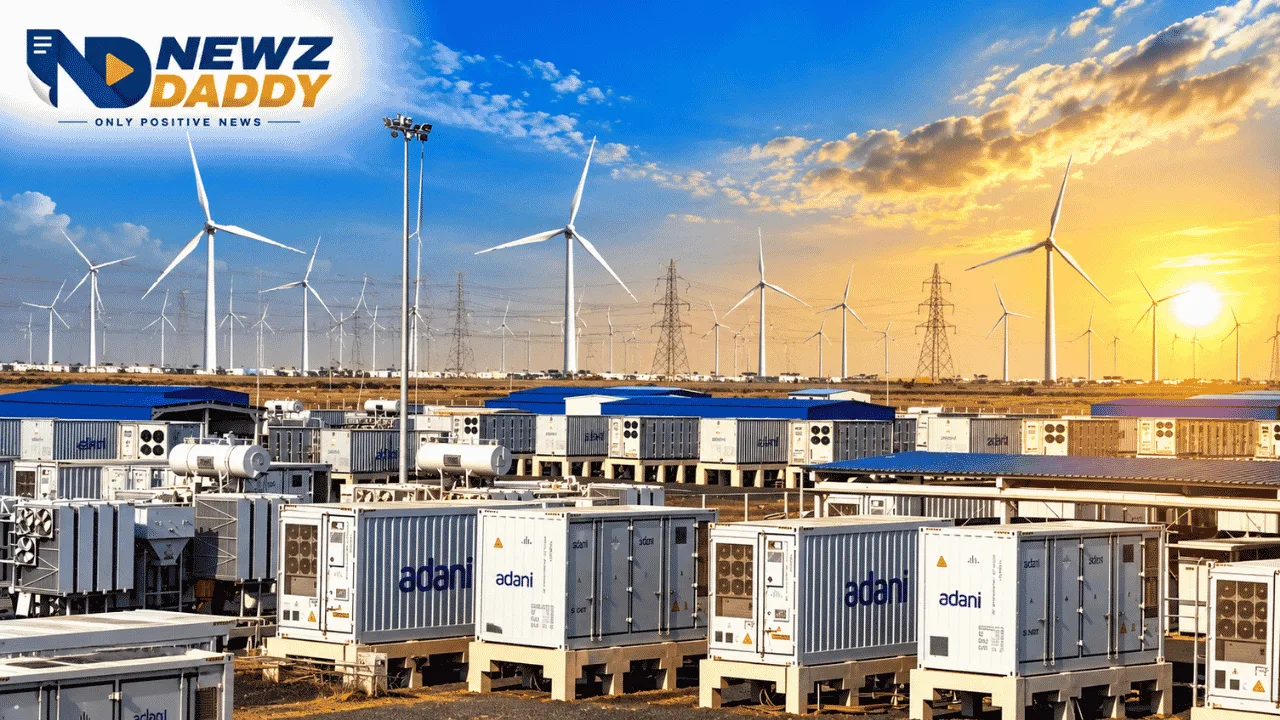
Adani Green Targets 50 GWh Battery Storage in Five Years
Adani Green Energy Expands Battery Storage to 6.63 GWh at Gujarat’s Khavda Site
The company says its installation accounts for more than half of India’s operational battery storage capacity, as it plans further expansion over the next five years.
The latest expansion also puts Khavda at the centre of India’s growing energy storage industry. AGEL describes the installation as the world’s largest operational battery energy storage system at a single location.
The new capacity was commissioned in 10 months from the start of its construction. The company reached the 6.63 GWh mark within 14 months of beginning battery storage construction at the site.
Khavda is also home to AGEL’s planned 30-gigawatt renewable energy project, spread across 538 square kilometres of land. The company is building solar and wind power facilities in the area, alongside battery storage infrastructure.
Solar panels produce electricity during daylight hours, while wind turbines depend on wind conditions. Electricity demand, however, continues after sunset and can rise sharply at certain times of the day.
Battery storage systems can hold electricity produced earlier and supply it when generation falls, or demand rises. This helps power companies manage changes in electricity supply and reduce the need to waste renewable energy when production is higher than immediate demand.
Adani Green Energy’s Khavda installation uses lithium-ion batteries connected to an Energy Management System (EMS). Automated monitoring systems track the charging and discharging of the batteries and manage their operation.
The company estimates that its 6.63 GWh storage capacity can hold enough energy to power around two million homes for a day. It also compares the storage capacity with that of more than 150,000 mid-sized electric vehicles.
According to Adani Green Energy, the installation could store enough electricity in a day to meet almost twice the estimated daily electricity requirement of the Delhi Metro. The stored energy could also support peak electricity demand in cities such as Nagpur, Patna and Visakhapatnam for several hours.
These comparisons describe the scale of the storage system. The amount of electricity actually delivered to homes, transport networks or cities would depend on operating conditions, energy losses and the way electricity is allocated.
These figures show the scale of the work ahead. AGEL’s current 6.63 GWh installation represents a small part of the country’s longer-term storage needs, even though it makes up more than half of the company’s reported operational capacity.
The Union government has introduced financial support to encourage battery storage projects. In June 2025, the Ministry of Power approved support for an additional 30 GWh of battery storage through the Power System Development Fund, with financial assistance of ₹5,400 crore. Earlier funding programmes were also designed to reduce the cost of setting up large battery storage projects.
On 30 September 2026, the Union Cabinet approved a ₹1.86 lakh crore renewable energy programme. The package includes ₹50,000 crore for a scheme supporting 50 GWh of battery storage installation. It also includes ₹1.36 lakh crore for improving electricity transmission networks within states, with the aim of supporting the movement of up to 135 GW of clean energy. These measures reflect the growing need to expand storage and transmission alongside renewable power generation.
AGEL plans to add more than 10 GWh of battery storage capacity during the 2026–27 financial year. It has set a target of reaching 50 GWh of storage capacity over the next five years.
The company is also developing pumped storage projects. Unlike battery systems, which store electricity through chemical processes, pumped storage plants use water held at different heights. Water is released through turbines to generate electricity when required. The method can store and supply large amounts of electricity, although it depends on suitable locations, water availability and major construction work.
Sagar Adani, Executive Director of Adani Green Energy, said, “Reaching 6.63 GWh of operational battery storage in just 14 months is a significant milestone for AGEL and India’s clean energy transition. At this scale, storage can make renewable power firmer, more reliable and dispatchable when the grid needs it. As India’s power demand grows, we will continue to scale energy storage solutions, both battery and pumped storage, to support a more resilient, lower-carbon grid.”
The expansion comes as India works towards a major increase in non-fossil fuel electricity generation. The country’s ability to use solar and wind power after their production hours will depend partly on how quickly storage facilities and electricity networks grow.
For AGEL, the next stage will involve adding more battery capacity while developing its renewable energy and pumped storage projects. The company’s 50 GWh target will require a substantial increase from its current operational capacity. Its progress will also form part of India’s wider effort to meet rising electricity demand while increasing the use of renewable energy.
Must Read:
Adani Energy Solutions Q1 FY27 Results Show 130% Profit Jump