


Adani Wind Gets Certification for Its New 5 MW Turbine Model
Adani Starts Production of India’s Longest Wind Turbine Blades at Mundra
The 91.2-metre blades will be used in a 5 MW turbine designed to generate electricity at sites with lower wind speeds. German certification has cleared the platform for serial production.
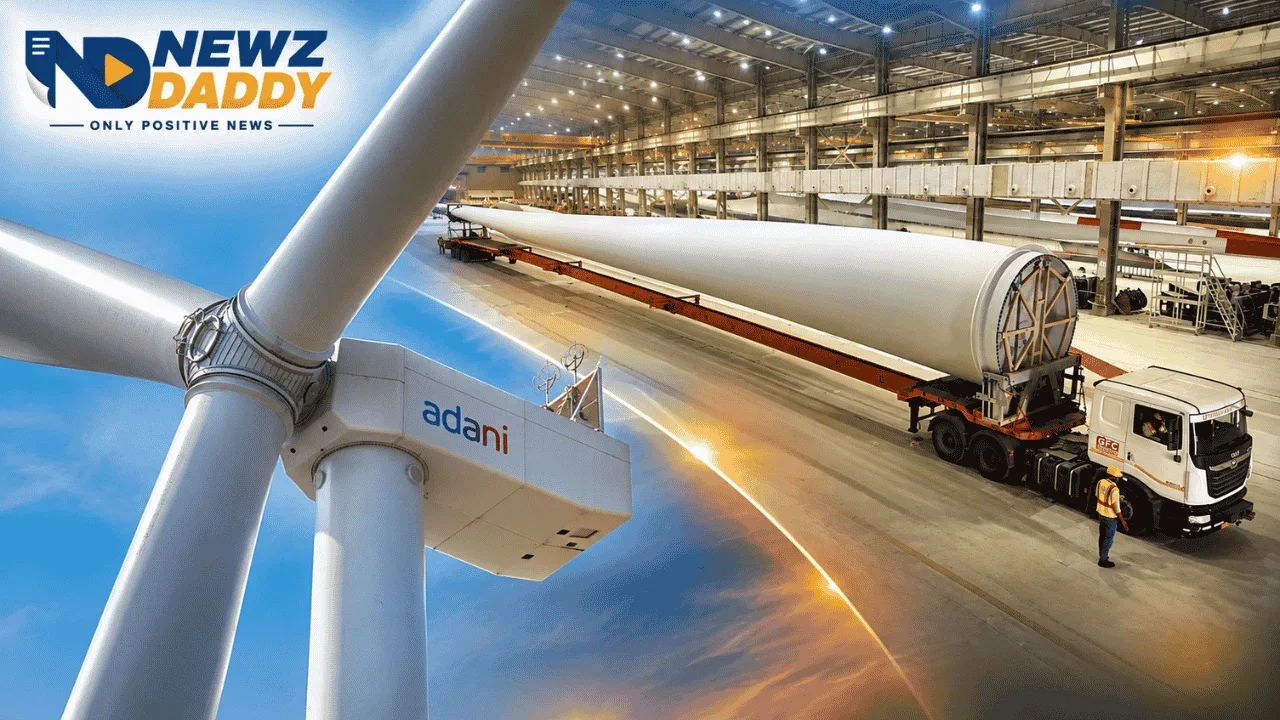
India has taken another step in domestic wind turbine manufacturing with Adani New Industries Limited (ANIL) starting production of 91.2-metre onshore wind turbine blades at its factory in Mundra, Gujarat.
The company has also received certification for its MWL185-5.0 MW wind turbine platform from Germany-based WindGuard Certification GmbH. The approval allows Adani Wind to move ahead with serial production of the turbine.
At 91.2 metres, the new blades are the longest wind turbine blades manufactured in India, according to the company. Their size reflects the growing demand for larger turbines that can capture more wind energy, particularly at locations where wind speeds are low or moderate.
The development comes as India continues to expand its renewable energy capacity and increase the domestic production of equipment used in wind and solar power projects.
The new turbine has a rotor diameter of 185 metres and a hub height of 140 metres. Its rotor covers a swept area of nearly 26,600 square metres when its blades rotate. This is equal to more than three and a half standard football pitches.
The size of the rotor matters because it determines how much wind can pass through the area covered by the blades. A larger swept area can help a turbine capture more energy, although the actual electricity produced depends on wind speed, turbine design and local conditions.
Adani Wind has developed the MWL185-5.0 MW model for locations with low and moderate wind speeds. The company expects the design to support more regular electricity generation across changing wind conditions and improve its capacity utilisation factor (CUF). CUF measures the electricity generated over a period against the amount a turbine could produce if it operated at full capacity throughout that period.
The blades will be manufactured at Mundra, where Adani’s existing production line makes blades measuring 78.6 metres and 80.5 metres. The move to 91.2-metre blades requires changes in design, materials, factory equipment and the way large components are handled.
For the Indian manufacturing sector, the ability to produce blades of this length is relevant because large wind turbine components are difficult to transport over long distances. Domestic production can help manufacturers supply projects within the country, although the final cost and delivery time will depend on production capacity, transport arrangements and demand.
The timing of the announcement is relevant to Gujarat’s position in India’s wind energy sector. According to the Ministry of New and Renewable Energy (MNRE), the country had 59,529.67 MW of installed wind power capacity as of 31 October 2026.
Gujarat accounted for 16,086 MW of installed wind capacity as of 30 June 2026, according to figures submitted by the Union government in Parliament. Tamil Nadu followed with 12,273 MW, while Karnataka had 8,896 MW.
India’s wind power projects generated around 106 billion units of electricity during the financial year 2025-26. The country added 6,050 MW of wind capacity during the same financial year, its highest annual addition at that point, according to the International Energy Agency’s wind sector report.
These figures show why domestic turbine manufacturing matters. India needs a steady supply of equipment as developers add new wind farms and replace or upgrade older machines. The availability of larger turbines could also help developers assess locations where older designs may not produce enough electricity to make a project financially attractive.
The government has introduced the Approved List of Models and Manufacturers for Wind Turbines (ALMM-Wind) to regulate the models and manufacturers eligible for relevant projects. Adani Wind has three turbine platforms listed under this system.
The MWL185-5.0 MW platform was developed in partnership with German technology company W2E (Wind to Energy). Its prototype underwent testing at the installation site in Mundra before WindGuard Certification GmbH granted certification.
The approval confirms that the turbine meets the internationally recognised IEC 61400 series of standards. These standards cover the design, testing and manufacturing requirements for wind turbines. Independent certification helps establish whether a turbine meets the technical requirements needed for commercial production.
Milind Kulkarni, Chief Executive Officer of Adani Wind, said: “Producing India’s longest wind turbine blade and securing certification for our 5 MW platform mark an important milestone for Adani Wind and the country’s wind manufacturing sector. Larger blades and higher-capacity turbines enable each machine to capture more energy, including at sites with lower wind speeds. This helps in broadening the geography available for wind generation. We are committed to developing and manufacturing advanced wind technology in India to support the country’s growing clean energy needs.”
Adani Wind already has a presence in the higher-capacity turbine segment through its MWL 160-5.2 MW platform. The model is listed under ALMM-Wind and has crossed 2 GW of installations at Khavda in Gujarat, which is home to the world’s largest renewable energy plant.
The company also features in BloombergNEF’s Global Top 15 turbine manufacturers ranking for 2025. According to Adani, it is the only Indian wind turbine manufacturer included in that ranking.
Its business outside the Adani Group is also growing. Recent orders have taken the company’s cumulative orders from independent power producers (IPPs) outside the group beyond 1 GW. These orders indicate demand from other power developers, although the figure represents orders and should not be confused with completed installations.
The new 5 MW platform will now enter the serial production stage. Its commercial performance will depend on how it operates at different wind sites, the cost of installation and maintenance, and the electricity it produces over its working life.
For Gujarat, the start of production at Mundra adds another development to a state that already leads India in installed wind power capacity. The coming years will show how much demand there is for larger domestically manufactured turbines and whether these machines can make more locations suitable for wind energy projects.