


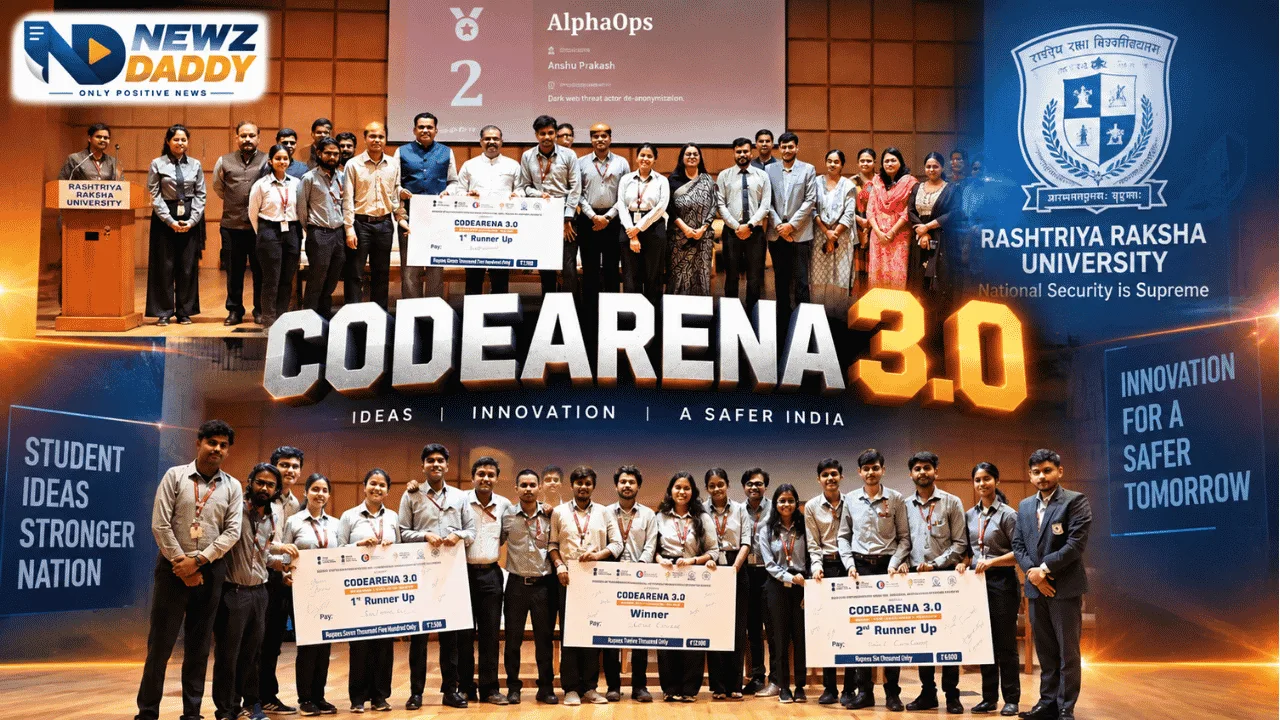
CODEARENA 3.0: RRU Sends 31 Teams to SIH 2026 From Gujarat
Rashtriya Raksha University Sends 31 Teams to Smart India Hackathon 2026 After CODEARENA 3.0
Rashtriya Raksha University (RRU) has selected 31 student teams for the next stage of the Smart India Hackathon (SIH) 2026 after its internal competition, CODEARENA 3.0, concluded at the university campus in Lavad, Gandhinagar.
Team Smart Smurfs, led by Shivangi Sharma, won the internal competition for a forensic analysis scripting solution built in a new programming language. AlphaOps, led by Anshu Prakash, finished as first runner-up with a project on dark web threat actor de-anonymisation. Tech Catalysts, led by Raj Vardhan, was named second runner-up for a 3D ocean-model visualisation platform.
The final event was held at the RRU Auditorium after the hackathon began on 9 September 2026. CODEARENA 3.0 brought together 64 teams and 384 students from RRU’s School of Information Technology, Artificial Intelligence and Cyber Security (SITAICS), School of Applied Sciences, Engineering and Technology (SASET), School of Integrated Defence and Strategic Studies (SISDSS), and the university’s Uttar Pradesh campus.
The scale of the selection round shows the range of subjects being taken up by students. According to the event organisers, the teams worked on 74 problem statements. After evaluation, 31 teams were selected for SIH 2026. They are working on 28 different problem statements put forward by 15 organisations.
Artificial intelligence and machine learning account for 12 of the selected teams, followed by 10 teams working in cybersecurity and forensics. Five teams are focused on IoT and embedded hardware, while four are working on software development.
The problem statements came from several government organisations and ministries. The National Technical Research Organisation (NTRO) has eight nominated teams, while the All India Council for Technical Education (AICTE) has four and the Ministry of Home Affairs (MHA) has three. Other selected projects are linked to problem statements from Union ministries and organisations.
The selection process was carried out by six industry jury members, who assessed the participating teams over two days. The shortlisted students will now have to submit their ideas through the Smart India Hackathon 2026 portal. Their projects will then go through further scrutiny by the organisations that issued the problem statements and by SIH evaluators.
Smart India Hackathon has followed this model since its launch in 2017. The Ministry of Education describes SIH as a nationwide programme through which students work on problems raised by government departments, ministries, industry and other organisations. Earlier editions have covered areas ranging from cybersecurity and digital services to disaster management, agriculture, energy and public infrastructure.
The 2025 edition also showed the scale of the national competition. The Ministry of Education said its Grand Finale was held at 60 nodal centres, with 271 problem statements in that edition. The programme has grown from its early years into a large national platform for student teams working on practical problems.
For RRU, the internal competition also fits the university’s wider academic focus. The institution, based at Lavad in Gandhinagar, is an Institution of National Importance under the Ministry of Home Affairs and has programmes and research activities linked to security, policing, cyber security and related areas.
Cybersecurity and digital forensics have been recurring areas of activity at the university. In 2025, SITAICS held CODEARENA 2.0 as its internal Smart India Hackathon, with 39 teams and 234 participants working across software development, artificial intelligence, blockchain, digital forensics, and hardware and IoT solutions.
The 2026 competition also placed considerable attention on participation by women. Of the 384 students involved in CODEARENA 3.0, 140 were women. Nine of the 31 teams selected for the national competition have women team leaders. Two of the nominated six-member teams consist entirely of women.
Dr Jasbir Kaur Thadhani, University Dean, said the experience required students to deal with pressure while working with others. She pointed to communication, emotional regulation, adaptability and decision-making as skills tested during the event. She also said RRU would provide opportunities for students to continue promising projects as extended work linked to the university’s own requirements.
Prof. (Dr.) Kalpesh H. Wandra, Pro Vice-Chancellor, RRU, who was the chief guest at the valedictory programme, told students that time management would be important during the national competition. He said teams should be able to explain their solutions to a jury within three minutes and use the feedback received during the internal evaluation to improve their projects.
The university also sees a possible route beyond the hackathon for some of the ideas. Darshan Prajapati, Manager, Placements, Internships and Training, SITAICS, said projects with commercial or social potential could be considered for incubation through the university’s Atal Incubation Centre.
Alongside Smart Smurfs, AlphaOps and Tech Catalysts, the other teams in the CODEARENA 3.0 Top 10 were Code Purple, SRON, Avengers, The Debuggers, Trishuli, Sarvanetra AI and Strive.
The next stage will determine which of RRU’s 31 nominated teams progress to the national finale. The shortlisted teams are expected to be invited to the Smart India Hackathon Grand Finale in December 2026 after scrutiny by the respective problem-statement organisations and SIH evaluators.
For the students involved, the competition now moves from an internal university test to a national selection process where their proposed solutions will be examined against teams from institutions across India.