


Dr BR Ambedkar Ideals Spark Hope in Ahmedabad Event
Powerful Dr BR Ambedkar Ideals Bring Real Change in Ahmedabad
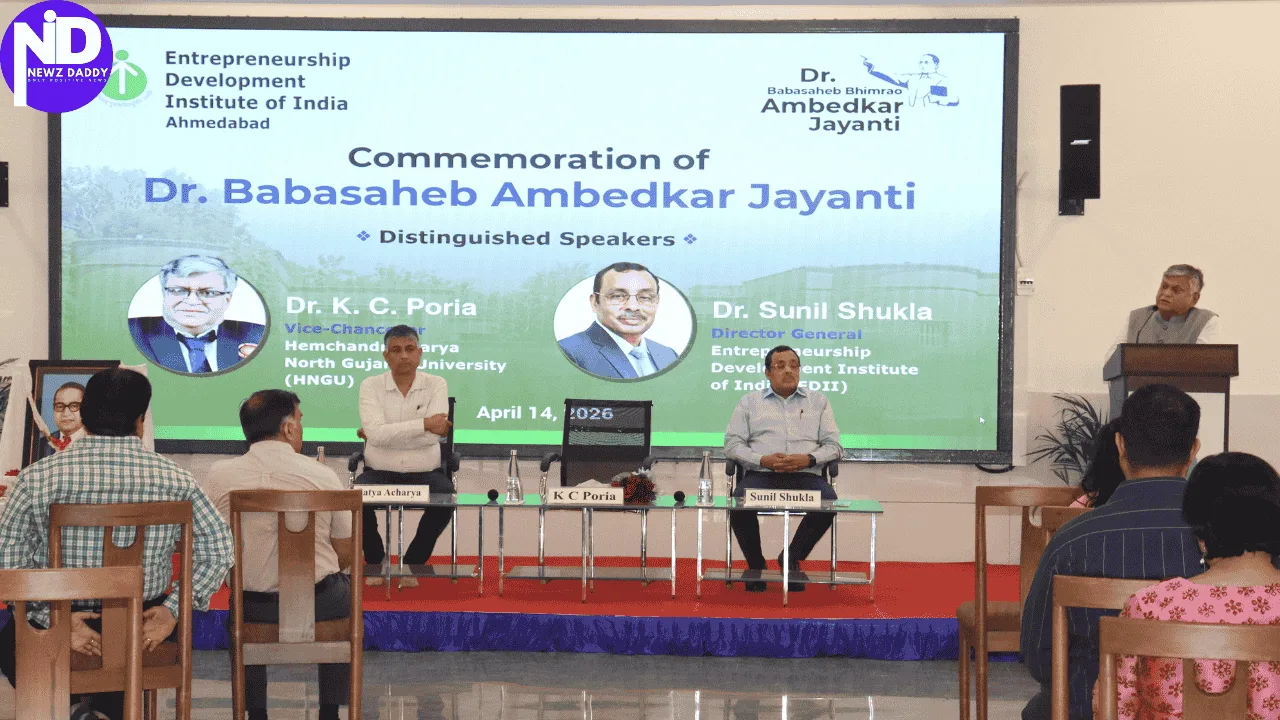
The Entrepreneurship Development Institute of India (EDII), Ahmedabad, celebrated the birth anniversary of the architect of the Indian Constitution, Bharat Ratna Bhimrao Ramji Ambedkar. Across India, this day is widely observed as Ambedkar Jayanti, with events held in universities, public institutions and social groups to remember his work on equality and justice.
On the occasion, a session was delivered by Chief Guest Prof. K C Poria, Hon’ble Vice Chancellor, Hemchandracharya North Gujarat University, Patan. Dr Sunil Shukla, Director General, EDII, also addressed the audience.
Talking about the monumental contributions of Dr BR Ambedkar, Prof. KC Poria said, “Every year on Dr Ambedkar’s birth anniversary, we pay our heartfelt tribute to this great person’s unique contribution to equality, social justice and inclusive development. The Chief Architect of the Indian Constitution, he upheld the significance of empowerment through education. Asserting on Education and Technology, he preached how these were the cornerstones of future development. I am glad that today the National Education Policy 2020 aligns with his mantras and learnings, thus encouraging and strengthening tech-driven, skill-based education among young learners.”
Across many global studies, education is still seen as the strongest path to social change. Reports by organisations such as UNESCO show that people with basic education earn up to 20 percent more than those without schooling. This supports Dr Ambedkar’s long-standing belief that education can break cycles of poverty and inequality. In India too, skill-based learning is growing fast, especially with digital tools, coding courses and vocational training reaching smaller towns.
Prof. Poria added, “We draw learnings from the life of this visionary leader, today. I urge all to imbibe Dr BR Ambedkar’s ideals in their lives and do their bit in empowering societies into a progressive and inclusive one.” His message reflects a wider shift in Indian education where values like equality and respect are now part of school and college discussions, not just textbooks. Many universities now run social outreach programmes where students work directly with underprivileged communities.
Dr Sunil Shukla, Director General, EDII, emphasised the importance of social upliftment for the overall progress of the country. He said, “Empowering the underprivileged is not just our responsibility, but an investment in our nation’s future. By supporting and encouraging them, we enable their potential to drive innovation, foster economic growth and build a more equitable society.”
Economic data also support this view. According to studies by the World Bank, countries that invest in inclusive growth see stronger long-term development. When more people join the workforce, small businesses increase, local jobs grow, and communities become more stable. In India, schemes that support women entrepreneurs, rural businesses and start-ups have already shown steady progress over the past decade.
Dr Shukla further said, “Inclusive progress and real empowerment ensure that every individual has an equal opportunity to succeed and contribute meaningfully.” In recent years, many start-up stories from smaller towns and marginalised groups have gained national attention. These stories show how access to finance, training and mentorship can change lives.
Closing the session, Dr Satya Ranjan Acharya, Professor & Director, Department of Entrepreneurship Education, EDII, said, “Entrepreneurship is a powerful tool for empowering marginalised communities; it is not just about creating businesses; it’s about fostering a culture of self-reliance, confidence and dignity.”
Experts in entrepreneurship studies agree with this view. Research published in journals linked to Harvard Business School notes that small enterprises create a large share of new jobs worldwide. In India, micro and small businesses form the backbone of the economy, especially in sectors like textiles, food services and local manufacturing. When people from weaker sections start their own ventures, they often create jobs within their own communities.
Dr Acharya added, “At EDII, we are committed to fostering an inclusive entrepreneurial ecosystem that enables individuals from all sections of society to grow together and contribute to economic and social progress.” This approach is now visible in many training programmes across India where first-generation entrepreneurs are given hands-on support, including business planning, funding guidance and market access.
As the event concluded, the message remained clear. The ideas of Dr BR Ambedkar are still deeply relevant today. Education, inclusion and self-reliance are not just ideals. They are practical tools that can shape a stronger and fairer society.