


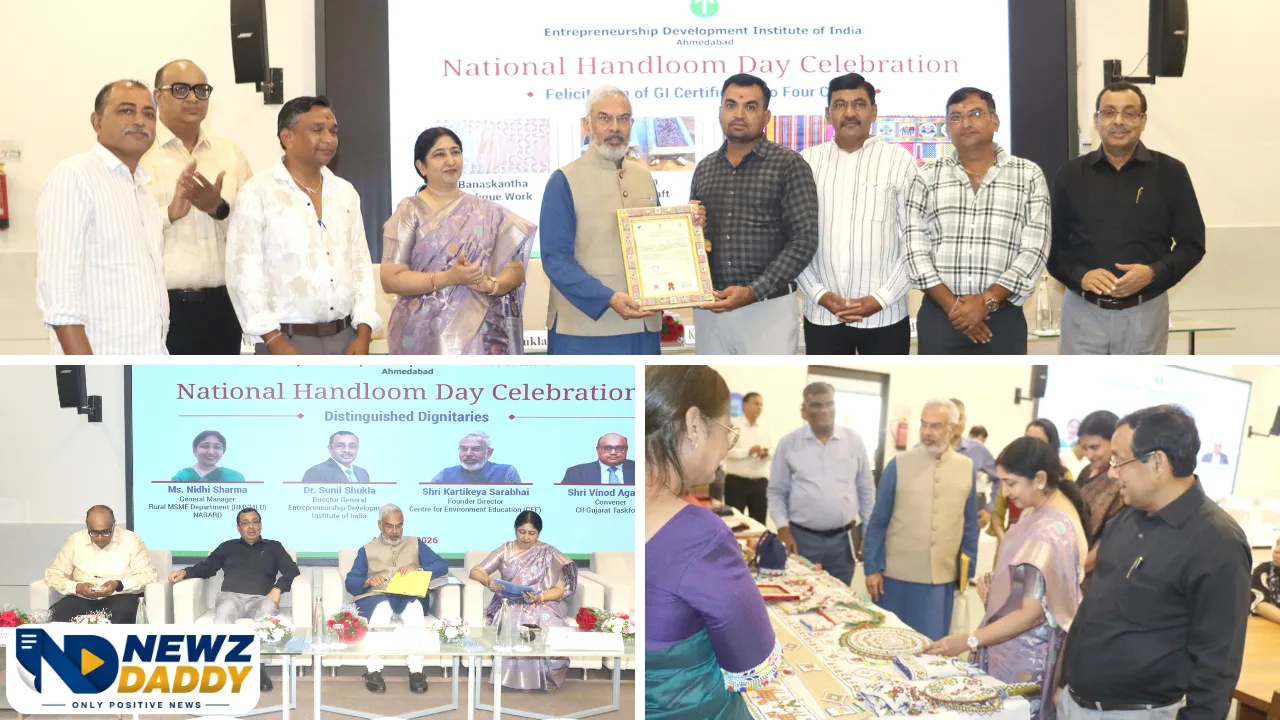
Four Gujarat GI Crafts Gain Recognition At EDII Ahmedabad
Four Gujarat Crafts Get GI Recognition as EDII Puts Focus on Artisan Livelihoods
Four traditional crafts from Gujarat were formally recognised at an event organised by the Entrepreneurship Development Institute of India (EDII) in Ahmedabad, as policymakers, bankers, industry representatives, academics, intellectual property professionals and artisans discussed ways to give local handloom and handicraft products better market access.
The four crafts are Jasdan Patari Craft, Patan Mashru Saree & Fabrics, Banaskantha Applique Work and Saurashtra Moti Bharatkam (Bead Work) of Gujarat.
The event was held around National Handloom Day and included an exhibition of indigenous crafts, followed by the ceremonial lighting of the lamp and a session on the role of geographical indication (GI) protection in helping traditional producers.
There is an important detail behind the ceremony. The four products are already registered GI products. Records maintained by the Geographical Indications Registry show that the registration certificates for all four were dated March 28, 2026. Jasdan Patari Craft is registered under application number 1194, Patan Mashru Saree & Fabrics under 1266, Banaskantha Applique Work under 1279, and Saurashtra Moti Bharatkam under 1280.
For artisans, the value of a GI tag goes beyond the certificate itself. Under India’s Geographical Indications of Goods (Registration and Protection) Act, 1999, a GI identifies goods whose quality, reputation or other characteristics are linked to a particular geographical area. Registered users can also take action against unauthorised use of the GI.
The four Gujarat registrations cover different kinds of traditional work. Jasdan Patari Craft is listed as a handicraft associated with Jasdan in Rajkot district. Patan Mashru Saree & Fabrics is registered as a textile product, with the Patan Mashru Producers Cooperative Company Limited as the applicant. Banaskantha Applique Work is registered as a handicraft, with Shri Nadabet Mahila Hastkala Audhyogik Sahakari Mandali Limited as the applicant. Saurashtra Moti Bharatkam is also registered as a handicraft, with Motikaam Hastkala Vikas Trust of Bhavnagar as the applicant.
The distinction matters in a market where products with similar names or designs can sometimes be sold without a clear link to their place of origin. The World Intellectual Property Organisation says GI protection can help producers protect the name of a product, strengthen its market position and prevent others from using the name for goods that do not meet the required conditions. It can also help producers build collective brands around products tied to a particular place.
At the Ahmedabad programme, Dr Sunil Shukla, Director General of EDII, said GI protection has a role in preserving traditional knowledge while connecting it with economic activity.
“GI tagging plays a crucial role in the journey of protecting our rich knowledge and tradition. Ideation must lead to innovation and innovation must lead to commercialisation for ideas to impact economic and social well-being. Geographical Indication (GI) is an important tool for protecting products. The GI tagging certificates for four crafts are a proud moment for us; it validates artisan-led development.”
Shri Kartikeya Sarabhai, Founder Director of the Centre for Environment Education (CEE), spoke about the knowledge built through generations of practice.
“India is home to a rich repository of knowledge, based on years of practice in multiple fields. It is very important to promote and protect the ideas and the processes involved, at the right time. GI tagging facilitation is highly helpful in promoting the social and economic wellbeing of our producers & artisans.”
CEE is an Ahmedabad-based Centre of Excellence associated with the Ministry of Environment, Forest and Climate Change. Sarabhai is listed by CEE as its Founder Director.
Ms Nidhi Sharma, General Manager, Rural MSME Department (RMSMED), NABARD, pointed to the role of institutional support in helping rural producers reach wider markets.
“At EDII, the establishment of the state’s first-ever Regional Geographical Indication (GI) Facilitation Centre with the support of the National Bank for Agriculture and Rural Development (NABARD) is transforming the lives of artisans and rural entrepreneurs by giving their traditional products the recognition they deserve. By ensuring that products are preserved well and gain national and international recognition, we can unlock newer markets and ensure premium value for artisans, weavers and entrepreneurs.”
EDII and NABARD have been working on GI-related support in Gujarat through a Regional GI Facilitation Centre at the EDII campus. EDII says the centre was inaugurated on September 15, 2025, with support from NABARD, and is intended to assist artisans, producer groups and entrepreneurs with GI applications, legal support, awareness, producer group formation and post-registration support.
The centre’s work follows earlier efforts by EDII to connect GI products with buyers. In January 2026, EDII, with the Business Women Committee of the Gujarat Chamber of Commerce and Industry and support from NABARD, organised the four-day Gramin Bharat Mahotsav – રંગ Sootain Ahmedabad. The exhibition brought together55 stalls representing artisan groups and producer collectives from 11 states. EDII reported that Gujarat had 28 GI-tagged products at the time of that programme.
For Gujarat’s craft producers, the next stage is likely to be as important as registration itself. A GI name can protect the identity of a product, but producers still need reliable production standards, market access, buyers, packaging, finance and awareness among customers. The GI law provides the legal framework, while institutions such as EDII and NABARD can help producer groups use that protection in commercial markets.
The Ahmedabad programme therefore placed the four newly registered craft names in a wider discussion about how traditional skills can remain economically useful to the communities that practise them. For the artisans behind Jasdan Patari Craft, Patan Mashru, Banaskantha Applique Work and Saurashtra Moti Bharatkam, the GI registration now provides a formal link between their products and the places from which those traditions come.