

Jamnagar Hosts Sahayata Setu 2026 With 24 Foreign Nations
Indian Air Force Holds Multinational Disaster Relief Exercise Sahayata Setu 2026 in Jamnagar
The Indian Air Force has completed a three-day multinational disaster relief exercise at Air Force Station Jamnagar, bringing together military personnel, government agencies and representatives from 24 foreign countries to practise coordinated responses to major natural disasters.
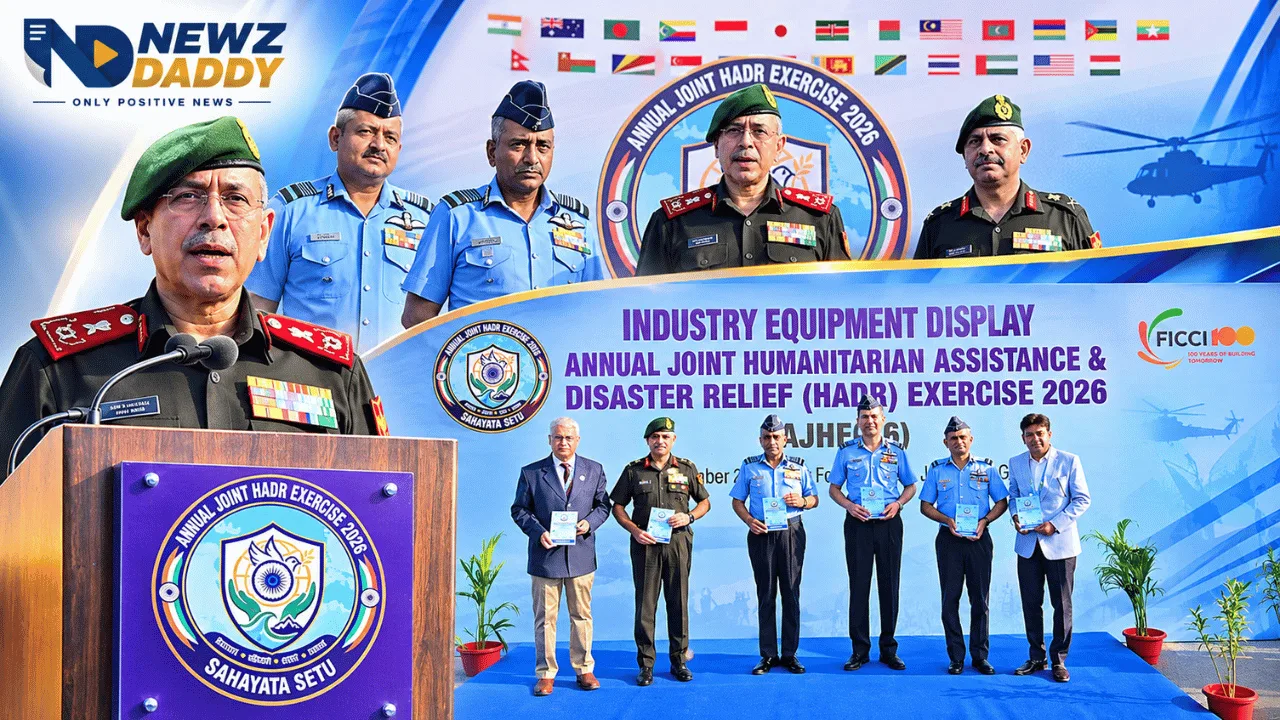
Exercise Sahayata Setu 2026, held from November 17 to 19, focused on improving how different countries and agencies work together during emergencies such as cyclones, floods and other disasters. The programme ended on Thursday with a Multi-Agency Capability Demonstration (MACD), attended by senior Indian military officials, Gujarat government representatives, international delegates and members of the public.
The exercise was conducted by the Indian Air Force under the aegis of Headquarters Integrated Defence Staff (HQ IDS) and Headquarters South Western Air Command (HQ SWAC), in coordination with national agencies and Friendly Foreign Countries (FFCs).
General N S Raja Subramani, PVSM, AVSM, SM, VSM, Chief of Defence Staff (CDS), attended the concluding event as the Chief Guest. Other senior dignitaries included Air Chief Marshal Ashutosh Dixit, PVSM, AVSM, VM, VSM, Chief of Air Staff; Shri Arjun Modhwadia, Gujarat Minister for Forest and Environment; the General Officer Commanding-in-Chief, Southern Command; the Flag Officer Commanding-in-Chief, Western Naval Command; and the Air Officer Commanding-in-Chief, South Western Air Command.
Media representatives and schoolchildren also attended the programme.
The international participation included Australia, Bangladesh, Comoros, Indonesia, Kenya, Madagascar, Malaysia, Maldives, Mauritius, Mozambique, Oman, Seychelles, Singapore, Somalia, South Africa, Sri Lanka, Tanzania, Thailand, the United Arab Emirates, Yemen, Japan, the United States, Myanmar and Nepal.
These countries have different levels of exposure to natural disasters. Several face cyclones, coastal flooding, earthquakes and other emergencies that can affect large populations and damage essential services.
Their participation allowed military and civilian representatives to discuss how they could support each other when disasters affect more than one country or require assistance from outside the affected region.
The programme included a seminar, a Table Top Exercise (TTX), a static equipment display and the final operational demonstration.
The seminar allowed experts to discuss disaster management and share their experience. The Table Top Exercise involved simulated emergency situations in which participants considered possible decisions, responsibilities and response plans.
The static display allowed visiting delegates to examine equipment used in disaster response. The final demonstration showed how different agencies could coordinate their activities across land, air and maritime areas.
A meeting of the QUAD Humanitarian Assistance and Disaster Relief Working Group was also held during the exercise.
The QUAD brings together India, Australia, Japan and the United States. Its cooperation covers several areas in the Indo-Pacific, including maritime security, health, technology and disaster response.
The four countries signed the Guidelines for the Quad Partnership on Humanitarian Assistance and Disaster Relief in the Indo-Pacific in 2022. The arrangement provides a framework for coordination when a major disaster requires international assistance.
In 2024, QUAD members also worked together following a landslide in Papua New Guinea. Their response included more than US$5 million in humanitarian assistance.
The working group meeting in Jamnagar formed part of continuing discussions on how member countries can improve their readiness and coordinate relief work during emergencies.
India’s role in humanitarian assistance has grown through several major rescue and relief operations over the past two decades.
The 2004 Indian Ocean tsunami was an important event in the development of India’s disaster response system. The scale of the disaster required the Indian Army, Navy, Air Force and Coast Guard to work together in relief operations across several affected areas.
In April 2015, India launched Operation Maitri following the devastating earthquake in Nepal. The Indian Air Force and Army carried out 2,223 sorties, evacuated around 11,200 people, including 780 casualties, and transported approximately 1,700 tonnes of relief supplies.
The IAF also played an important role during the Kerala floods in August 2018. According to government figures, its aircraft and helicopters helped rescue 663 people and transport 974 tonnes of relief material. Medical teams were also sent to support affected communities.
More recently, Operation Brahma was launched in March 2025 following the earthquake in Myanmar. Indian military aircraft and naval ships delivered relief supplies, while an Indian Army field hospital treated more than 2,500 injured people within two weeks.
These operations show why air transport, helicopters, medical teams and military logistics are important when roads, bridges and other transport links are damaged.
Addressing the media at the Jamnagar event, General N S Raja Subramani said disaster relief required a coordinated “whole – of – nation” approach.
He also described India as a dependable first responder in the Indo-Pacific and Indian Ocean Region (IOR). He referred to the country’s “Neighbourhood First” policy and the vision of ‘Mahasagar’ while discussing India’s approach to regional cooperation.
MAHASAGAR stands for Mutual and Holistic Advancement for Security and Growth Across Regions. Announced in 2025, the policy expands India’s earlier SAGAR vision, which focused on Security and Growth for All in the Region.
The approach places importance on cooperation with countries in the Indian Ocean and wider maritime regions. Disaster assistance, maritime security and support for neighbouring countries form part of this regional engagement.
A major disaster can damage airports, roads, hospitals, communication networks and electricity supplies within hours. Rescue teams may have to work in areas where normal transport and communication services are unavailable.
In such situations, aircraft can carry rescue personnel, medical teams and essential supplies. Helicopters can reach locations that road vehicles cannot access, while naval ships can transport large quantities of equipment and provide assistance along coastlines.
However, military resources alone cannot manage every part of a disaster. Police forces, health departments, local administrations, the National Disaster Response Force (NDRF), state disaster response agencies and other organisations also have important duties.
Exercises such as Sahayata Setu allow these organisations to understand their responsibilities and practise working under a shared response plan. International participation adds another layer of preparation, particularly when an affected country needs help from neighbouring nations.
The Jamnagar exercise ended on November 19 after three days of discussions, practical demonstrations and meetings with foreign delegates. Its main message was clear: when a major disaster strikes, the speed and success of relief work depend heavily on how well military forces, civilian agencies and partner countries can work together.
Must Read:
Jamnagar Hosts Sahayata Setu Exercise From 17 to 19 November