


Justice Surya Kant’s appointment: New energy at India’s top court
Newz Daddy Political Updates
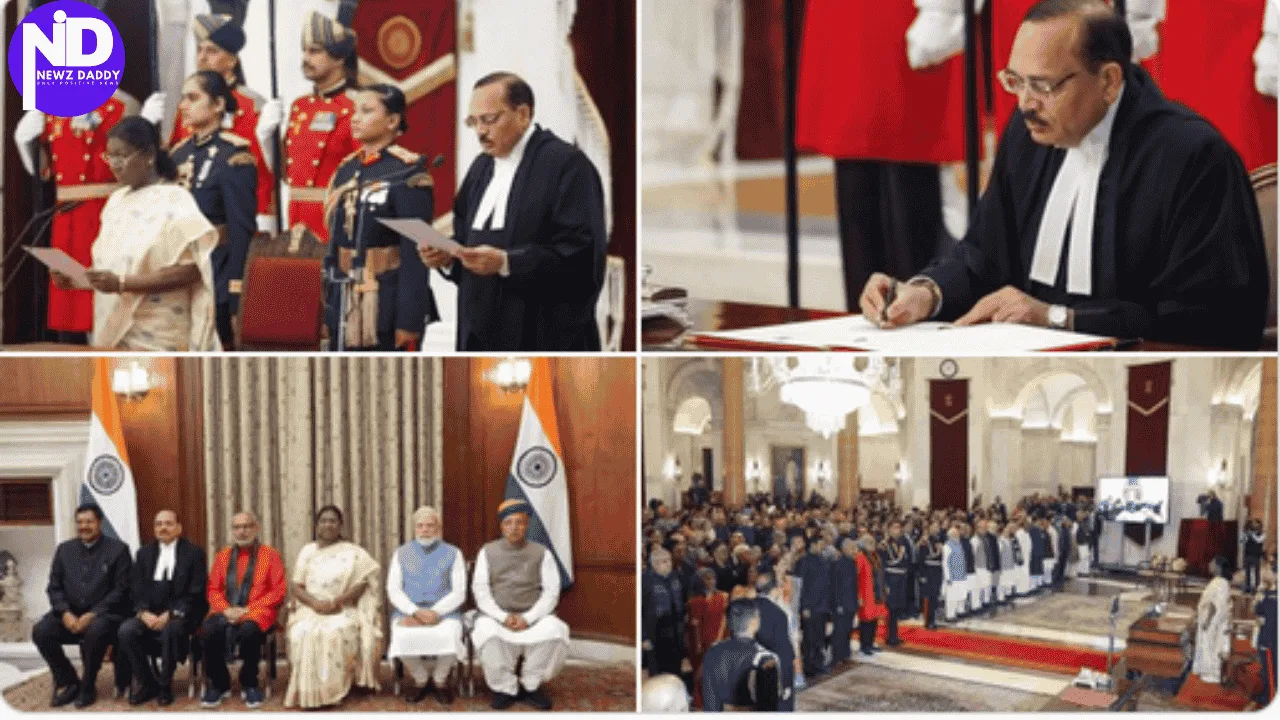
The Prime Minister of India, Narendra Modi, attended the swearing-in ceremony of Justice Surya Kant as the Chief Justice of India on 24 November 2025.
The event took place at the Supreme Court of India (SCI) in New Delhi and was marked by the presence of senior judicial and government officials.
Justice Surya Kant has had a long judicial career. He was born on 10 February 1962 in Petwar village, Hisar district, Haryana. He holds a law degree from Maharishi Dayanand University, Rohtak and began practising in 1984 in the Hisar district court.
He was elevated to the Supreme Court in May 2019 and has now become India’s 53rd Chief Justice. His term is expected to last around 14 to 15 months, ending in February 2027.
In his message posted on the social platform, Prime Minister Modi conveyed his best wishes to Justice Surya Kant for the tenure ahead.
Observers note that this appointment is significant because Justice Kant is the first Chief Justice from Haryana and rose from humble beginnings to the highest judicial post.
The ceremony reinforces the continuity of judicial leadership in India. The Supreme Court, headed by the Chief Justice, plays a key role in interpreting the Constitution, ensuring justice and maintaining the rule of law.
Justice Kant has in the past delivered several noteworthy judgments. These include contributions to landmark matters on constitutional issues, civil rights and institutional accountability.
His background – a first-generation lawyer who studied in a village school and rose through the ranks – resonates with many as a story of perseverance, merit and service.
With his swearing-in, the Supreme Court enters a new chapter of leadership at its top. Many hope that Justice Kant’s tenure will bring renewed focus on access to justice, efficiency and the adaptability of the judiciary in facing modern challenges.
The swearing-in of Justice Surya Kant as Chief Justice of India, with Prime Minister Modi in attendance, marks a moment of both continuity and change in India’s judiciary. It underscores the importance of experience, merit, representation and leadership at the highest level of the legal system.
Must Read:
PM Modi Inaugurates ₹11,000 Cr National Highway Projects In Delhi