

NCC Cadets Visit RRU as Ek Bharat Shreshtha Bharat Camp Grows
More Than 400 NCC Cadets Visit Rashtriya Raksha University During National Integration Camp
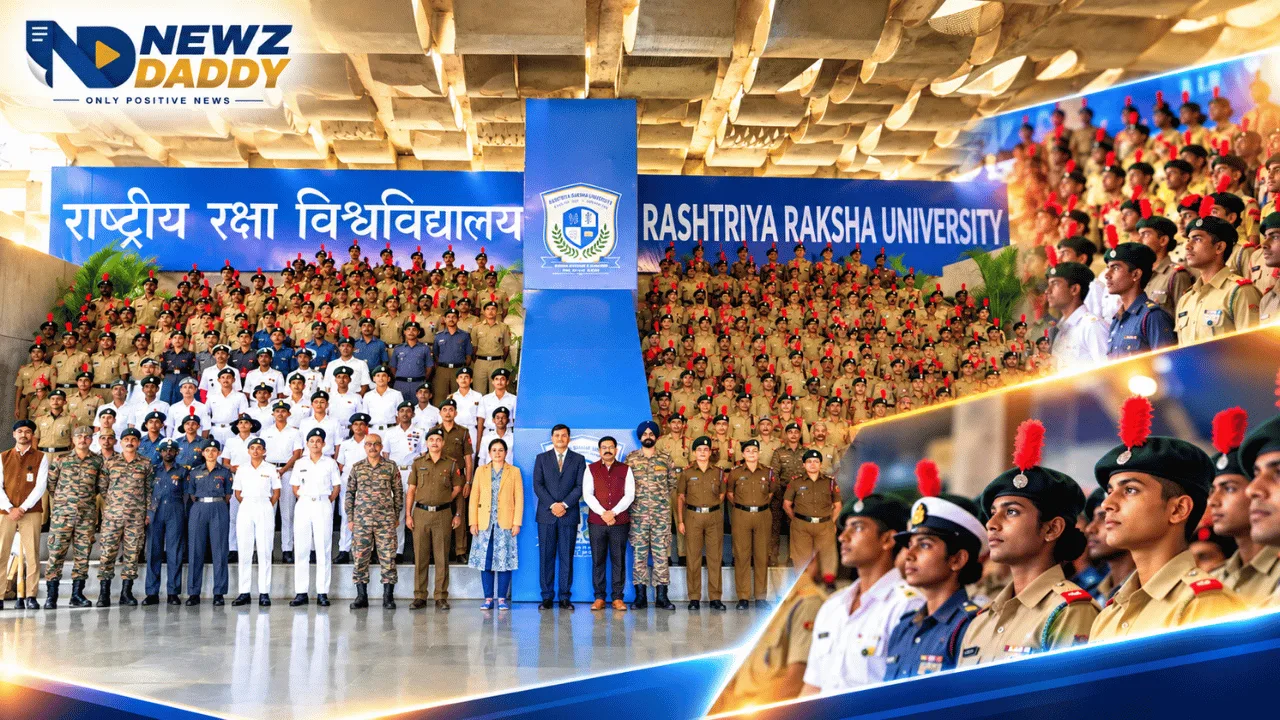
More than 400 NCC cadets from five directorates visited Rashtriya Raksha University in Gandhinagar on September 25 as part of an Ek Bharat Shreshtha Bharat National Camp.
The group included cadets representing the Gujarat, Dadra and Nagar Haveli and Daman and Diu, Tamil Nadu, Puducherry, and Andaman and Nicobar Directorates. The visit gave the young participants a look at a university where national security, policing, defence, public safety and related subjects are taught and researched.
For many of the cadets, the visit also brought together two parts of their training. NCC camps give young people exposure to discipline, leadership and national integration, while RRU provides specialised academic and practical training linked to security and public safety.
Rashtriya Raksha University was established by an Act of Parliament in 2020 and is an Institution of National Importance under the Ministry of Home Affairs, Government of India. Its academic work covers areas such as internal security, policing, cyber security, forensic science, criminal law, coastal security and strategic studies.
During their visit, the cadets were taken through laboratories, training facilities, academic spaces and technology-based learning areas at the university.
They were also introduced to drone technology and other emerging technologies. The university’s Atal Incubation Centre was among the facilities presented to the visitors, giving the cadets an introduction to how new technology and entrepreneurship can be linked with security-related needs.
The exposure is relevant as drone technology has become an increasing part of training and preparedness in the security sector. The National Cadet Corps has also added drone training to its wider training activities. In January 2026, the Ministry of Defence said drone training was among the newer measures being introduced into NCC training.
The cadets were introduced to RRU’s specialised schools and centres and were briefed about its academic and training programmes. The university’s work covers several areas that require knowledge of both traditional security practices and newer technologies.
RRU also has a dedicated School of NCC and Police Martial Music Band. Its NCC activities include drills, camps, social service programmes and leadership exercises.
The university’s own NCC unit includes 1 Gujarat Artillery Battery, 1 Gujarat Girls Battalion, 1 Gujarat Naval Unit and units of the 37 Gujarat Battalion.
The Ek Bharat Shreshtha Bharat programme was announced by Prime Minister Narendra Modi on October 31, 2015, on the occasion of Rashtriya Ekta Diwas, which marks the birth anniversary of Sardar Vallabhbhai Patel.
The programme seeks to encourage people from different parts of India to learn about each other’s languages, traditions, food, culture and way of life. Government documents describe cultural exchange and long-term interaction between states and Union Territories as key parts of the programme.
The NCC has used the programme through dedicated camps that bring cadets from different parts of the country together. In 2024, the government reported that 34 NCC Ek Bharat Shreshtha Bharat camps had been conducted during the year, with 13,550 cadets taking part. Eight Special National Integration Camps during the same period involved another 2,474 cadets.
A December 2025 NCC camp at Kamptee, Maharashtra, offers another example. That camp brought together 600 cadets, including 150 cadets from the Tamil Nadu, Puducherry and Andaman and Nicobar Directorates.
Such programmes give cadets the chance to spend time with peers who may speak different languages and come from different social and cultural backgrounds. The Gandhinagar visit formed part of that wider exchange.
RRU’s work has expanded beyond conventional classroom teaching. Its current academic structure includes schools dealing with internal security and smart policing, information technology, artificial intelligence and cyber security, criminal and military law, private and corporate security, applied sciences and engineering, and physical education and sports.
The university has also been developing specialist training in areas connected with ceremonial and martial music through its School of NCC and Police Martial Music Band. The school began operations in 2025 and has training programmes for personnel connected with police, paramilitary forces and NCC.
For NCC cadets, therefore, the September 25 visit offered more than a tour of a university campus. It allowed them to see how subjects they encounter during youth training connect with higher education, professional training and research.
The visit was coordinated by 1 Gujarat Battalion NCC, which hosted the programme in Gujarat, along with RRU’s Extension and Distance Learning Directorate and the School of NCC and Police Martial Music Band.
The programme also placed attention on leadership, discipline, teamwork, innovation and the use of technology in national security.
For the cadets travelling from Gujarat and the Union Territories and southern regions, the day combined institutional exposure with the central purpose of the Ek Bharat Shreshtha Bharat programme: meeting young people from other parts of India and learning through direct contact.
The Gandhinagar programme ended with a message about the role of young NCC cadets in nation-building and their future contribution to a secure and developed India.