


PV Shivanand Honours War Hero Sekhon At DSSC Wellington
PV Shivanand Addresses DSSC Officers As Sekhon’s Gnat Recalls The 1971 War Today
DSSC Wellington honours 1971 war hero Nirmaljit Singh Sekhon
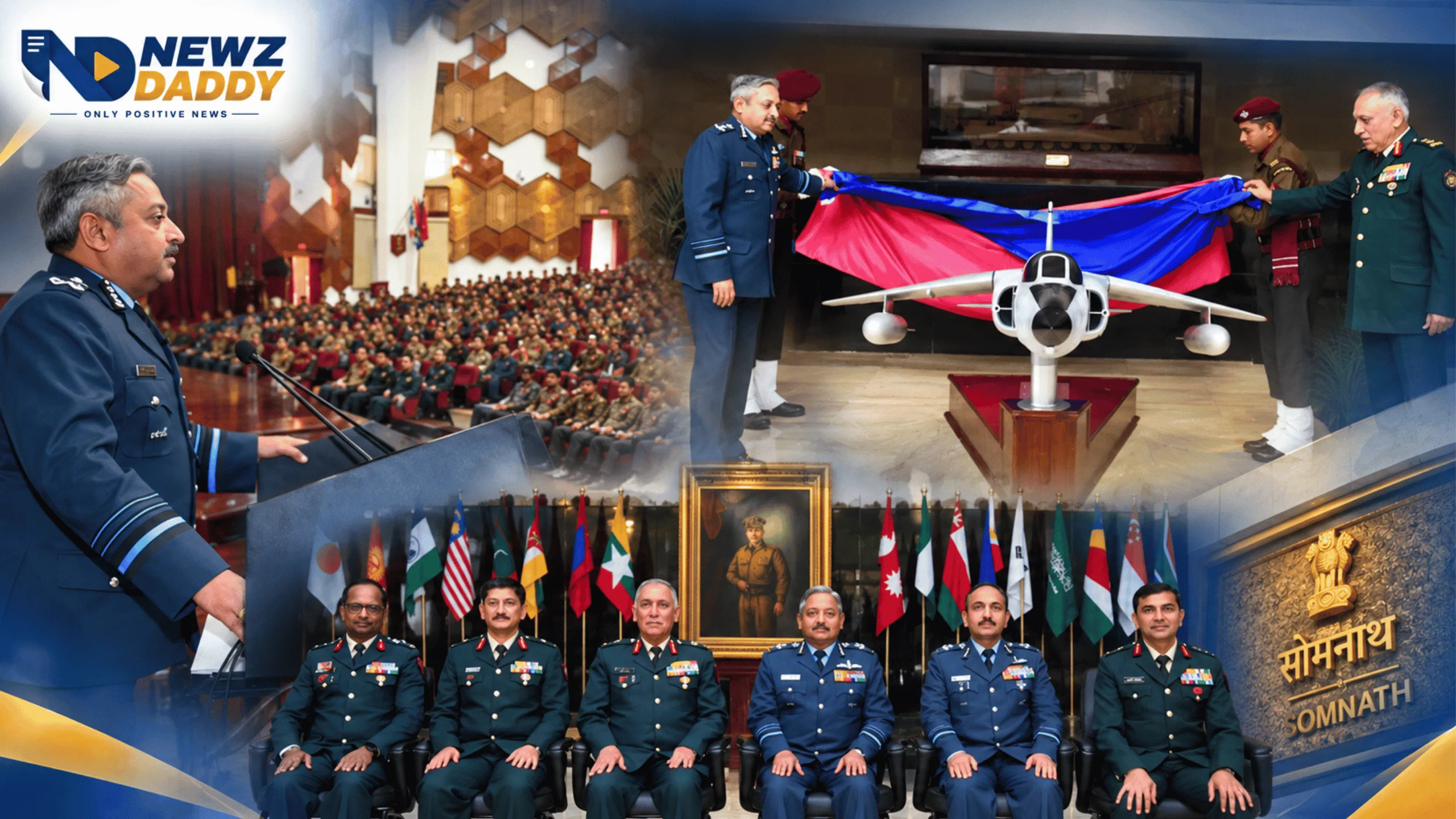
Air Marshal PV Shivanand, Air Officer Commanding-in-Chief, addressed officers of the 82nd Staff Course and permanent staff at the Defence Services Staff College (DSSC), Wellington, where he spoke about operational planning, joint operations and the changing demands of modern warfare.
The visit also included a ceremony to unveil a replica of the Folland Gnat flown by Flying Officer Nirmaljit Singh Sekhon during the 1971 India-Pakistan war. The replica will be placed at the Somnath Foyer of DSSC, where it is intended to serve as a reminder of the courage shown by the Indian Air Force officer during one of the war’s major air battles over Srinagar.
Sekhon remains closely linked with the history of the Indian Air Force because of his actions on December 14, 1971. He was serving with No. 18 Squadron, known as the “Flying Bullets”, which operated Folland Gnat fighter aircraft. The squadron had been moved to Srinagar during the war to help defend the Kashmir Valley against Pakistani air attacks.
On that morning, six Pakistani F-86 Sabre aircraft attacked Srinagar airfield. Sekhon was on readiness duty and took off in his Gnat as the attack was underway. He engaged the attacking aircraft and succeeded in damaging two Sabres. He was then faced by the remaining aircraft and was eventually overwhelmed by their numerical advantage. His aircraft was hit, and Sekhon was killed.
The action earned him the Param Vir Chakra, India’s highest wartime gallantry award, awarded posthumously. He remains the only Indian Air Force officer to have received the Param Vir Chakra.
The battle took place during the final phase of the 1971 war, a conflict that led to the creation of Bangladesh. Air power played an important role on both the eastern and western fronts. In the Kashmir sector, protecting Srinagar was particularly important because the airfield supported military operations in the region.
The Folland Gnat had entered Indian Air Force service in the 1950s and became known for its small size, speed and ability to engage larger fighter aircraft. During the 1965 India-Pakistan war, the Gnat had already gained a strong reputation in air combat. By 1971, No. 18 Squadron was among the units operating the aircraft in combat.
Sekhon’s mission at Srinagar was especially difficult because the Gnat detachment had to operate in demanding conditions. The pilots were dealing with the high altitude and cold weather of the Kashmir Valley while also defending an airfield under attack.
The official account of the battle records that Sekhon engaged two Sabres and damaged both before additional Pakistani aircraft joined the fight. The attack placed him at a severe numerical disadvantage. His actions helped prevent the attacking aircraft from continuing their intended assault on Srinagar airfield.
Sekhon was born on July 17, 1943, in Isewal village in Punjab’s Ludhiana district. He joined the Indian Air Force and was commissioned as a pilot officer on June 4, 1967. He later joined No. 18 Squadron and became a fighter pilot at a time when the Indian Air Force was expanding its combat capability.
His story has remained part of the Indian Air Force’s institutional history for more than five decades. His Param Vir Chakra citation recognised his courage, flying skill and determination during the defence of Srinagar.
The decision to place a replica of his Gnat at the Somnath Foyer at DSSC gives that history a place within an institution responsible for training military officers. DSSC brings together officers from the Indian Army, Navy and Air Force for joint professional military education. Its courses focus on preparing officers to understand operations beyond the boundaries of their individual services.
That joint approach was also central to Air Marshal PV Shivanand’s address to the 82nd Staff Course and the permanent staff. He discussed operational planning, jointness and integrated operations, areas that have become increasingly important as modern military operations involve several services working together.
The Indian armed forces are also preparing for a strategic environment in which speed and accurate decision-making can have a major effect on operations. The Indian Air Force has been developing its ability to conduct coordinated operations across air, land and maritime domains, while adapting to changes in technology and the nature of military threats.
For officers studying at DSSC, the story of Sekhon carries a direct professional lesson. His final mission was carried out under extreme pressure, with limited time to respond and a large numerical disadvantage. The battle also shows the importance of training, judgement and the ability to act quickly during an unfolding operation.
The Gnat replica at Wellington will therefore connect two periods of Indian military history: the air battles of the 1971 war and the preparation of today’s defence leadership. More than five decades after Sekhon’s last mission, his aircraft and his record continue to form part of the institutional memory of the Indian Air Force.
The ceremony at DSSC places that memory in front of officers preparing for senior military responsibilities. For the students of the 82nd Staff Course, the replica will stand alongside their studies as a reminder of the decisions that combat officers may have to make when circumstances leave little room for delay.
Also Read:
Rajnath Singh Backs Sri Lanka as India Deepens Ties in Colombo