


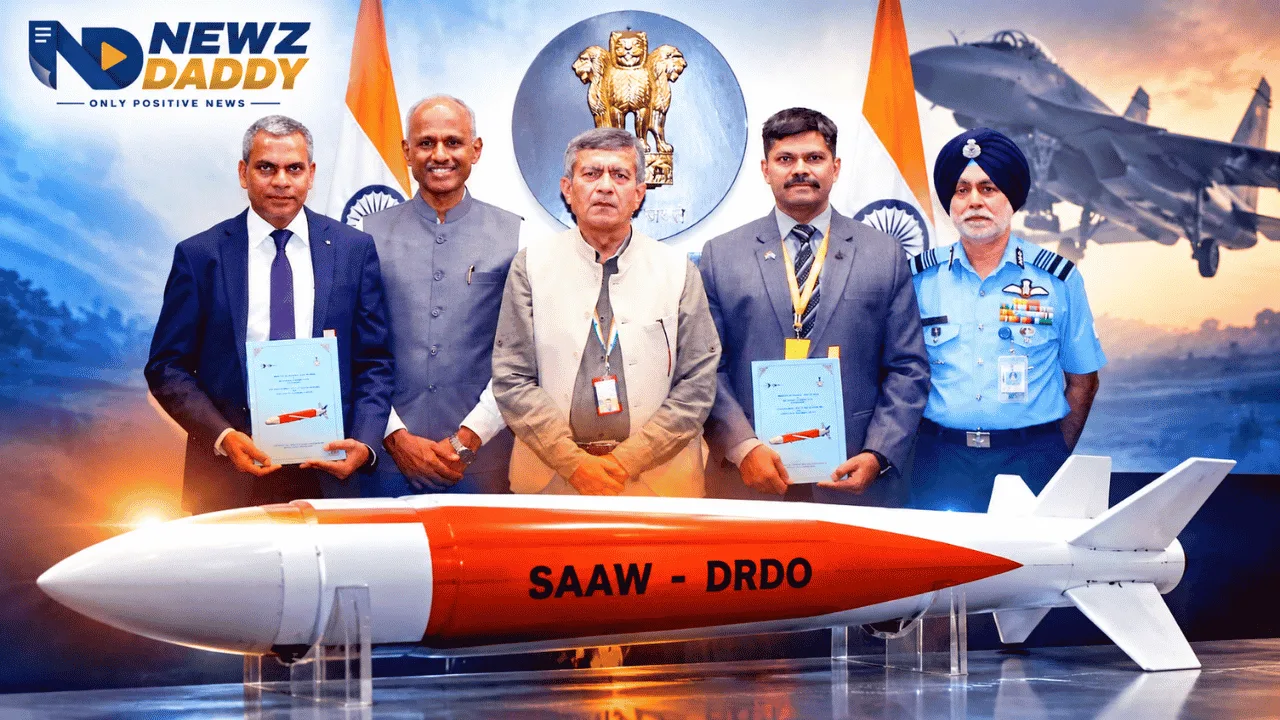
SAT-SAAW: ₹810.79 Crore Contract Signed With BDL for IAF
MoD places ₹810.79 Crore Order for 160 SAT-SAAW Weapons for Indian Air Force
The Ministry of Defence has signed a ₹810.79 crore contract with Bharat Dynamics Limited (BDL) for 160 Satellite Smart Anti-Airfield Weapons, or SAT-SAAW, for the Indian Air Force.
The agreement was signed in New Delhi on 23 September 2026 in the presence of Defence Secretary Rajesh Kumar Singh. The order also covers associated equipment and has been placed under the Buy (Indian-Indigenously Designed, Developed and Manufactured) category.
SAT-SAAW is a precision-guided air-to-ground glide bomb developed by the Defence Research and Development Organisation (DRDO). It is designed to be released by fighter aircraft and attack ground targets from a distance, allowing the aircraft to remain away from the immediate target area.
The weapon can be carried by the Jaguar, Hawk and Su-30 MKI aircraft, according to the Defence Ministry. The Department of Defence Production lists SAT-SAAW as a long-range, stand-off, precision air-to-surface weapon. Its published specifications give the weapon a mass of 125 kg, a length of 1.85 metres and a range of up to 90 to 100 km, depending on release conditions.
The new contract is significant because it moves the system further into large-scale production for the Indian armed forces. The SAT-SAAW programme has been under development for several years. In November 2017, DRDO reported successful flight tests of the weapon from an Indian Air Force aircraft. Three tests were carried out under different release conditions, with the weapon reaching targets at distances of more than 70 km.
The weapon’s development has involved the Research Centre Imarat and other DRDO laboratories, working with the Indian Air Force. The system uses precision navigation to guide the bomb towards its target. BDL’s published specifications state an accuracy of less than 7 metres using inertial navigation and GPS, with accuracy of less than 3 metres when a seeker is used.
The latest order calls for 60 per cent indigenous content in the SAT-SAAW system. The Ministry of Defence has also said that components such as the Initial Measurement Unit, Long Impact Delay Fuse and Twin Store Carrier will be indigenised as part of the programme.
That production work will involve BDL, the Hyderabad-headquartered defence public sector company under the Ministry of Defence. BDL was established on 16 July 1970 to provide a manufacturing base for guided missile systems and related equipment for the Indian armed forces. Over the years, it has worked with DRDO and foreign original equipment manufacturers on missile and other defence systems.
BDL has also been involved in several indigenous defence programmes. Its official record lists production work connected with the Integrated Guided Missile Development Programme, Akash weapon systems, anti-tank guided missiles and underwater weapons. The company was listed on the Bombay Stock Exchange and National Stock Exchange in 2018.
The SAT-SAAW order also follows an earlier government decision to move towards wider procurement of the weapon. In September 2020, the Defence Acquisition Council approved procurement of SAAW at an estimated cost of about ₹970 crore. The decision was part of a broader procurement policy that placed greater emphasis on domestic production of defence equipment.
For the Indian Air Force, the importance of a stand-off weapon lies in the ability to attack selected ground targets without requiring the aircraft to fly directly over the target. The published range of up to 90 to 100 km gives the weapon a different role from conventional bombs that require aircraft to approach much closer before release. The exact effective range depends on factors such as the aircraft’s release conditions.
The weapon is also part of a wider shift in India’s military procurement towards equipment designed and manufactured within the country. The Buy (Indian-IDDM) category used for the latest order specifically covers equipment that is designed, developed and manufactured in India. In this case, the Ministry says the SAT-SAAW has been developed by DRDO and will contain 60 per cent indigenous content.
The production schedule will extend over two financial years. Deliveries of the 160 SAT-SAAW weapons are planned for 2027-28 and 2028-29. The Ministry expects their induction to add to the Indian Air Force’s ability to carry out operations while supporting the country’s wider defence preparedness.
For India’s defence manufacturing sector, the order also shows how a weapon can move through several stages before reaching regular service use: research and development by DRDO, testing with the armed forces, procurement approval and finally production by an Indian defence manufacturer.
The ₹810.79 crore contract therefore covers more than the purchase of 160 weapons. It marks the next production phase for a DRDO-developed system that has been tested over several years and is now scheduled for delivery to the Indian Air Force from 2027-28. The project also brings further domestic production of key components into the programme.
The source material supplied for this rewrite specifically identifies the 23 September 2026 contract, the ₹810.79 crore value, 160 weapons, 60 per cent indigenous content, the participating organisations and the 2027-28 and 2028-29 delivery schedule.
Must Read:
HAL Aircraft to Join IAF and Pawan Hans Fleets on September 18