

Discusses Voice Loss and Recovery in Ahmedabad
Shekhar Ravjiani Opens Up on Rejection, Losing His Voice and Finding His Way Back to Music
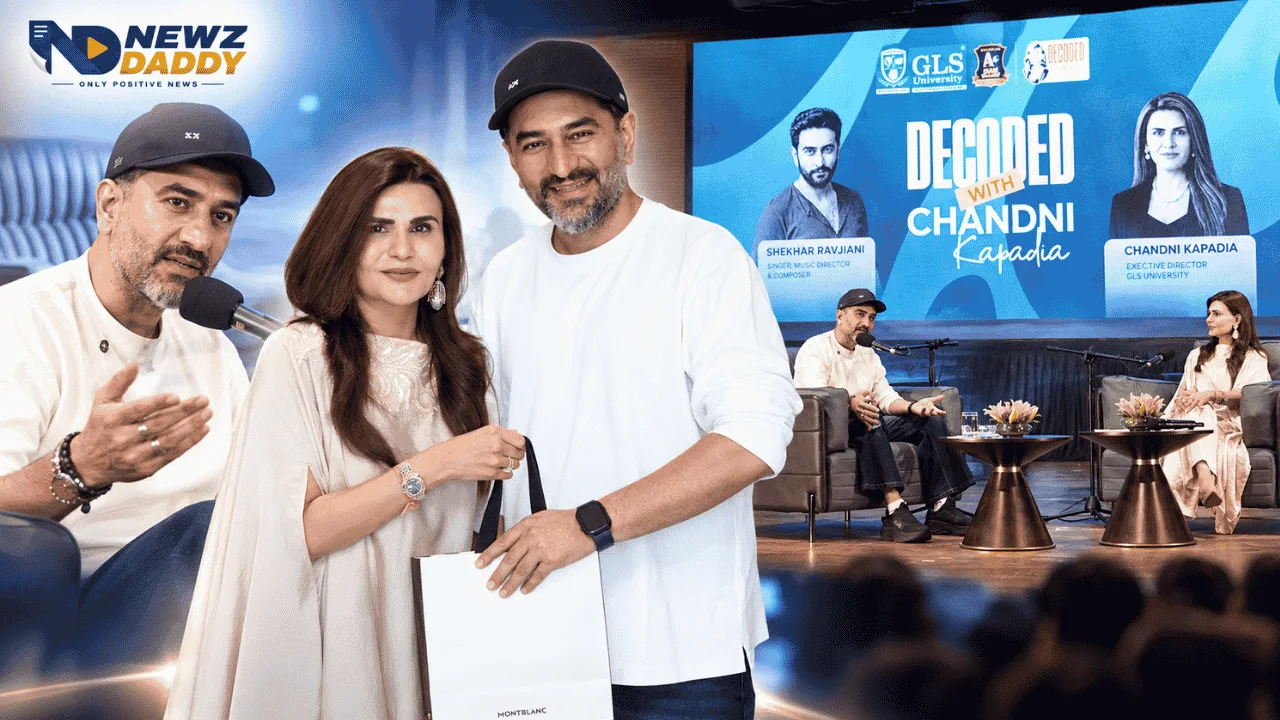
Shekhar Ravjiani’s meeting with students at GLS University took an unexpected route. The singer and composer spoke about an early rejection on television, a period when he feared he might never sing again, the teachers who shaped his music and the experiences behind some of his best-known work.
Ravjiani was the guest on “Decoded with Chandni Kapadia”, a conversation series hosted by Dr Chandni Kapadia, Executive Director of GLS University. The session was held in Ahmedabad and ended with the launch of the university’s Youth Festival 2026.
The conversation gave students a look at parts of Ravjiani’s career that are less visible from a concert stage or a film soundtrack.
Ravjiani recalled appearing as a contestant on Sa Re Ga Ma Pa, where he missed qualification by five marks. Years later, he returned to the programme in a very different role. He went on to serve as a judge and mentor on the music reality show.
Looking back at the rejection, he told students, “I convert negativity into positivity. I channelise all the energy into positivity.”
Shekhar Ravjiani association with the programme goes back to the late 1990s. A 2016 Times of India profile noted that Ravjiani had been a participant on Sa Re Ga Ma Pa in 1997 and later became a mentor on Sa Re Ga Ma Challenge.
For a singer, however, one of the hardest periods of Ravjiani’s career came much later.
Shekhar Ravjiani spoke about left vocal cord paresis, a condition that affected his voice and left him unsure about his future as a performer. Ravjiani had publicly discussed the problem in 2024, saying that he lost his voice in 2022 and feared he would never sing again. Medical reports describe vocal cord paresis as reduced movement of one of the vocal cords, which can affect voice production.
Shekhar Ravjiani said that he continued his professional commitments while undergoing vocal treatment. His recovery included help from specialists and vocal exercises. In an interview published in 2024, he said the experience had been deeply difficult and that vocal warm-ups later became an important part of his routine.
At GLS University, he described the period in simpler terms: “Sometimes, all you need is some light, some sunshine in the darkness.”
The subject of faith also came up during the discussion. Ravjiani spoke about the influence of his grandmother and the Hanuman Chalisa. His faith in Lord Hanuman has also been mentioned in his earlier accounts of his recovery.
Music entered his life through people around him. Ravjiani recalled how Jagjit Singh introduced him to Ustad Niyaz Ahmed Khan, giving him his first lessons in classical music. In an earlier interview, Ravjiani described sitting with other students during his first lesson and later developing greater confidence in his singing.
Shekhar Ravjiani’s teachers remained an important part of his musical story. In a 2024 tribute to his gurus, Ravjiani named his father, Ustad Niyaz Ahmed Khan, Sir Xavier Fernandes and Jagjit Singh as people who helped shape him as a musician.
The influence of Jagjit Singh is especially significant. Ravjiani later performed in concerts paying tribute to the legendary ghazal singer, including a 2016 concert in Singapore and a 2017 tour.
Ravjiani also remembered his early working years, including the first studio he set up inside a marble factory in Worli, Mumbai. The detail offered students a glimpse into the practical beginnings of a career that later took him into mainstream Hindi cinema.
Ravjiani is best known to many listeners as one half of Vishal-Shekhar, the music duo formed with Vishal Dadlani. The partnership began in 1999 and went on to produce music for films including Om Shanti Om, Ra. One and Chennai Express.
One of the better-known collaborations discussed at GLS University was “Chammak Challo”, the song from Shah Rukh Khan’s 2011 film Ra.One. The track featured Senegalese-American singer Akon. Ravjiani had explained at the time that Akon learnt the Hindi lyrics quickly after hearing them in the studio.
The song became one of the notable Bollywood-Akon collaborations of that period and showed how a Hindi film soundtrack could bring an international pop singer into a mainstream Indian production.
At the university session, Ravjiani also spoke about friendship, trust and openness in the recording process. He discussed remixes, changing listening habits and the way younger audiences consume music.
The conversation moved away from the recording studio at several points. Ravjiani spoke about his six dogs and the place they hold in his life. “I find God in their eyes. No one will love you the way they do,” he said.
He also discussed his daughter Bipasha and her approach to learning music through practice. For Ravjiani, learning music has always involved doing and listening, rather than relying on classroom theory alone.
That view fits with his own background. His training combined classical instruction with exposure to different musicians and styles. Over the years, his work has moved between film music, playback singing, live performances and independent musical projects.
For the students at GLS University, the discussion offered a career story with several turning points. A five-mark rejection did not end Ravjiani’s association with a major singing programme. A serious vocal problem did not end his work as a singer. His early training remained connected to the teachers who helped him start.
The session concluded with Ravjiani joining GLS University students for the launch of Youth Festival 2026. Students also presented a musical tribute to him.
“Decoded with Chandni Kapadia” has previously featured personalities from entertainment, sports, business, law, education and other fields. GLS University says the series is designed around conversations about professional careers and the experiences behind them. Earlier guests have included Suryakumar Yadav, Aman Gupta, Pankaj Patel, Paresh Pahuja, Rhea Singha, Manhar Udhas, Sourabh Raaj Jain, Karan Tacker, Aarohi Patel and Ujjwal Nikam, among others.
For Ravjiani, the Ahmedabad conversation brought several stages of his life into one room: the young singer who missed a television selection, the student of classical music, the composer behind major Hindi film songs and the performer who once had to fight to regain his own voice.
The message to the students came largely through those personal experiences. His career has been shaped by decisions made after setbacks, by teachers who gave him direction and by the discipline required to return to work when circumstances became difficult.
Must Read:
GLS University Decoded with Dr Chandni Kapadia Inspires Students
Jay Thadeshwar at GLS University Inspires Future Storytellers