


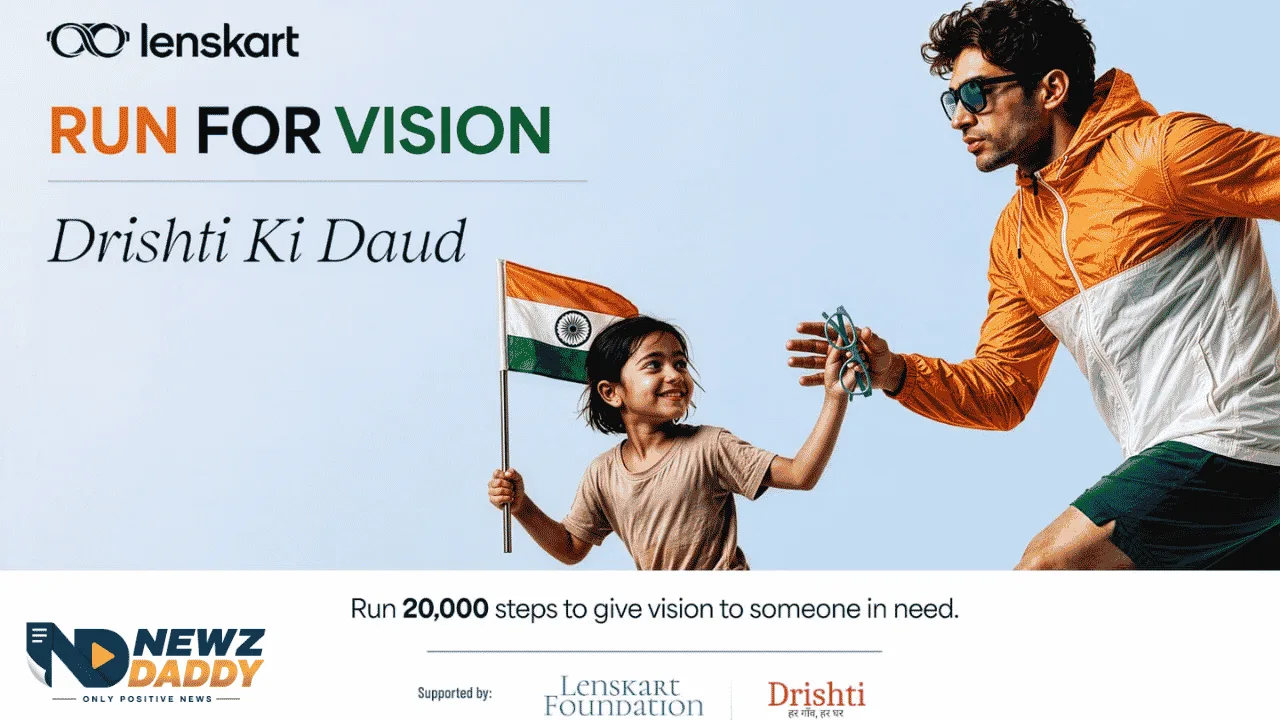
Lenskart Drishti Ki Daud: Walk for Glasses This August
Lenskart’s Drishti Ki Daud Links Walking With Access to Glasses
Lenskart is asking people across India to turn their steps into pairs of prescription glasses this Independence Day weekend, as the eyewear company launches its virtual run, ‘Drishti Ki Daud’ – Run for Vision.
The campaign will run on 15 and 16 August 2026. Participants who complete at least 20,000 steps through the Lenskart app can help unlock up to four pairs of prescription glasses, which Lenskart Foundation says will be donated to people who need vision care.
The programme comes at a time when access to basic eye care remains a major public health issue. Lenskart says more than 350 million Indians cannot afford vision care. The company has also reported that a large number of Indians who need vision correction do not wear spectacles.
The World Health Organization’s latest global figures show the scale of the wider problem. At least 2.2 billion people worldwide have near or distance vision impairment, with at least 1 billion cases either preventable or still not properly addressed. Refractive errors, the type of problem commonly corrected with spectacles, are among the leading causes of vision impairment.
For people taking part in Drishti Ki Daud, the system is based on the number of steps recorded. A participant completing 20,000 steps will account for one pair of glasses. At 30,000 steps, the contribution rises to two pairs, followed by three pairs at 40,000 steps and four pairs at 50,000 steps.
Participants can join through the Lenskart app by selecting the ‘Drishti Ki Daud’ banner on the home page. They are then asked to connect the app with a health application on their phone, following the instructions provided.
Once the challenge is completed, participants can download a digital finisher frame carrying their details and share it on social media. Their names will also be credited on the Lenskart Foundation page.
The donation programme will be handled through Lenskart Foundation, the company’s non-profit arm. Lenskart has been working on access to vision care through several programmes. Its corporate information describes ‘Drishti Didi Har Gaon Har Ghar’, also known as the Women Eye Marshall programme, under which local women are trained to carry out preliminary eye checks and pass vision data to the company’s teams. People identified as needing further care can then receive comprehensive eye examinations and spectacles.
Lenskart has also previously promoted a ‘Vision to India’ programme based on a one-for-one model, saying that for every pair of glasses sold, a pair would be provided to someone in need. The company states that 75% of Indians who need spectacles do not wear them.
The new walking campaign gives that work a different route into the public. Instead of asking people to make a direct donation, it connects a common activity, walking or running, with the provision of spectacles.
Peyush Bansal, CEO and Founder of Lenskart, said, “The future of eye care in India has to be about greater awareness and wider access to vision care. Through Lenskart Foundation, our ambition is to build a more vision-aware India where quality care is within reach for everyone. ‘Drishti Ki Daud’ takes this ambition into a new space by turning an everyday habit into a shared act of contribution. We are counting on people across India to come together and show how everyday actions, when multiplied by collective participation, can create meaningful change at scale.”
The campaign follows Lenskart’s earlier ‘Run for Frame’ activity. The company says that initiative brought close to one million participants together across India, Thailand and Singapore through the Lenskart app. Lenskart’s Thailand campaign records show that the earlier programme used activity data from health and running apps, including Strava, Nike Run Club, Apple Health, Whoop, Apple Watch and Garmin.
The company has continued to expand its work in eye testing and access to spectacles. In its recent corporate reporting, Lenskart said it conducted more than 6 million eye tests in one quarter, with almost half involving first-time examinations. It also reported that the Lenskart Foundation served more than 150,000 people with free eye screenings in the quarter and provided eyewear to many of them.
The company’s wider reach has also grown. Lenskart says it now has more than 1,000 stores, with free eye tests available through its retail network.
The need for affordable spectacles is also receiving attention beyond private companies. In 2025, the World Health Organisation and the Universal Postal Union announced a pilot programme with India Post in Assam to improve access to reading glasses. Postal workers were to receive training in simple vision screening and provide low-cost ready-made reading glasses to people with near-vision problems. The programme was designed to reach people who may not regularly visit health facilities.
That wider effort points to a basic problem in vision care: identifying a person who needs glasses is only one part of the task. The person must also be able to afford the examination and spectacles and reach a service that can provide them.
For Drishti Ki Daud participants, the immediate task is straightforward. Walk or run during the 15 and 16 August campaign period, record the activity through a compatible health app and sync the result through the Lenskart app. The number of completed steps will determine the number of pairs linked to the campaign.
The initiative places Independence Day at the centre of a public participation campaign, but its lasting value will depend on how many people receive usable spectacles and how effectively such programmes reach people who have limited access to eye care.
For those taking part, the starting point is 20,000 steps. For someone waiting for a pair of glasses, the result could be much more important than the number on a phone screen.
Must Read:
Rajeev Khandelwal Named Host of Vande Bharatam in India