


Rotary CSR Conclave in Ahmedabad Draws Corporate Leaders
Rotary District 3055 brings companies and community groups together at Ahmedabad CSR Conclave
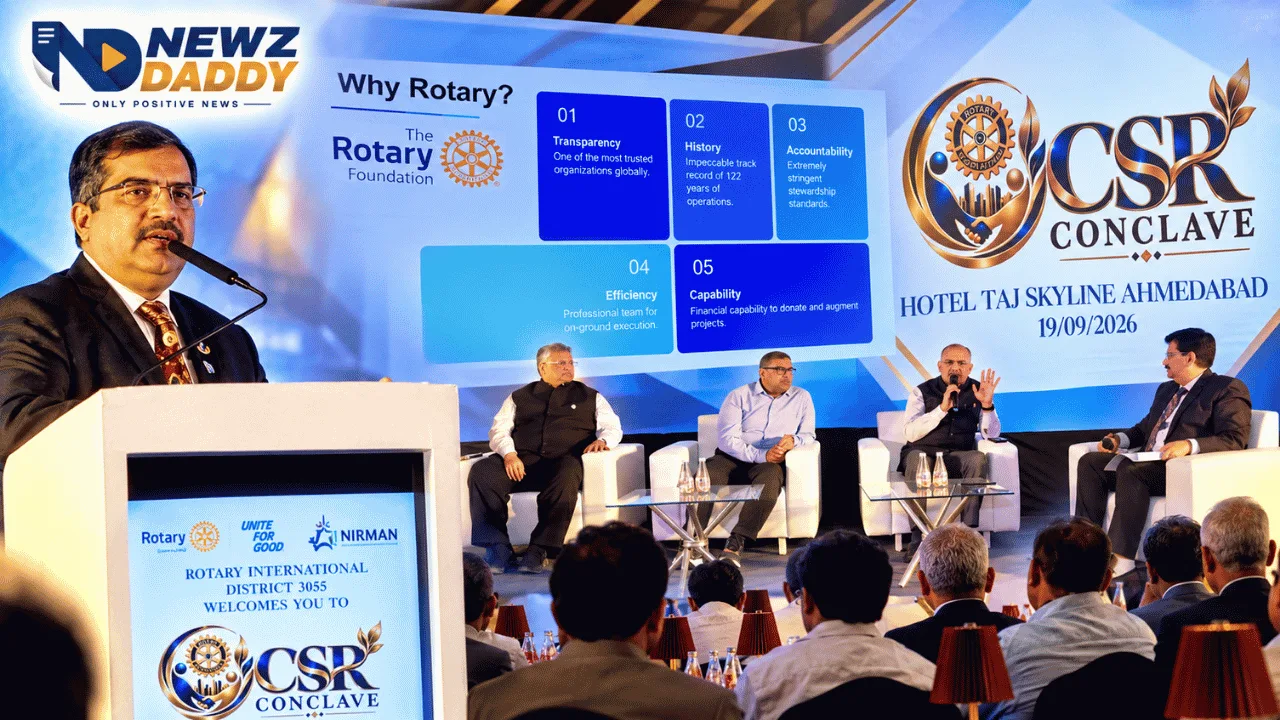
Corporate social responsibility spending was the focus of a Rotary International District 3055 meeting in Ahmedabad on Saturday, where representatives of companies, foundations and Rotary project teams discussed possible work in healthcare, education, skills, water conservation and rural development.
The CSR Conclave, held under the theme “Collaborate and create lasting impact: Together for a stronger, more inclusive society,” brought together CSR representatives from organisations including Adani Foundation, Nirma Limited, AM/NS India, Cadila Pharmaceuticals, Harsha Engineers Limited, Monte Carlo, Zen Foundation, Voltas Beko, Kiran Motors, ONGC, GHCL, IFFCO-Tokio, Suzlon and Stovec.
The meeting comes at a time when Indian companies face clear rules on how qualifying CSR funds can be spent and how outside organisations can be used to carry out projects.
Under Section 135 of the Companies Act, companies that meet specified financial thresholds are required to follow CSR provisions. These include companies with a net worth of at least Rs 500 crore, turnover of at least Rs 1,000 crore or net profit of at least Rs 5 crore. Such companies are required to spend at least 2% of their average net profits, subject to the provisions of the law.
The government allows eligible companies to carry out CSR work themselves or through approved implementing agencies. Such agencies include certain Section 8 companies, registered public trusts and societies that meet the required conditions. Implementing agencies are also required to register on the MCA21 portal.
This makes the choice of an organisation to carry out a CSR project an important part of the process.
Addressing corporate representatives at the Ahmedabad meeting, Naimish N. Ravani, Rotary District Governor for 2026-27, presented the case for working with The Rotary Foundation on CSR projects.
Ravani pointed to five areas that he said form the basis of Rotary’s approach: financial transparency, its long history of service, accountability in handling grants, project execution and the ability to add funding through Rotary’s grant systems.
Rotary International was founded by Paul P. Harris in Chicago on February 23, 1905. The organisation says its work has grown from local community service into humanitarian programmes around the world.
Rotary also publishes annual reports, audited financial statements and federal tax returns. According to its current financial information, The Rotary Foundation has invested about US$3 billion in thousands of projects over the past 100 years.
The Rotary Foundation uses several grant programmes. District grants support smaller, shorter projects, while global grants support larger international projects with measurable outcomes in Rotary’s areas of focus.
For India, Rotary has also developed a CSR grant route. Rotary India material says CSR funds have been used for areas including disease prevention, clean water and sanitation, maternal and child health, education and local economic development.
Ravani told the corporate delegates:
“Corporates today seek not only statutory compliance, but measurable, transparent, and sustainable outcomes from their CSR investments. The Rotary Foundation combines over a century of global credibility with robust grassroots execution capabilities, making it a natural and dependable implementation partner. We are opening our arms to associate with more corporates to manage and execute their CSR initiatives in a seamless and completely hassle-free manner. We would love to be approached by corporate partners and will also be proactively reaching out to more organizations in the future to build transformative, high-impact partnerships.”
The wording reflects Rotary’s effort to position its network as a route through which companies can put CSR money into community projects while meeting the administrative requirements attached to such spending.
Discussions at the conclave covered healthcare infrastructure, quality education, skill development, water conservation and rural empowerment.
These areas broadly match several activities recognised under India’s CSR framework. Schedule VII of the Companies Act includes healthcare, sanitation and safe drinking water, education and vocational skills, livelihood projects, measures addressing social inequality and rural development.
The importance of implementation has also grown as CSR reporting and compliance requirements have become more structured. The Ministry of Corporate Affairs says registration of implementing agencies on the MCA21 portal was introduced to help companies identify suitable organisations and improve accountability and transparency in CSR implementation.
Rotary’s India network has already used CSR funding for projects in several states. A Rotary India bulletin, for example, recorded corporate-supported projects involving healthcare, diagnostic services, mangrove plantation and community facilities.
A more recent example came from Andhra Pradesh. In September 2026, Rotary reported on a project supported by a Rs 20 million CSR grant from Coal India Limited, under which more than 200 women received high-speed commercial sewing machines through a District 3020 livelihood project.
Such projects show the range of work that can sit between corporate funding and community-level delivery.
The Ahmedabad conclave was held during Ravani’s first year as District Governor of Rotary District 3055. The district’s official website currently lists 105 clubs and 3,274 members, with 261 projects, 12,207 reported volunteer man-hours and Rs 1.63 crore spent on projects, benefiting 51,815 people.
The district’s current leadership information also identifies Ravani as its District Governor for 2026-27.
For companies, the meeting therefore provided an opportunity to speak directly with an established network of Rotary clubs and project teams about areas where CSR funds could potentially be used.
The conclave ended with an interactive dinner involving corporate delegates and Rotary representatives. No specific new CSR agreement or funding commitment was announced in the material released about the event. The immediate outcome was a series of discussions around possible partnerships, with healthcare, education, skills, water and rural development emerging as the main areas of interest.
As India’s CSR system continues to place greater emphasis on documented spending, eligible partners and project reporting, the meeting in Ahmedabad reflects a wider question facing companies: how to turn allocated CSR funds into projects that can be properly implemented, monitored and reported at community level.
Must Read:
Rotary Club Aadarsh Ahmedabad Installs New Leadership For 2026-27