


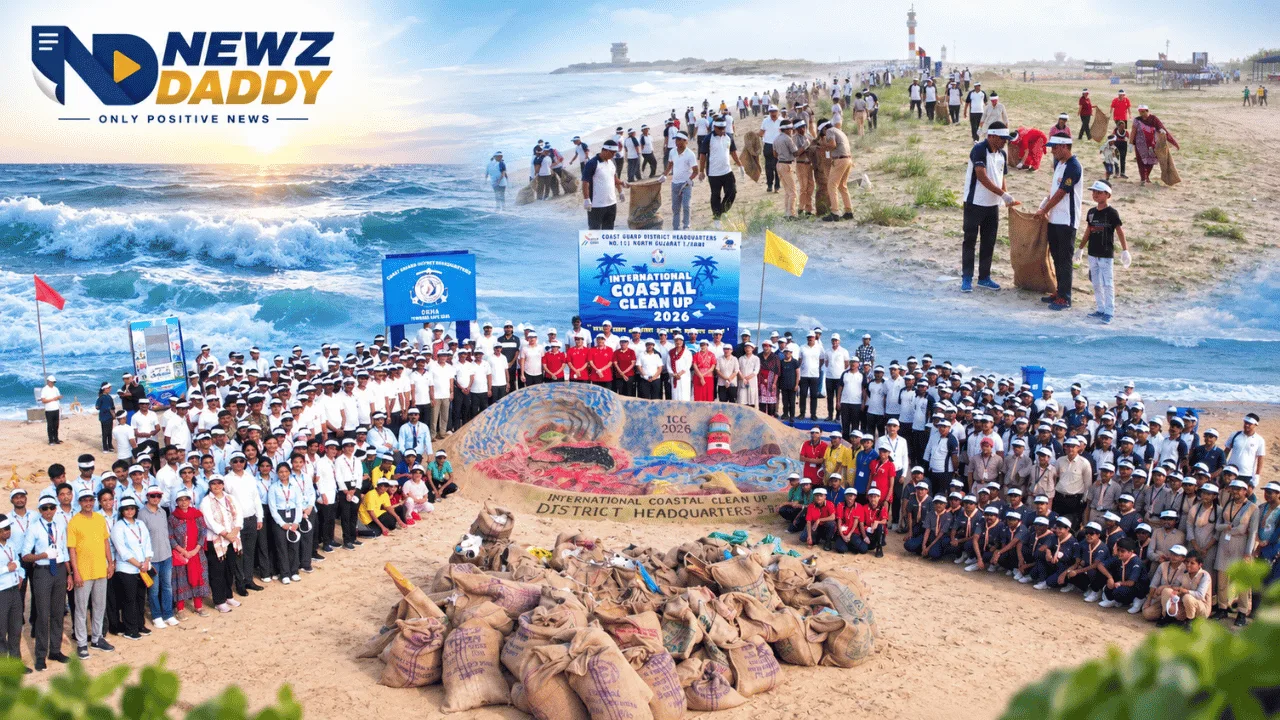
Coastal Cleanup Removes 820 kg of Waste Across Gujarat Coast
Indian Coast Guard Leads Coastal Clean-up Drive Across 8 km in Gujarat
The Indian Coast Guard and community groups removed about 820 kg of waste from four coastal locations in Gujarat on 19 September 2026 as part of International Coastal Cleanup Day.
The clean-up was organised by Coast Guard District Headquarters (North Gujarat), with the main activity held at CG Beach, Okha. Teams also worked at Pingleshwar Beach in Jakhau, the DPA gate to Narara Bet at Vadinar, and Luni Beach at Mundra.
The four locations together covered about 8 km of coastline. The waste was collected during a two-hour operation that began at 7.30 am and was handed over to the Municipal Corporation for further processing.
International Coastal Cleanup Day is held on the third Saturday of September. The campaign has grown into a large international effort involving communities in more than 100 countries. Ocean Conservancy, which runs the global International Coastal Cleanup programme, says nearly 20 million volunteers have taken part since 1986 and helped remove more than 400 million pounds of waste from beaches and waterways.
In India, the Indian Coast Guard has coordinated the coastal clean-up programme since 2006. The Coast Guard says the annual activity is conducted with support from government bodies, local authorities, schools, colleges, NGOs, fisheries groups, Marine Police and other organisations.
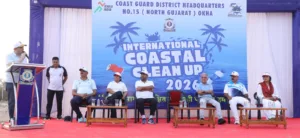
At Okha, the programme was attended by Shri Vikrant Deoras, Site & Manufacturing Head of Tata Chemicals Ltd, Mithapur, as Chief Guest. Dr Prabhakaran Paleri, former Director General of the Indian Coast Guard, attended as Guest of Honour.
The event began with a ribbon-cutting ceremony followed by a pledge carrying the message, “Clean Seas, Safe Seas”. Personnel from Coast Guard Station Okha and other units under the command of Coast Guard District Headquarters (North Gujarat) took part.
The participating Coast Guard units included ICGS Jakhau, ICGS Vadinar and ICGS Mundra. School students, local volunteers, Marine Police personnel, civil society members, government agencies, organisations and educational institutions also joined the operation.
The size of the participation reflects the way coastal clean-up work in India has increasingly moved beyond government-led activity. The Indian Coast Guard’s own records show that 26,092 volunteers took part in its 2025 International Coastal Cleanup campaign across the country. The campaign collected about 20,365 kg of marine litter and 14,583 kg of plastic waste. The western region recorded the largest participation, with 12,537 volunteers, and collected about 9,276 kg of marine litter.
The 2024 campaign had 27,563 participants and resulted in the collection of about 41,833 kg of marine litter and 19,415 kg of plastic waste, according to Coast Guard figures. The western region accounted for about 22,220 kg of marine litter that year.
Gujarat has also recorded large participation in earlier campaigns. In 2021, the Coast Guard reported 2,077 volunteers in Gujarat and the collection of about 8,663 kg of marine litter.
The 2026 clean-up at Okha and the other three Gujarat sites formed part of a wider national campaign called Swachh Sagar, Surakshit Sagar 2026. The Ministry of Earth Sciences campaign ran from 13 to 19 September, with the National Centre for Coastal Research coordinating the programme. Activities were held at coastal locations across India’s 13 coastal States and Union Territories.
The timing is important because marine litter does not remain confined to the place where it is dropped. Plastic packaging, fishing-related material and other waste can be carried by tides and currents, allowing rubbish from beaches and coastal settlements to enter the sea.
For the Indian Coast Guard, marine environmental protection is also part of its statutory role. Under the Coast Guard Act, 1978, preservation and protection of the marine environment and control of marine pollution are among its functions. The Coast Guard was appointed India’s Central Coordinating Authority for oil-spill response in maritime zones in 1986.
The wider clean-up programme therefore combines a practical task with public participation. Removing litter from a beach deals with waste already present, while the involvement of students and residents is intended to build awareness about how waste reaches coastal waters.
The Indian Coast Guard’s national experience also shows the scale of the problem. Its records from earlier International Coastal Cleanup campaigns contain thousands of kilograms of marine debris collected across Gujarat and other coastal States. In 2019, Gujarat alone recorded 6,190 kg of debris during the campaign, while the national total was about 75,224 kg.
The 2026 programme at Okha carried the message, “स्वच्छ सागर, सुरक्षित तट, यही पहचान हमारी”. For the participants working along the Gujarat coast, the message was put into practice through the removal and disposal of 820 kg of waste in a single morning.
The event also showed the range of groups involved in keeping the coast clean. Coast Guard personnel worked alongside students, volunteers, Marine Police, civil agencies and private-sector representatives. The collected material was then transferred to the Municipal Corporation rather than being left at the clean-up site.
For coastal communities such as Okha, Jakhau, Vadinar and Mundra, regular removal of marine litter remains a practical environmental issue. The 19 September operation covered only a limited stretch of Gujarat’s long coastline, but it added to a national and international campaign in which clean-up groups record the waste they find and remove it from areas where it could otherwise reach the sea.
The day’s work ended with 820 kg of litter taken away from the four locations. The larger challenge remains reducing the amount of waste that reaches the coastline in the first place.
Must Read:
Indian Coast Guard Reforms Bring Big Changes for Officers
ICGS Meera Behn decommissioned at Okha after 20 years