

EDII MSME Conference Focuses on Technology, Skills and Jobs
EDII conference puts MSMEs at the centre of India’s Industry 5.0 debate
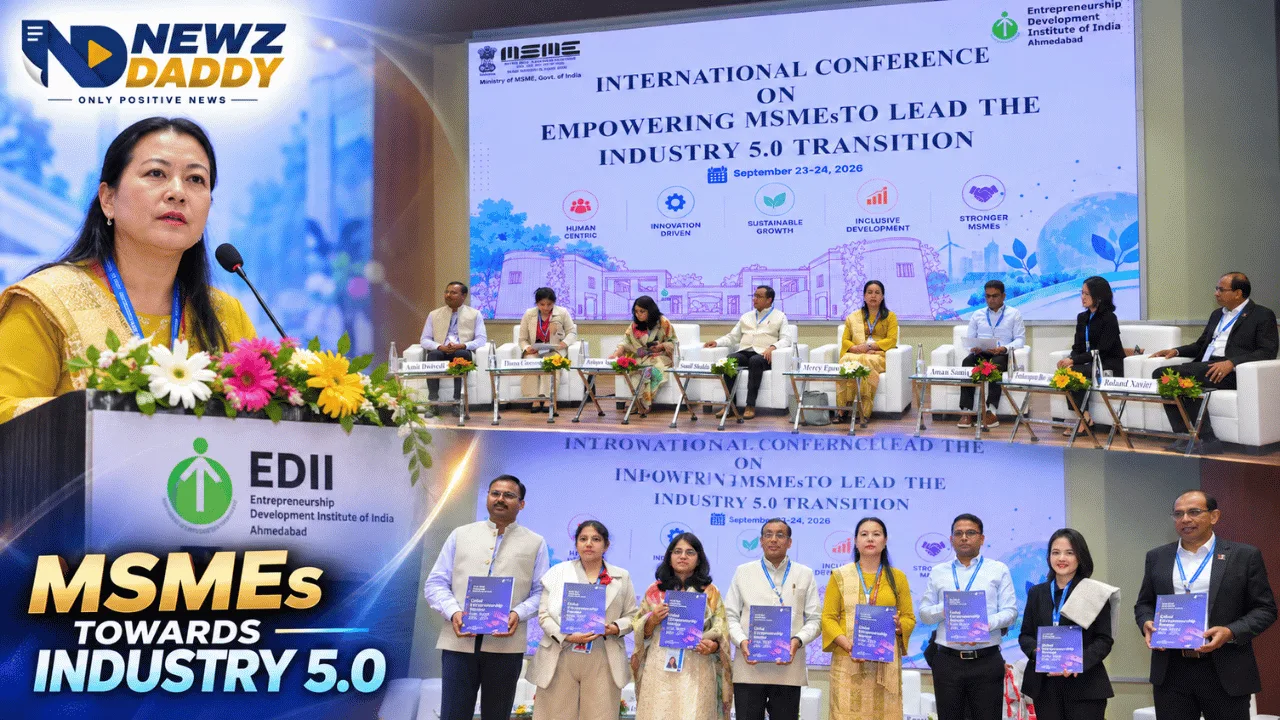
The Entrepreneurship Development Institute of India (EDII), Ahmedabad, has opened a two-day international conference examining how micro, small and medium enterprises can prepare for the next phase of industrial change.
The conference, titled ‘Empowering MSMEs to Lead the Industry 5.0 Transition’, is being held on September 23 and 24 with support from the Ministry of Micro, Small and Medium Enterprises, Government of India.
The meeting comes as smaller businesses face growing pressure to adopt digital tools, improve productivity and deal with supply-chain risks while also responding to changing environmental and workforce needs.
Industry 5.0 is generally described as a development beyond the Industry 4.0 focus on automation and digital technology. The European Commission defines it around three broad areas: human-centred production, sustainability and resilience. It also places greater attention on the relationship between people and technologies such as artificial intelligence and robotics.
For Indian MSMEs, the subject has practical importance. The Ministry of MSME says the sector accounted for 31.1% of India’s GDP in FY2023-24. Government data also puts the number of registered MSMEs at 81.9 million under Udyam and Udyam Assist as of April 2026, with the sector accounting for 48.58% of foreign trade in FY2024-25.
The Ahmedabad conference was inaugurated on September 23 in the presence of Mercy Epao, Joint Secretary, Ministry of MSME and a member of the EDII Governing Board; Kshipra Agre, IAS, Commissioner, MSME, Industries and Mines Department, Government of Gujarat; Aman Samir, IAS, Director, MSME, Department of Industries, Government of Bihar; and Dr Sunil Shukla, Director General, EDII.
Epao said MSMEs need supportive policies and conditions that allow them to grow. She said businesses also need to understand emerging technologies while keeping people, sustainability and resilience at the centre of their growth.
“MSMEs are the key to growth for any nation. They have to be nurtured through enabling policies and a supportive ecosystem to ensure their growth, which ultimately contributes to the growth of the national economy. As the world moves towards Industry 5.0, it is important for MSMEs to understand and embrace emerging technologies while keeping people, sustainability and resilience at the centre of their growth. I am sure this conference will serve as a crucial platform for sharing best practices, exploring new opportunities and building meaningful associations, leading to a strong foundation for the growth and competitiveness of MSMEs.”
Agre focused on the skills and knowledge needed by entrepreneurs. She said stronger entrepreneurial ability can help MSME owners contribute to economic growth and create businesses that can withstand changes.
“Entrepreneurial proficiency is a key factor for MSME entrepreneurs aiming to contribute significantly to economic growth. A higher entrepreneurial quotient among entrepreneurs strengthens the business ecosystem and creates a resilient and sustainable model for growth. This conference is a significant step towards creating knowledge infrastructure in the domain of MSMEs and Industry 5.0. This initiative will facilitate experience sharing and mutual learning.”
For Bihar’s MSME sector, Aman Samir pointed to technology adoption and access to changing value chains as key issues.
“The transition towards Industry 5.0 presents significant opportunities for MSMEs to enhance their productivity, competitiveness and resilience. It is important to create greater awareness about emerging technologies and facilitate their adoption by enterprises, particularly those seeking to scale and integrate into the evolving value chains. The conference is planned well to provide an opportunity for policymakers, industry and entrepreneurs to exchange experiences and identify practical and scalable approaches.”
Dr Sunil Shukla said India already has several schemes and policies aimed at supporting MSMEs. He linked the Industry 5.0 discussion to the combined role of technology, human skills and sustainability.
“MSMEs have come to play a vital role in the development of economies across countries. India has several beneficial MSME-related schemes and policies and is constantly seeking to institute ways and means to strengthen the sector. The transition to Industry 5.0 brings together technology, human capabilities and sustainability, creating new possibilities for MSMEs. This international conference is very well represented and will certainly facilitate meaningful dialogue and knowledge exchange in this realm.”
The move towards Industry 5.0 raises a different question from simply whether a company can buy new technology. For smaller firms, the cost of technology, availability of skilled workers, access to finance and the ability to use new systems effectively can determine whether digital investment delivers results.
The Union government’s Raising and Accelerating MSME Performance (RAMP) programme, supported by the World Bank, includes technology upgradation among its objectives. The five-year programme for FY2022-23 to FY2026-27 has a total project cost of ₹6,062.45 crore, including ₹3,750 crore in World Bank support.
Gujarat also has schemes covering areas such as capital investment, interest support, quality certification, technology-related equipment and skill development for MSMEs.
Against this background, the Ahmedabad conference is bringing together policymakers, entrepreneurs, academics, technology specialists and industry representatives. According to EDII, 120 delegates from three countries and six Indian states are taking part.
International speakers include Diana Cisneros, Chief Operating Officer of Hero Startup, Peru, who is speaking on digital twins and supply-chain disruption; Prof. Siri Roland Xavier, Professor and Programme Director at Tun Razak Graduate School, Unirazak, Malaysia, whose session focuses on next-generation innovation and Industry 5.0; and Dr Patcharaporn Boonyos (Mo), Business Service Development Expert at ISMED and a business consultant from Thailand, who is addressing the use of AI with human control.
The programme also includes sessions and panel discussions involving Dr Anand Bhadalkar, Director, Savli Technology & Business Incubator, Government of Gujarat; Dr Jaimin R. Vasa, Chairman and Managing Director of Vasa Pharmachem and Vasa Wellness; Chhail Khalsa, Founder and Creative Principal, Anuvad Innovation Studio LLP; Hunny Bhagchandani, Founder of Torchit; and Nirav Galaiya, Vice President of Impel Intralogistics.
Other participants include Dr Ravindra Raj BM, Founder and Managing Director of Omspace Rocket and Exploration Pvt. Ltd.; Sunil Mainani, Chief Executive Officer of Aronec FinWise Pvt. Ltd.; Vaibhav Shitole, Founder and CEO of IOTA Diagnostic; Vijaysinh Rahevar, Founder of Mindstein Technology Pvt. Ltd.; and Yash Patel of SixD Engineering Solutions Pvt. Ltd.
The wider Industry 5.0 debate has been developing internationally for several years. The European Commission began framing the concept in 2021 as a way to complement Industry 4.0 by giving greater weight to worker wellbeing, environmental limits and industrial resilience. Its 2024 roadmap also called for research and innovation that keeps people at the centre of manufacturing.
For Indian MSMEs, the debate now moves closer to the factory floor and the business office. The question is how small and medium firms can adopt useful technologies, train their workers and remain competitive without losing sight of the human and environmental factors that Industry 5.0 places at the heart of industrial development.
Must Read:
EDII Lecture: Local Enterprise Gets Focus in Ahmedabad Now