


Adani University MBA in Infrastructure Management Begins
Former Gujarat IAS Officer Urges Adani University Students to See Infrastructure as a Driver of India’s Future
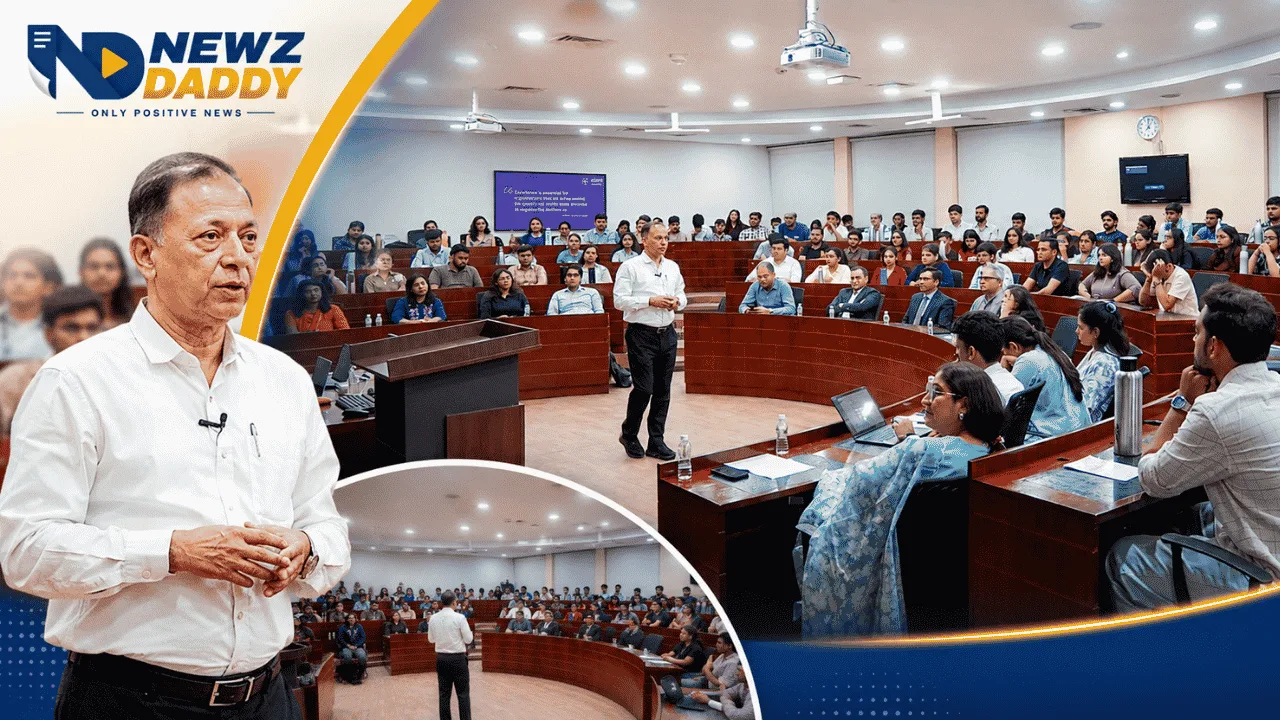
Former Gujarat Additional Chief Secretary Jagdish Prasad Gupta, IAS (Retd.), addressed 120 students of Adani University’s newly admitted MBA in Infrastructure Management (2026 to 2028) programme, sharing lessons from more than three decades in public administration and explaining why infrastructure will play a central part in India’s development over the coming decades.
The interaction formed part of the Adani University’s orientation programme and brought together students preparing for careers in infrastructure planning, policy and management. During the session, Gupta spoke about governance, public administration and the role that transport, utilities, finance and urban development have played in India’s economic growth.
Referring to the national goal of becoming a developed country by 2047 under the Government of India’s Viksit Bharat vision, Gupta said long-term investment in infrastructure can strengthen the economy, improve public services and raise the country’s global competitiveness. He encouraged students to think beyond engineering projects and view infrastructure as an important public asset that affects people’s daily lives.
Drawing on international examples, he told students, “Leadership provides direction, but infrastructure builds nations,” urging them to recognise that roads, ports, airports, power systems, digital networks and public facilities support both economic activity and social progress.
Gupta served the Government of Gujarat for more than 34 years and worked in several important departments, including finance, taxation, healthcare, water management, infrastructure development and e-governance. During his career, he was associated with major administrative reforms that shaped Gujarat’s economic and investment landscape.
Among the important initiatives discussed during the session was Gujarat’s transition to the Value Added Tax (VAT) system before India adopted the nationwide Goods and Services Tax (GST) in July 2017. The GST replaced many indirect taxes with a single tax framework intended to simplify taxation and improve the movement of goods across states. Gujarat was one of the states that played a significant role in implementing these reforms because of its large manufacturing and trading base.
Gupta also referred to projects that have become closely linked with Gujarat’s development story, including Gujarat International Finance Tec City (GIFT City), the Statue of Unity at Kevadia and the Vibrant Gujarat Global Summit.
GIFT City, located between Ahmedabad and Gandhinagar, was established as India’s first operational International Financial Services Centre. It was created to attract global financial institutions, insurance companies, fintech firms and investment businesses while providing a regulatory environment designed for international financial services. Over the past decade, the project has expanded steadily and is now home to banks, stock exchanges and technology companies operating in the financial sector.
The Statue of Unity, dedicated to India’s first Deputy Prime Minister Sardar Vallabhbhai Patel, opened in 2018 and stands at 182 metres, making it the world’s tallest statue. Besides becoming a major tourist destination, it has helped increase tourism and economic activity in the surrounding region.
Another initiative mentioned was the Vibrant Gujarat Global Summit, launched in 2003 as an investment promotion event. Over the years, it has attracted participation from governments, multinational companies, industry leaders and investors from around the world. While investment commitments announced during such summits do not always translate fully into completed projects, the event has remained one of Gujarat’s best-known platforms for business engagement.
During the discussion, students questioned Gupta about public policy, leadership, infrastructure planning and the challenges involved in delivering large public projects. Topics included balancing economic development with administrative efficiency, improving governance systems and preparing future professionals for increasingly complex infrastructure needs.
India’s infrastructure sector has expanded rapidly during the past decade through investment in highways, freight corridors, renewable energy, airports, metro rail systems and digital connectivity. According to government policy documents, infrastructure development is expected to remain one of the country’s major economic priorities as India works towards its long-term growth targets.
Business groups and educational institutions have also increased their focus on specialised training for infrastructure management as demand grows for professionals who understand finance, policy, engineering, sustainability and project execution. Programmes such as Adani University’s MBA in Infrastructure Management aim to prepare graduates for roles across public agencies, infrastructure companies, consulting firms and financial institutions involved in large development projects.
The interaction followed the university’s orientation programme held the previous week, during which Adani University President Dr Priti Adani addressed the incoming batch. She encouraged students to combine professional competence with integrity, compassion and a sense of responsibility towards society.
Universities across India have increasingly invited retired civil servants, industry executives and policy experts to interact with students as part of orientation and leadership programmes. Such sessions are intended to expose students to practical experience that complements classroom learning and gives them a better understanding of how public policy and industry operate together.
For students beginning careers in infrastructure management, Gupta’s address offered a practical account of how government policy, economic planning and public administration have influenced Gujarat’s development and continue to shape India’s future infrastructure ambitions.
Must Read:
Dr Priti Adani Inspires India’s Future Leaders with Purpose
Dr. Priti Adani Honoured with Second Doctorate for Social Impact