


Vadodara Exports in Focus at 2026 EXIM Conclave
Vadodara trade meet puts engineering, chemicals and MSME exports in focus
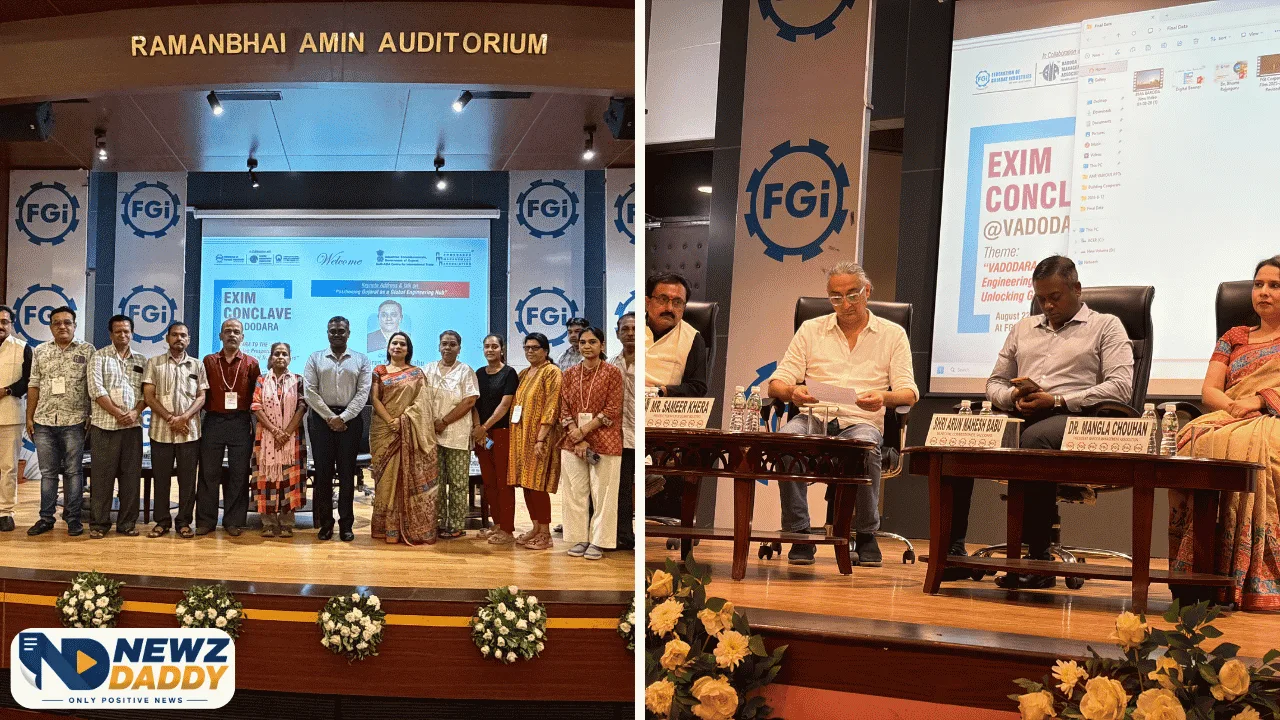
The role of Vadodara and Gujarat’s industrial districts in India’s overseas trade came under discussion at a two-day exhibition and export-import conference held at the Federation of Gujarat Industries (FGI) Business Centre in Vadodara.
The Ahmedabad Management Association (AMA), through its GoG-AMA Centre for International Trade, organised the One District One Product (ODOP) Exhibition and EXIM Conclave 2026 in association with FGI, Baroda Management Association (BMA) and the Quality Council of India (QCI).
The exhibition ran from Friday, August 21, to Saturday, August 22. It brought district-level products into the same setting as discussions on export rules, free trade agreements, quality certification, digital sales and the problems faced by small businesses seeking overseas buyers.
The central theme of the conference was “Vadodara to the World: Engineering Prosperity, Unlocking Global Trade Corridors.”
For Vadodara, the subject has a strong industrial base. A district export action plan prepared under the Districts as Export Hubs programme describes the city’s industrial mix as covering chemicals and fertilisers, pharmaceuticals, biotechnology, textiles, machine tools, glass, engineering and other manufacturing activities. It also lists more than 18,000 small-scale industrial units in the district.
The district administration also lists petrochemicals, engineering, chemicals, pharmaceuticals and plastics among Vadodara’s major industries. The city sits on the Delhi-Mumbai rail and highway routes, giving manufacturers access to major markets within Gujarat and beyond.
The conference opened with a keynote address by Arun Mahesh Babu, M.S., IAS, Municipal Commissioner, Vadodara. His address was titled “Positioning Gujarat as a Global Engineering Hub.”
Unmesh Dixit, Executive Director of Ahmedabad Management Association; Sameer Khera, President of the Federation of Gujarat Industries; and Dr Mangla Chouhan, President of the Baroda Management Association, delivered the welcome address.
A panel discussion then examined the prospects for engineering and chemical manufacturers seeking overseas markets. Vikram Singhal, Managing Director of Gulbrandsen Technologies (India) Pvt. Ltd., and Ujjval Shah, Director of Prakash Chemicals International Pvt. Ltd., took part in the session titled “The Global Blueprint: Taking District Engineering & Chemical Clusters to the World”. Priyanka Verma, Deputy Secretary General of FGI, moderated the discussion.
The focus on engineering exports comes at a time when engineering products remain one of India’s largest merchandise export groups. The Department of Commerce reported that engineering exports rose 4.25 per cent to US$79.74 billion during April to November 2025-26, compared with US$76.49 billion during the same period a year earlier. Engineering goods accounted for 27.30 per cent of India’s merchandise exports during that period.
Vadodara’s export profile has room for further expansion. NITI Aayog’s Export Preparedness Index 2022 identified textiles as the district’s principal export product at that time, with Vadodara accounting for 1.01 per cent of India’s district-level exports in the data used for the index.
More recent district export work points to a broader industrial base. The Vadodara export action plan identifies engineering, chemicals and pharmaceuticals among the district’s major industrial clusters. It also notes the presence of several industrial estates, including Makarpura, Nandesari, Waghodia, Savli and Savli Biotech Park.
Another session at the conference dealt with quality requirements for overseas trade. Dr Bhumi Rajyaguru, Joint Director, National Accreditation Board for Testing and Calibration Laboratories (NABL), Quality Council of India, spoke on “Navigating NABL Accreditation for Global Market Entry.”
NABL’s accreditation system is linked with international accreditation arrangements. Its current general information document says NABL is a full member of the Asia Pacific Accreditation Cooperation and the International Laboratory Accreditation Cooperation, with mutual recognition arrangements covering areas such as testing and calibration.
For exporters, such recognition can matter because buyers and regulators in other countries may require test reports and certificates from recognised laboratories. NABL states that reports from accredited conformity assessment bodies can receive wider acceptance through international mutual recognition arrangements.
Trade agreements formed another part of the programme. Ankit Majmudar, Founder and CEO of Global Business Solutions and AMA EXIM Faculty, conducted a masterclass titled “The New Trade Paradigm: How Recent FTAs Level the Playing Field for Indian Businesses.”
India has been expanding its network of trade agreements, including agreements with the UAE and Australia, while also working on further trade arrangements. The Department of Commerce has said that better use of existing FTAs and new agreements are part of the country’s wider export strategy.
For smaller companies, however, overseas trade can involve paperwork, financing, logistics, standards and changing rules. These issues were taken up by Pranav Doshi, Senior Vice President, FGI and Director, Urja Power Pvt. Ltd., and Ketan Parikh, Partner, SD Intermediate, during a panel titled “Breaking the Border Friction: Opportunities for MSMEs Navigating Fragmented Global Trade”. Manisha Thaker, Vice President of TRIALLIANCE Global Solutions, EXIM Faculty, AMA Trainer and Logistics Expert, moderated the session.
The focus on smaller exporters comes against a wider national push to increase their role in foreign trade. The Ministry of MSME currently reports that micro, small and medium enterprises accounted for about 45 per cent of India’s goods and services exports in FY 2022-23.
The final special session turned to online commerce and artificial intelligence. Rutvij Vora, Co-Founder and CEO of Satark AI, and Pooja Sant, Manager, Inside Sales at Logibeats Freight Services Pvt. Ltd., discussed “Leveraging E-Commerce, Digital Marketplaces, and AI for Export Promotion”.
The ODOP exhibition gave the trade discussions a district-level focus. The national ODOP programme, run by the Department for Promotion of Industry and Internal Trade, seeks to identify, brand and promote at least one product from each district. The programme says 1,244 products have been identified across 773 districts, with support including exhibitions, capacity-building programmes, e-commerce onboarding and international buyer-seller activities.
Gujarat was among the states brought into the national ODOP programme through cooperation between DPIIT and the state government. In 2023, the government said Gujarat’s ODOP collection covered 68 products across its districts, including agricultural goods and traditional crafts.
The Vadodara conference therefore placed two related questions before local businesses: how district products can find buyers outside India, and what manufacturers must do to meet the standards and trade conditions of those markets.
The programme ended with the concluding remarks and vote of thanks after the session on e-commerce, digital marketplaces and AI.