


Anil Bhardwaj Speaks on India’s Space Journey at GLS University
At GLS University, Anil Bhardwaj asks students to keep questioning
India’s progress in space science has been built through years of research, repeated experiments and the willingness to work through failure. Those themes came up during a conversation with Prof. Anil Bhardwaj, Director of the Physical Research Laboratory (PRL), Ahmedabad, at GLS University on Tuesday.

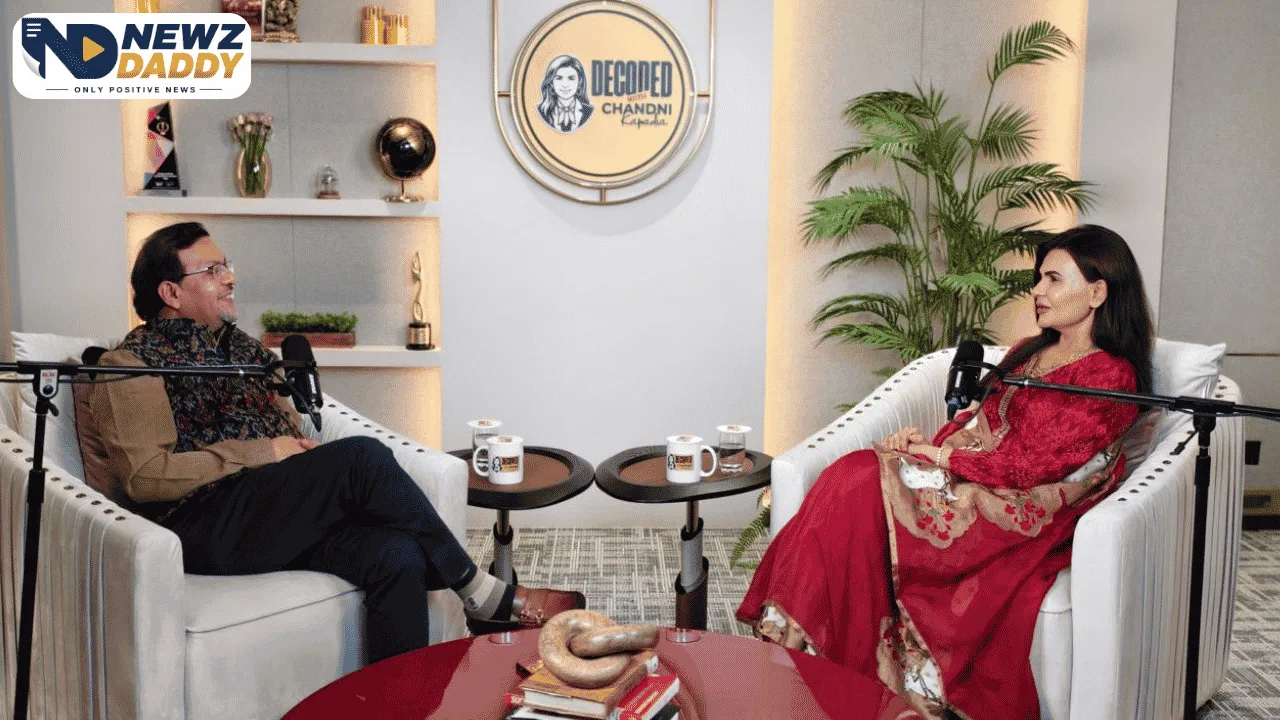
Bhardwaj was the guest on the latest edition of “Decoded with Chandni Kapadia”, a conversation series hosted by Dr Chandni Kapadia, Executive Director of GLS University. The session covered his career in space and planetary science, India’s space missions, scientific research, risk, failure and the role of young people in shaping future research.
For Bhardwaj, the interest in space began with physics and eventually led to a career that has included work on several Indian planetary missions. He completed his M.Sc. at Lucknow University in 1987 and his PhD at the Indian Institute of Technology, Banaras Hindu University, in 1992. He joined the Indian Space Research Organisation (ISRO) in 1993 at the Space Physics Laboratory of the Vikram Sarabhai Space Centre in Thiruvananthapuram. He later headed its Planetary Science Branch and served as director of the laboratory from 2014 to 2017. He has been director of PRL since 2017.
His work has taken him beyond India as well. Bhardwaj spent about two years at NASA’s Marshall Space Flight Centre in the United States during 2004 and 2005 as a National Academy of Sciences senior research associate. His research covers planetary and space sciences, solar system exploration and the study of space environments.
His research has also been closely linked with India’s planetary missions. He was the principal investigator for the SARA experiment on Chandrayaan-1 and the MENCA experiment on the Mars Orbiter Mission, better known as Mangalyaan. His teams have also worked on instruments flown on later Indian planetary missions.
The discussion of Mangalyaan provided an example of how India has approached difficult space missions with limited resources. ISRO launched the Mars Orbiter Mission on November 5, 2013. The spacecraft successfully entered Mars orbit and continued collecting scientific data for more than eight years, well beyond its planned six-to-10-month mission life.
For students, the point was less about the record itself and more about the work behind it. Bhardwaj spoke about problem-solving, teamwork and the need to keep looking for answers when a mission presents an unexpected problem.
That question of risk became more personal when the discussion turned to Chandrayaan-2. The mission was launched on July 22, 2019, carrying an orbiter, the Vikram lander and the Pragyan rover. During the landing attempt on September 7, communication with Vikram was lost when it was about 2.1 km above the lunar surface. ISRO later confirmed that the orbiter remained operational and continued its scientific work.
The experience became an important lesson in dealing with uncertainty. Scientific research involves outcomes that cannot always be known in advance. The discussion stressed the value of supporting research teams when experiments fail and giving scientists room to learn from difficult results.
India’s subsequent lunar progress added another chapter to that story. On August 23, 2023, Chandrayaan-3’s Vikram lander made a successful soft landing on the Moon, followed by the deployment of the Pragyan rover. The mission carried out experiments including measurements of near-surface plasma, lunar soil temperature and the presence of mineral elements.
The conversation also moved beyond individual missions. Bhardwaj spoke about what India should aim for after its achievements in lunar and Martian exploration. He stressed the need to encourage young researchers to take on difficult scientific problems and to build a stronger research culture.
That focus fits the wider work of PRL, which operates as an autonomous unit of the Department of Space and conducts research in areas including astronomy and astrophysics, planetary science, solar physics, space and atmospheric sciences, geosciences and theoretical physics. Its Thaltej campus in Ahmedabad hosts the PLANEX planetary exploration programme.
Another part of the discussion dealt with the difference between belief and evidence. Questions around astrology and traditional beliefs led to a wider discussion on scientific thinking. Bhardwaj stressed the value of questioning claims, making observations and using evidence when reaching scientific conclusions.
The conversation also touched on humanity’s interest in the Moon, Mars and other planets. Bhardwaj linked that interest with the need to care for Earth. Space research can help people understand planets and their environments, while research on Earth remains essential to understanding the conditions that support life.
Bhardwaj has spent more than three decades working in India’s space research system and has received several major honours, including the Shanti Swarup Bhatnagar Prize in 2007 and the Infosys Prize in 2016. ISRO gave him its Outstanding Achievement Award in 2017. In 2024, he received the Vikram Sarabhai Medal of the Committee on Space Research and the Basic Sciences Section Award of the International Academy of Astronautics.
His work has also included public outreach. PRL says he has delivered more than 100 lectures and interacted with more than 100,000 school and college students and teachers.
At GLS University, the conversation ended with questions from students on science, leadership, innovation and future research. Kapadia said such interactions can help students learn from people working outside the usual classroom setting.
The message Bhardwaj left with the students was simple:
“Science is driven by curiosity. The questions we ask today become the discoveries of tomorrow. Exploration is not only about reaching new worlds; it is also about expanding our understanding of ourselves and the universe around us.”
For students considering a career in science, the discussion offered a practical lesson: major discoveries often begin with a question, but answering that question can take years of study, testing and persistence.
Must Read:
GLS University Decoded with Dr. Chandni Kapadia Inspires Students
Jay Thadeshwar at GLS University Inspires Future Storytellers