


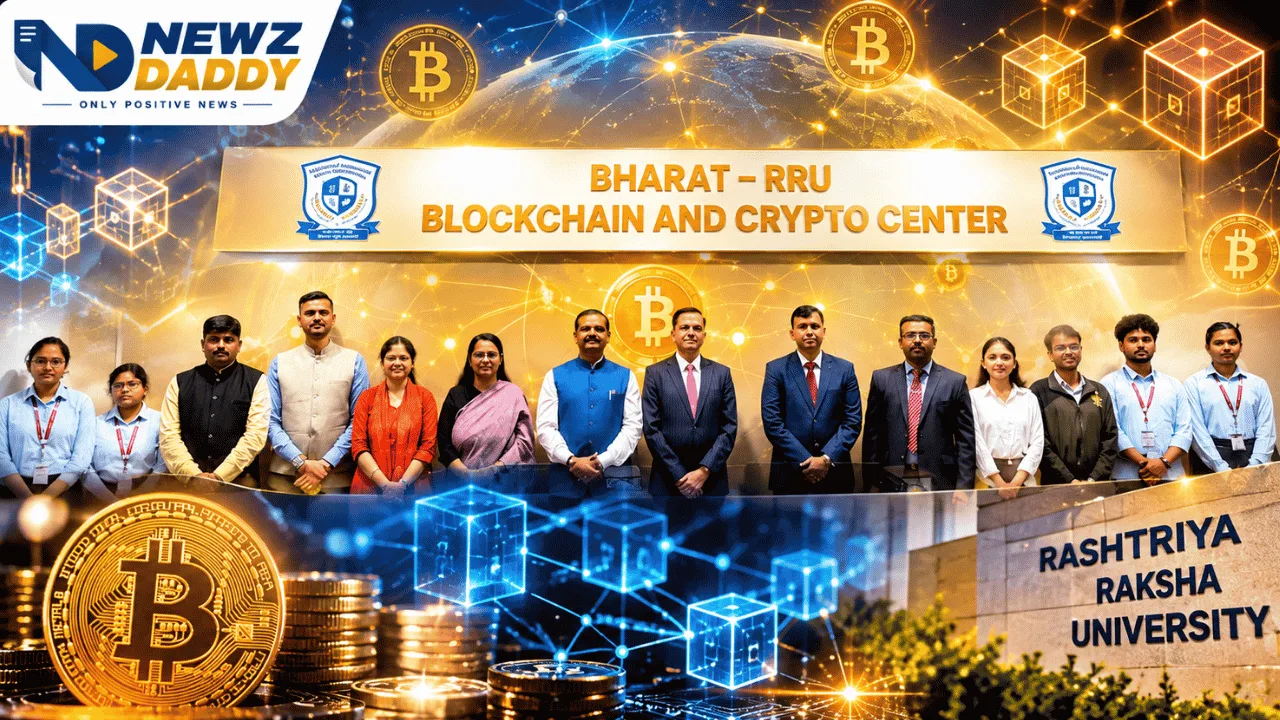
Blockchain Centre Opens at RRU in Gandhinagar for Investigators
RRU Opens Blockchain and Crypto Centre in Gandhinagar to Train Investigators and Researchers
RRU opens blockchain and crypto centre in Gandhinagar to train investigators and researchers
Rashtriya Raksha University (RRU) has inaugurated the Bharat-RRU Blockchain and Crypto Centre (BRBCC), a new centre for research, education and specialist training in blockchain technology, cryptocurrency and digital-asset investigations.
The centre will offer case-based courses for police officers, financial investigators, prosecutors and technical professionals. Its proposed academic pathway will range from short-term certificate courses to MSc/MTech degrees, PhD programmes and post-doctoral research.
RRU also plans to develop home-grown tools to trace cryptocurrency transactions and examine blockchain records. The work is intended to strengthen India’s investigative resources and reduce dependence on tools developed outside the country.
The announcement comes as Indian authorities face a growing need to trace money moved through digital currencies, including funds linked to online fraud, ransomware attacks and money laundering. Such investigations often involve transactions across several countries, making technical expertise and cooperation between agencies important.
Blockchain is a digital record of transactions maintained across a network of computers. Many public blockchains allow people to examine transaction records without needing permission from a central authority. Cryptocurrency transactions can therefore leave a trail that investigators may study.
However, finding a transaction does not automatically reveal the identity of the person behind it. Investigators may need to connect wallet addresses with exchange accounts, bank transfers, seized devices and other evidence. Some cases involve several wallets, overseas services or methods intended to hide the movement of funds.
These difficulties make specialist training useful for police and financial investigation teams. Officers need to understand how digital assets move, how to record their findings and how to preserve evidence for legal proceedings.
India has already taken steps to bring virtual digital asset service providers within its anti-money laundering system. The Financial Intelligence Unit-India (FIU-IND), under the Ministry of Finance, receives and examines reports of suspicious financial activity and shares relevant information with enforcement agencies. Its rules require covered virtual digital asset service providers to meet reporting and compliance duties under the Prevention of Money Laundering Act, 2002.
The Directorate of Enforcement has also investigated cases involving cryptocurrency and alleged financial crime. Its annual report for 2025-26 describes work involving crypto-assets and money laundering. These cases show why investigators need to understand both blockchain records and conventional financial transactions.
The Bharat-RRU Blockchain and Crypto Centre will focus on cryptocurrency tracing, wallet and transaction analysis, the movement of illicit funds, ransomware payments and crimes linked to the dark web. Its work will also cover the seizure of virtual assets, the handling of digital evidence, anti-money laundering investigations and risks linked to Web3 technologies.
Training will include practical exercises, simulated cases and laboratory-based learning. These activities are intended to help participants examine transaction trails, map the movement of funds and study possible links between digital wallets and suspected offenders.
The centre’s research programme is expected to cover blockchain intelligence, crypto-asset tracing, decentralised finance, tokenisation and security risks linked to digital assets. Tokenisation refers to representing ownership or rights to an asset through a digital token. Decentralised finance uses blockchain-based systems to provide financial services, often without a traditional central intermediary.
RRU plans to bring government departments, regulators, universities, technology firms, financial institutions and overseas partners into discussions and joint research. The centre may also support international police bodies through training, expert exchanges, research meetings and simulated exercises involving cross-border investigations.
RRU is an Institution of National Importance established under the Rashtriya Raksha University Act, 2020, and operates under the Ministry of Home Affairs. Located in Gandhinagar, Gujarat, the university focuses on national security, policing, law enforcement and related fields.
Its existing areas of work include cyber security, digital forensics, cybercrime investigation, cryptology, artificial intelligence and machine learning, dark web research, open-source intelligence (OSINT), Internet of Things security, cyber defence and digital evidence analysis.
The new centre will extend this work to blockchain systems and digital assets. Its proposed role includes academic research, professional training, policy studies and the development of investigative methods that can be tested and assessed by relevant agencies.
The centre is also expected to support existing forensic laboratories and cybercrime units. It could contribute through training material, standard operating procedures, case studies and research for practitioners. Its work will need to fit the legal and technical requirements followed by agencies handling digital evidence.
Students and researchers will be among the intended beneficiaries, with opportunities for specialist courses, workshops, internships and research projects. Government bodies may use the centre for technical studies and advice on the safe use of blockchain-based systems. Legal professionals and prosecutors could also receive training on evidence records, chain of custody and issues related to digital assets.
The centre’s stated purpose is to help India prepare for the risks and uses of digital assets while supporting responsible blockchain adoption. Its progress will depend on the quality of its courses, the usefulness of its research and the extent to which investigators can apply its work in real cases.
For law enforcement, the test will be whether the centre can help officers trace funds more accurately, preserve evidence correctly and build cases that stand up in court. Its planned development of Indian investigative tools will also be worth watching as authorities deal with financial crime involving digital currencies.