


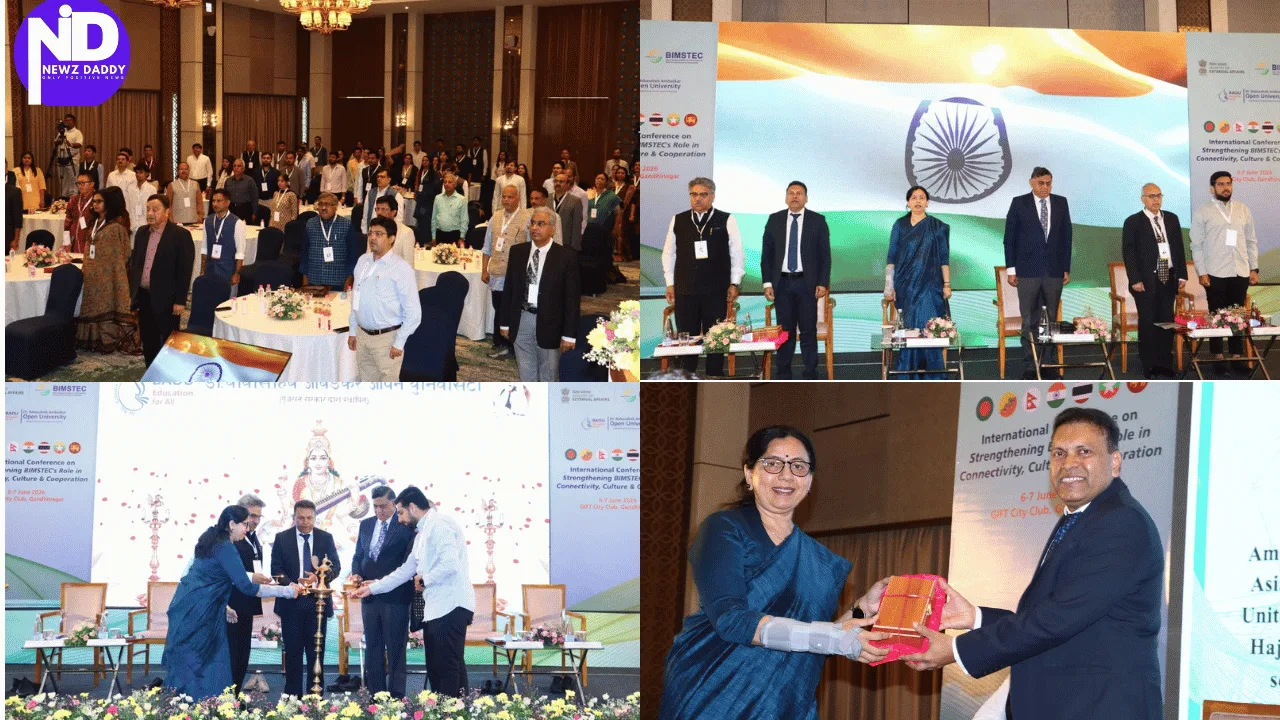
BIMSTEC Conference in Gandhinagar Sparks Hope for Stronger Ties
BAOU Hosts International BIMSTEC Conference to Strengthen Regional Cooperation
An international conference on the theme “Strengthening BIMSTEC’s Role in Connectivity, Culture and Cooperation” was inaugurated on the occasion of BIMSTEC Day 2026. The event was jointly organised by Dr. Babasaheb Ambedkar Open University (BAOU) and the Ministry of External Affairs, Government of India. Representatives from all seven BIMSTEC member countries attended the conference, reflecting the growing importance of regional partnerships in South and Southeast Asia.
The conference comes at a significant time for BIMSTEC. Established in 1997, the regional grouping now connects seven nations around the Bay of Bengal and represents more than 1.7 billion people. Over the years, BIMSTEC has become an important platform for cooperation in areas such as trade, connectivity, technology, education, security and cultural exchange. Recent discussions within the organisation have placed greater focus on digital development, youth engagement and sustainable growth across the region.
In her opening address, BAOU Vice-Chancellor Prof. Ami Upadhyay welcomed the delegates and spoke about the university’s commitment to inclusive, flexible and technology-based education. Her proposal to establish the “BIMSTEC Consortium for Folk Arts and Knowledge Systems” received special attention. Across the BIMSTEC region, traditional art forms, folk music and indigenous knowledge remain an important part of cultural identity. Experts have often stressed that preserving these traditions is necessary while countries move towards rapid modernisation and digital transformation.
The keynote speaker, Dr K.K. Khandelwal, Chief National Commissioner of the Bharat Scouts and Guides, described connectivity, culture and cooperation as the three pillars that can strengthen BIMSTEC. His suggestions, including a BIMSTEC Digital Knowledge Grid, Youth Connectivity Corps and School and University Twinning Programme, reflected a growing trend among regional organisations to use digital tools and educational exchanges to build stronger people-to-people connections. Many international studies have shown that student exchanges and youth partnerships help create long-term cooperation between countries and improve mutual understanding.
Ambassador Sugandh Kumar Rajaram, Joint Secretary in the Ministry of External Affairs and BIMSTEC National Coordinator, presented India’s 21-point Action Plan. The plan includes Centres of Excellence, scholarships, youth exchange programmes, digital public infrastructure projects and joint research networks. In recent years, the digital public infrastructure developed in India has attracted global attention for improving access to services and promoting inclusion. Several countries are now studying similar models to support education, governance and economic development.
Former Ambassador and former Director General of the Indian Council for Cultural Relations, Ambassador Akhilesh Mishra, spoke about BIMSTEC’s strong demographic and economic potential. With one of the world’s largest combined populations and a rapidly growing economy, the BIMSTEC region is increasingly viewed as an important centre of global growth. Analysts have noted that stronger cultural ties can often support economic partnerships by building trust and a deeper understanding among member nations.
In his special address, Ambassador Anil Trigunayat reflected on BIMSTEC’s thirty-year journey and stressed the need to strengthen regional trade, people-to-people connections and transport links. Experts believe that better transport corridors, shipping routes and digital networks can help member countries increase trade and improve economic opportunities. Stronger connectivity has become one of the main priorities of BIMSTEC in recent years.
The programme was attended by BAOU Board of Management members Shri Yatinkumar Patel, Shri Jayeshbhai Patel, Shri Narendrabhai K. Patel, Shri Ashokbhai Mondal and other board members. The event was conducted by Dr. Yesha Bhatt.
At the conclusion of the programme, Prof. Nilesh Modi, Director of BAOU’s School of Computer Science, delivered the vote of thanks and appreciated the contribution of all participants. His remarks reflected the spirit of cooperation that remained central throughout the event.
The discussions during the conference highlighted a shared commitment to strengthening BIMSTEC as a dynamic platform for regional connectivity, cultural exchange and sustainable cooperation. Educational institutions are increasingly playing an important role in supporting regional development by encouraging research, innovation and knowledge sharing across borders.
BAOU also presented itself as an important academic partner in advancing the shared vision of development and progress within the BIMSTEC region. Open and distance learning institutions are becoming increasingly important in expanding access to higher education, particularly for working professionals, rural learners and students who may not have access to traditional universities.
On the second day, discussions will focus on key topics including Peace and Regional Cooperation, Sustainability and Blue Economy, and Education, Human Development and Future Workforce. These themes reflect many of the major challenges and opportunities currently facing the region.
The conference will conclude with a valedictory session at Radisson GIFT City Club, Gandhinagar. According to the BAOU press release, former Ambassador of India to Vietnam Ms Preeti Saran, Honourable Education Minister Dr Pradyuman Vaja, and Vadodara Member of Parliament Shri Hemangbhai Joshi will attend the session as special guests.
The conference has provided an important platform for dialogue, fresh ideas and future partnerships. As BIMSTEC continues to expand its role in regional cooperation, such academic and diplomatic engagements are expected to contribute to stronger ties among member countries and support a more connected and prosperous Bay of Bengal region.
Must Read: