


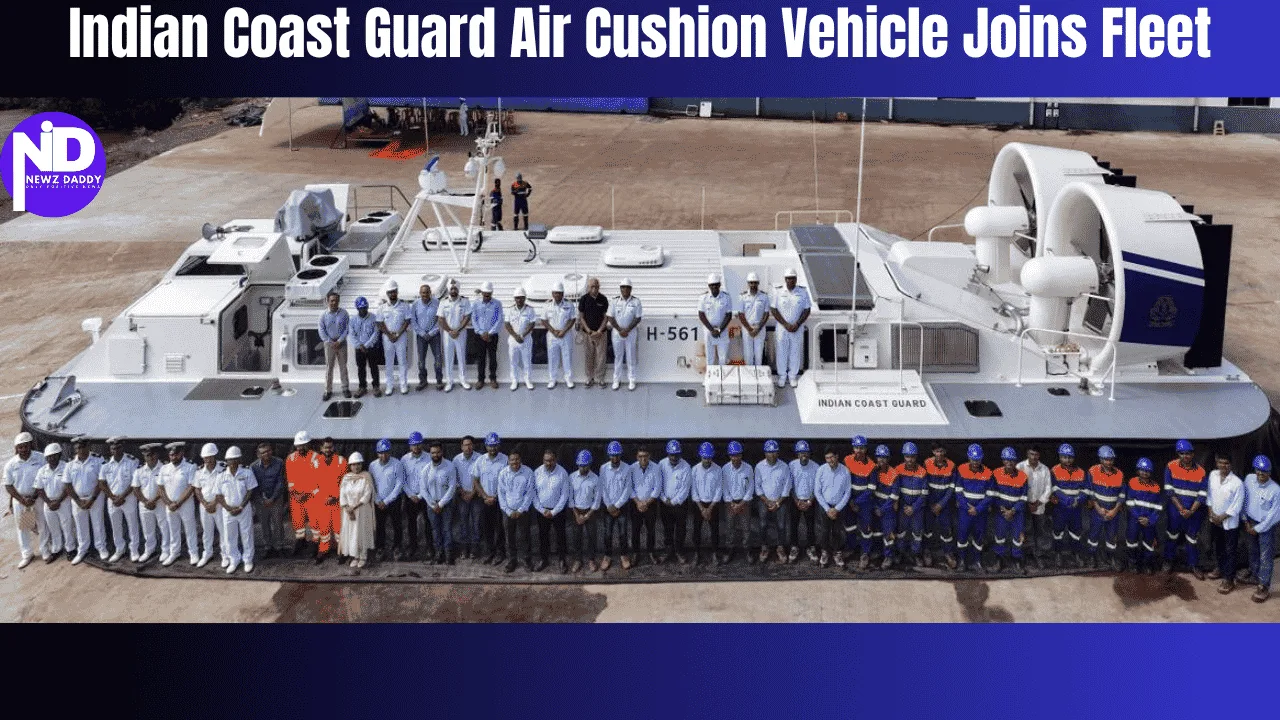
Indian Coast Guard Air Cushion Vehicle Inducted in Goa
Indian Coast Guard Inducts First Indigenous Hovercraft Built in India
The Indian Coast Guard (ICG) has inducted the first of six indigenously built Air Cushion Vehicles (ACVs), commonly known as hovercraft, into service at Goa on 18 June 2026. The vessel, constructed by Goa-based Chowgule & Company Private Limited, marks an important step in India’s efforts to strengthen coastal security using equipment manufactured within the country.
The induction ceremony was attended by senior Indian Coast Guard officers and representatives from the shipbuilding sector. Officials said the hovercraft will support a wide range of maritime operations and improve the force’s ability to respond quickly in coastal and shallow-water environments.
The newly inducted ACV is the first vessel from a fleet of six ordered by the Ministry of Defence under a contract awarded to Chowgule & Company Private Limited. The agreement, valued at ₹387.44 crore, was signed on 24 October 2024 for the construction of six Air Cushion Vehicles for the Indian Coast Guard. The project falls under the government’s Buy (Indian) procurement category and represents the first time such hovercraft are being built in India for Coast Guard service.
Hovercraft occupy a unique position in maritime operations because they travel on a cushion of air rather than directly on land or water. This allows them to move across water, mudflats, marshes, sandy beaches and other difficult coastal terrain where conventional boats may struggle to operate. Such capabilities are especially valuable for a country like India, which has a coastline of more than 7,500 kilometres and faces a range of maritime security, search-and-rescue and law-enforcement challenges.
According to defence officials, the new ACVs are intended for multiple operational roles. These include high-speed coastal patrolling, surveillance and reconnaissance missions, interception of suspicious vessels, search-and-rescue operations and assistance to ships or boats in distress. The hovercraft is also expected to improve access to shallow waters and marshy regions where traditional patrol vessels may be restricted.
The induction comes less than a year after construction activities gathered momentum at Chowgule Shipyard in Goa. In July 2025, the Indian Coast Guard and the shipbuilder marked the start of physical construction of the first indigenous ACV through a girder-laying and erection ceremony. At the time, officials described the programme as a significant step towards strengthening India’s maritime response capability through domestic manufacturing.
The Indian Coast Guard has steadily expanded its fleet and infrastructure over the past decade as India’s maritime responsibilities have grown. Established in 1978, the force is responsible for protecting India’s maritime interests, enforcing maritime laws, conducting search-and-rescue missions, preventing smuggling and supporting marine environmental protection. The organisation also plays an important role during natural disasters and emergency situations at sea.
Recent years have seen increasing attention on coastal security, particularly following lessons learned from past security incidents and the growing strategic importance of the Indian Ocean region. The Coast Guard has consequently invested in new patrol vessels, aircraft, helicopters and surveillance systems. The addition of modern hovercraft is intended to complement these assets by providing rapid mobility in areas where larger vessels cannot easily operate.
Defence planners view hovercraft as particularly useful for missions close to shore. Their ability to move directly from water onto beaches without the need for port facilities allows quicker deployment during emergencies. They can also reach isolated coastal communities during floods and other natural disasters. In search-and-rescue situations, speed often plays a critical role, and hovercraft are capable of reaching affected areas faster than many conventional vessels.
The project also carries significance for India’s defence manufacturing sector. For many years, specialised hovercraft used by Indian maritime forces were sourced from overseas suppliers. Building these vessels domestically is expected to strengthen technical expertise within the country’s shipbuilding industry and reduce dependence on imports.
Government officials have repeatedly linked the ACV programme with the broader Aatmanirbhar Bharat initiative, which seeks to increase domestic production in strategic sectors, including defence. Industry observers note that defence manufacturing projects often create opportunities not only for large shipyards but also for smaller suppliers that provide components, engineering services and specialised equipment. The Ministry of Defence has previously stated that the ACV programme is expected to support indigenous ancillary industries, including small and medium enterprises.
Chowgule & Company Private Limited, the builder of the hovercraft, is a long-established Indian industrial group with interests that include shipbuilding and engineering. The company’s Goa shipyard has constructed a variety of specialised vessels over the years. The ACV programme has expanded its role within India’s defence production network and placed it among the companies contributing to indigenous naval and coast guard capabilities.
Experts point out that the development of indigenous maritime platforms is becoming increasingly important as India seeks greater self-reliance in defence technologies. Building vessels within the country allows greater control over maintenance, upgrades and future modifications. It can also reduce long-term operational costs while creating skilled employment opportunities in the maritime sector.
The induction of the first ACV is expected to be followed by the delivery of the remaining five hovercraft under the contract. Once the full fleet enters service, the Indian Coast Guard will have greater flexibility in conducting patrols, surveillance and rescue missions across diverse coastal environments.
For the Coast Guard, the arrival of the new hovercraft represents both an operational enhancement and a technological milestone. India’s shipbuilding sector, it demonstrates growing capability in producing specialised maritime platforms that were once largely imported. As coastal security and maritime safety continue to gain importance, such projects are likely to play an increasingly visible role in the country’s maritime strategy.
The induction at Goa, therefore, marks more than the arrival of a single vessel. It reflects a broader effort to strengthen coastal preparedness, expand domestic defence manufacturing and equip maritime forces with tools suited to the varied challenges of India’s coastline and surrounding waters.