

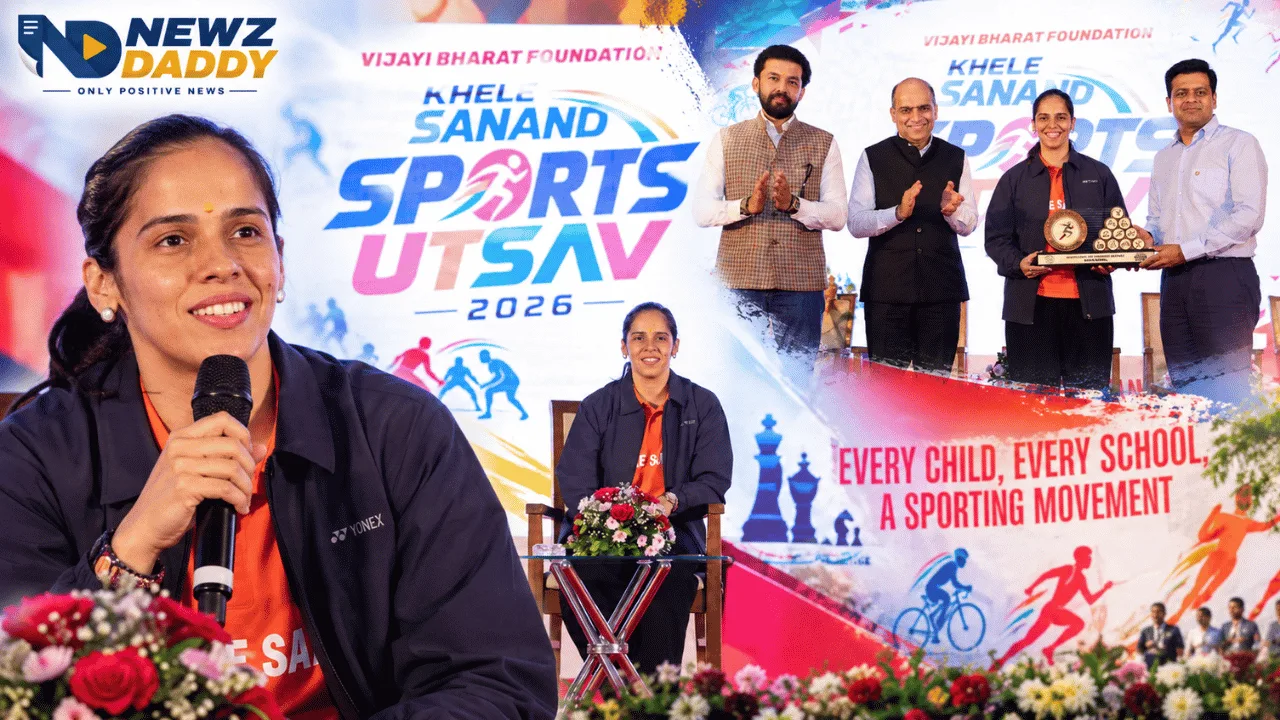
Saina Nehwal Opens Khele Sanand Sports Utsav in Sanand Taluka
Saina Nehwal Opens Khele Sanand Sports Festival for 25,000 Students
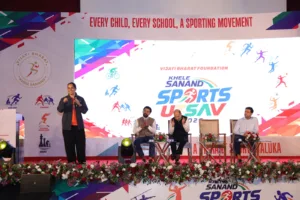
More than 25,000 school students from across Sanand Taluka will take part in an 18-day sports festival that began on Thursday, with Olympic medallist Saina Nehwal opening the event at Sanskardham.
The Khele Sanand Sports Utsav 2026, organised by Vijayi Bharat Foundation (VBF), will run from September 17 to October 7. The programme covers more than 150 schools across all 105 villages of Sanand Taluka.
Students aged between five and 17 will compete in four age groups: Under-8, Under-11, Under-14 and Under-17. Boys and girls will take part in the competitions.
The scale of the programme is notable for Sanand. Earlier Khele Sanand seasons were smaller school-level competitions. According to the Vijayi Bharat Foundation’s current programme information, previous editions involved thousands of players across sports such as kabaddi, kho-kho, volleyball and athletics. Its published records show player numbers rising from 1,840 in the first season to 2,544 in the second, followed by 7,200 participants in the third season.
The 2026 Sports Utsav takes that school sports model to a much larger group of children.
The opening ceremony at Sanskardham was attended by Nehwal and VBF board members Jalaj Dani, Dhanraj Nathwani, Dilip Thaker and Durgesh Agarwal.
Nehwal, who won a bronze medal in women’s singles badminton at the London 2012 Olympics, told the gathering that giving children a chance to play organised sport at a young age can help build confidence and participation. She also said she was pleased to be present at the start of the Sanand programme. The Indian Olympic Association records Nehwal’s London bronze as India’s first Olympic medal in badminton.
“This is a great initiative because it creates an opportunity for children to experience organised sport at a very young age and within their own schools and communities. When an entire taluka comes together to create sporting opportunities for its children, the impact goes beyond competition. It can build confidence, encourage participation and help create a stronger sporting culture from the grassroots. I am very happy to be here as Khele Sanand Sports Utsav begins this journey.”
The festival has 10 sporting disciplines. They include kabaddi, softball throw or kids’ javelin throw, sprint, cycling, kho-kho, chess, standing broad jump, badminton, volleyball and tug of war. A sports quiz has also been included.
The programme will begin with competitions at participating schools. Successful participants will then move into knockout rounds before the final competition at Sanskardham on October 7.
The inclusion of several sports gives children with different abilities a chance to take part. A child who may not be suited to a team sport, for instance, can enter a sprint, jump, throw, cycling or chess competition.
This approach fits into a wider effort in India to increase participation in sport at school and community level. The national Khelo India programme includes sports competitions, talent identification, school fitness and support for rural and indigenous sports. Its current programme describes competition as part of a pathway through which young athletes can be identified and given opportunities to progress.
The government has also expanded the Khelo India programme in 2026. In July, the Union Cabinet approved an expanded scheme and increased support for national sports federations, with a combined allocation of ₹36,441 crore for 2026-27 to 2030-31.
For Sanand, the question will be what happens after the festival ends.
A large competition can identify children who perform well, but continued training, access to facilities and regular competition are needed if those children are to progress. Khele Sanand’s previous records provide examples of that progression. The foundation says the Under-14 girls’ kho-kho team from Telav Village won a zonal bronze medal in 2024, while the Under-14 girls’ kabaddi team from D.G. School, Sanand, became state-level champions in the same year. It also records a district-level Khel Mahakumbh win for the Under-14 girls’ kho-kho team in 2025.
Gagan Narang, an Olympic bronze medallist and adviser to Vijayi Bharat Foundation, said the Sanand programme could help take organised sport into communities that may not normally be seen as major sporting centres. Narang won the men’s 10m air rifle bronze at the London 2012 Olympics.
“India’s sporting future will be shaped by how effectively we take sport beyond the traditional centres of competition and create opportunities for children across every community. What makes Khele Sanand Sports Utsav significant is its scale and its grassroots approach. 105 villages, more than 150+ schools and thousands of children participate within one common sporting framework. When children get an opportunity to compete at this scale, we are not only identifying sporting talent; we are helping build a culture where sport becomes a natural part of growing up. Initiatives like these can play an important role in building the foundation for a stronger sporting India.”
The Sports Quiz adds an academic element to the programme. Students will be asked to engage with sporting knowledge alongside their physical events, giving the festival a place for children who may be interested in sport beyond playing on the field.
VBF’s Khele Sanand programme has previously focused on sports such as kabaddi, kho-kho, volleyball and athletics. Its published programme records also show the expansion of athletics and the addition of competitions for girls in sports that had earlier been offered to boys or open-age groups.
The 2026 festival now brings a much wider group of schools and villages into the competition.
For the children taking part, the first target is simple: compete. For organisers and schools, the larger test will be whether performances during these 18 days lead to regular training and further opportunities for promising young athletes.
The final round of Khele Sanand Sports Utsav 2026 will be held at Sanskardham on October 7.
Must Read:
The Asmita Khelo India Wushu League 2025, hosted by Rashtriya Raksha University