


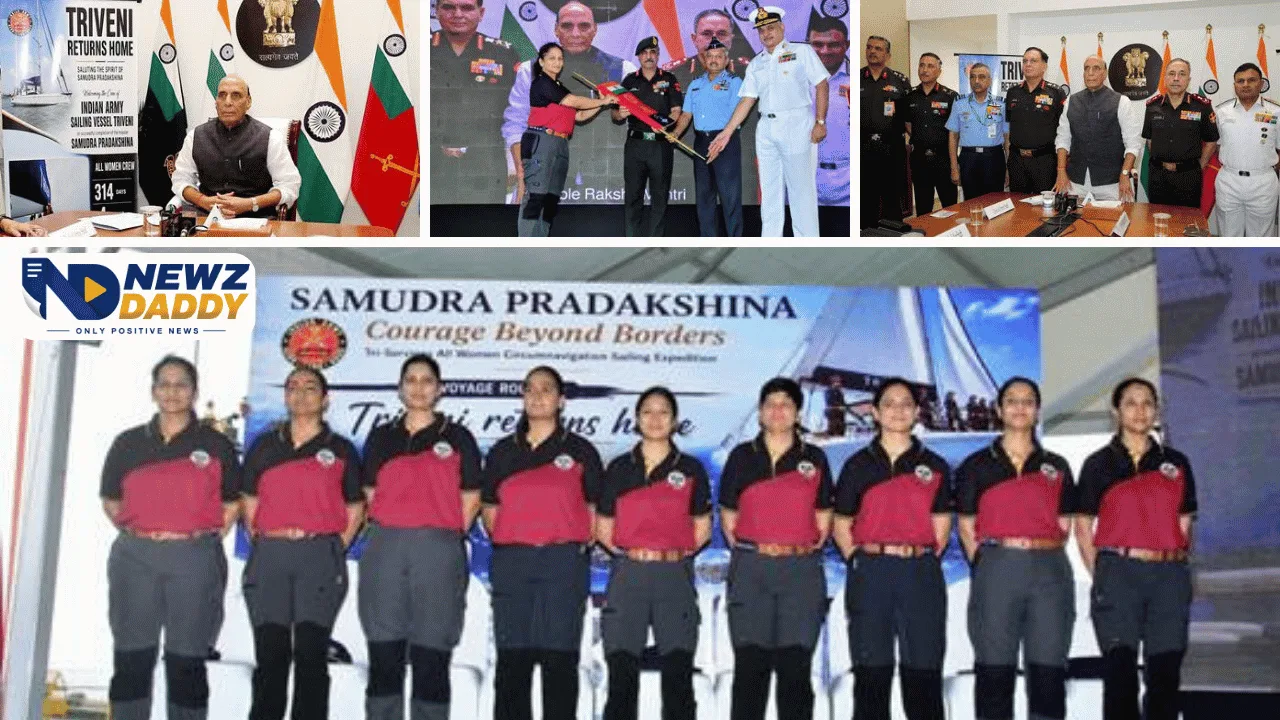
Samudra Pradakshina Ends Historic 314 Day Global Sailing Mission
India’s First Tri-Service All-Women Sailing Crew Returns After Historic Global Voyage
India’s first all-women tri-service sailing expedition has completed a historic journey around the world after spending 314 days at sea and covering nearly 25,500 nautical miles across four oceans. The nine women officers returned to Mumbai aboard the Indian Army Sailing Vessel (IASV) Triveni on 22 July 2026, marking the end of a mission that defence officials say is a milestone for military cooperation, women’s participation in the armed forces and India’s maritime ambitions.
Defence Minister Rajnath Singh formally welcomed the crew through a video conference during a flag-in ceremony. The expedition, named Samudra Pradakshina, had originally departed from Mumbai on 11 September 2025 after being virtually flagged off by the Defence Minister.
The voyage met the internationally accepted standards for a complete circumnavigation of the globe. During the journey, the crew crossed every line of longitude, crossed the Equator twice, sailed across the International Date Line and rounded three of the world’s best-known capes: Cape Leeuwin in Australia, Cape Horn in South America and the Cape of Good Hope in South Africa.
One of the most demanding parts of the expedition came in the Drake Passage, the stretch of water between South America and Antarctica. Strong winds, high waves and unpredictable weather make it one of the most difficult sea routes in the world. By safely rounding Cape Horn, the crew earned membership of the respected international community of Cape Horners, a distinction awarded to sailors who complete one of the toughest passages in global sailing.
Addressing the crew, Rajnath Singh described the expedition as an example of India’s growing confidence and the increasing role of women in national service.
“Ocean waves may rise high, but the spirit of India’s daughters soars higher,” he said.
The Defence Minister also said the mission represented India’s commitment to greater cooperation among the Army, Navy and Air Force. Referring to the expedition, he stated:
“Capability multiplies when there is coordination. Victory paves its own path when the three forces march together.”
The crew included officers from all three branches of the Indian Armed Forces. Living and working together for more than ten months required constant coordination, shared leadership and technical cooperation. Defence planners have increasingly focused on joint operations in recent years as India moves towards integrated theatre commands designed to improve coordination during future military operations.
The expedition itself was the result of nearly two years of preparation. The officers underwent extensive sailing and survival training before departure, while a round-the-clock shore-based support team monitored weather conditions, logistics and communications throughout the mission. Such long-distance ocean voyages require careful planning because crews must handle changing weather systems, equipment maintenance, navigation and medical emergencies while remaining largely self-sufficient for long periods.
Beyond its sailing achievements, the mission also served a diplomatic purpose. IASV Triveni made port calls in several countries during the voyage, where the crew interacted with local authorities, defence representatives and Indian communities. These visits promoted India’s maritime traditions and strengthened military contacts with friendly nations. Defence experts often describe such missions as an important part of defence diplomacy because they help build professional relationships without involving military exercises or combat operations.
Another notable feature of the expedition was the vessel itself. IASV Triveni is a 50-foot sailing boat built in India. Rajnath Singh described the vessel as an example of the country’s growing domestic manufacturing capability.
“The vessel stands as a testament to India’s engineering excellence, indigenous capability, and strategic confidence,” he said.
The project also reflects the wider goals of the Government’s Atmanirbhar Bharat programme, which encourages greater domestic production in sectors including defence manufacturing. India has increased investment in indigenous defence equipment over the past decade, with locally built warships, aircraft, missiles and military systems becoming a larger part of the country’s armed forces.
Women have steadily taken on wider operational responsibilities in the Indian military during recent years. Permanent commissions for women officers have expanded, more combat-related roles have opened, and women now serve in areas that were previously closed to them. The Navy has also increased opportunities in aviation, warship deployment and maritime operations, while the Army and Air Force have widened career options in operational branches.
Although Indian women sailors have previously completed notable offshore expeditions, Samudra Pradakshina is the first global circumnavigation undertaken by an all-women crew representing all three services together. Defence officials consider this joint approach an important step in demonstrating operational integration across the armed forces.
Senior military leaders attended the ceremony from New Delhi alongside the Defence Minister. They included Chief of Defence Staff General Anil Chauhan’s successor General NS Raja Subramani, Chief of the Naval Staff Admiral Krishna Swaminathan, Chief of the Army Staff General Dhiraj Seth, Vice Chief of the Air Staff Air Marshal Ashutosh Dixit and Director General Integrated Training Lieutenant General Ajay Ramdev. Defence representatives from Australia, New Zealand, Argentina and South Africa also attended.
At Mumbai’s Gateway of India, the returning crew received a ceremonial welcome from Lieutenant General Rajesh Pushkar, Air Marshal PV Shivanand, Lieutenant General Vipul Singhal, Vice Admiral Rahul Vilas Gokhale, serving personnel, veterans and the families of the officers.
The completion of Samudra Pradakshina adds another chapter to India’s growing record in long-distance ocean sailing while reflecting broader changes taking place within the armed forces. The expedition combined endurance, navigation, international engagement and military cooperation in a mission that lasted more than ten months and stretched across four oceans before bringing the crew safely back to where the journey began.